

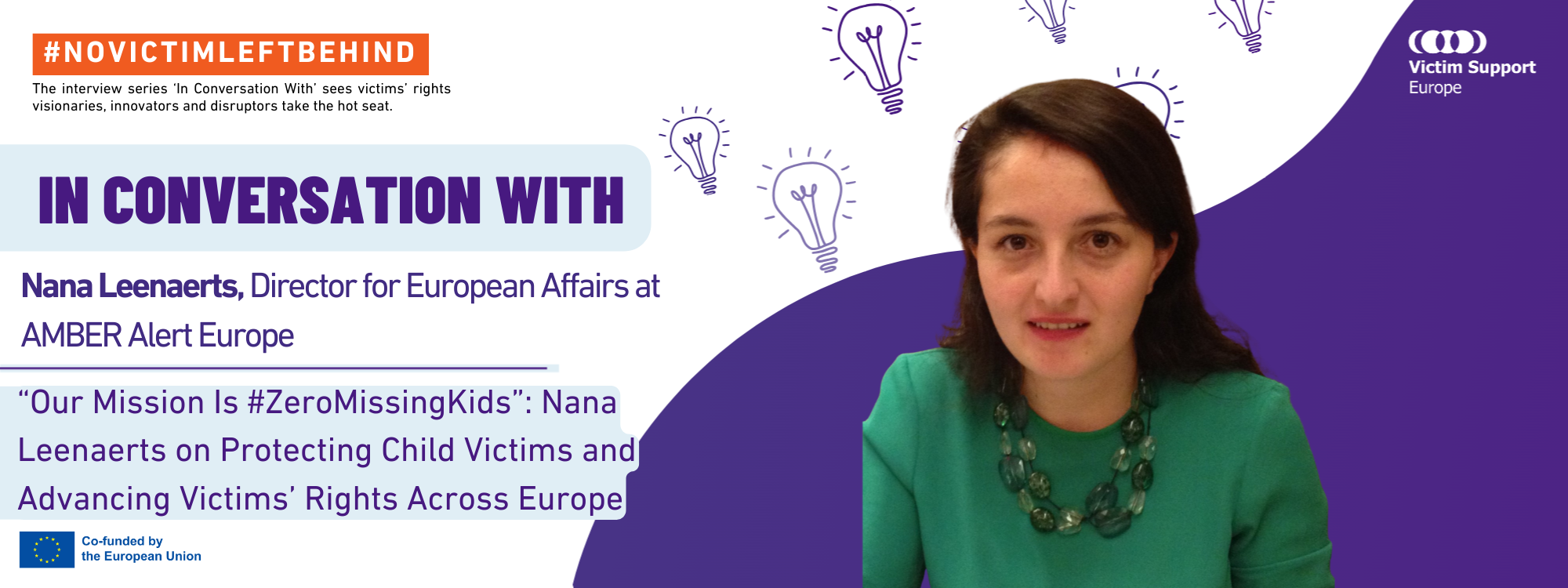
In 2025, Victim Support Europe (VSE) led the Year of Victims’ Rights, a Europe-wide campaign involving VSE members and numerous NGOs working with diverse groups of victims. Among them was AMBER Alert Europe, focusing specifically on protecting and supporting child victims. The campaign highlighted the universality of victims’ rights, promoted inclusive support systems, and advanced long-term policy and legislative goals across the continent.
Against this backdrop, Marina Kazakova from VSE spoke with Nana Leenaerts, Director for European Affairs at AMBER Alert Europe, about the organization’s work, lessons from 2025, and priorities for 2026.
Marina Kazakova, VSE: Nana, how did you come to work at AMBER Alert Europe? What is your role within the organization?
Nana Leenaerts, AMBER Alert Europe: I joined AMBER Alert Europe in January 2023. The newly created role of EU Affairs Coordinator closely aligned with the human rights diplomacy work I had done for years in European capitals. Focusing on children’s fundamental rights, justice, and home affairs felt like a meaningful next step. Today, as Director for European Affairs, I advance our EU policy agenda, maintain AAEU’s collaboration with law enforcement across the EU on missing children cases, and strengthen our International Cold Case Analysis Project. I also coordinate our network of over 80 partner organizations.
Marina Kazakova, VSE: During the Year of Victims’ Rights 2025, what steps did AMBER Alert Europe take to raise awareness, improve prevention, and support victims across member states?
Nana Leenaerts, AMBER Alert Europe: Prevention has always been at the heart of our work. In 2025, on the International Day of Missing Children (25 May), we launched a new prevention campaign, developed with our partners, focusing on reducing victimization and building resilience. Beyond awareness, our International Cold Case Analysis Project (ICCAP) kept victims’ access to justice central. Using a multidisciplinary, multi-stakeholder approach, ICCAP helps bring justice in cases that span decades. Its international scope ensures victims’ rights are promoted even beyond EU borders. The project exemplifies how collaboration across sectors enables society to recognize victims and help them pursue justice, even many years later.
Marina Kazakova, VSE: The ongoing revision of the Victims’ Rights Directive offers a chance to strengthen protections. What changes or initiatives would you like to see reflected?
Nana Leenaerts, AMBER Alert Europe: Coordinated, continuous support—from the first report through recovery—is essential to building a victim-centered justice system. Recognizing the unique needs of different groups of victims is a significant step forward. Member states should provide services that offer age-appropriate and situation-appropriate support and protection, helping prevent re-victimization. Under the revised directive, victims will benefit from medical examinations, emotional and psychological support, reporting opportunities, and individualized assessments of their protection needs. We studied the benefits of return interviews for missing persons, hosted webinars with CEPOL, and continue researching how these tools prevent further victimization.
Marina Kazakova, VSE: How does AMBER Alert Europe use data and evidence-based research to shape interventions and policies, and what gaps remain?
Nana Leenaerts, AMBER Alert Europe: We actively consult our partners, including governments, NGOs, foundations, and academia. In 2025, we established a Scientific Advisory Board with academics from across Europe. Data on victims—especially missing persons—is complex, as each EU member state gathers information differently. Our mission toward #ZeroMissingKids drives our work in child safety, but evidence-based research underpins all our initiatives, ensuring robust prevention, recovery measures, and safeguards. Through ICCAP, we continue supporting victims’ rights in long-duration cases while building a strong academic network to strengthen EU policy through research-driven insights.
Marina Kazakova, VSE: Looking ahead to 2026 and beyond, what emerging challenges in victim support do you foresee, and how is AMBER Alert Europe preparing to address them? How can society help achieve #ZeroMissingKids?
Nana Leenaerts, AMBER Alert Europe: A multidisciplinary, multi-stakeholder approach is key. ICCAP has already demonstrated the benefits of this model, showing how society can join forces to deliver justice. Certain groups of victims—especially those with cases pending for decades—need more accessible measures to reopen cases, particularly as technology advances and offers new ways to support victims. Identifying and addressing the specific needs of vulnerable groups, including missing children, is essential.
Marina Kazakova, VSE: Following the Year of Victims’ Rights, what message would you like to share with victims and their families?
Nana Leenaerts, AMBER Alert Europe: You are not alone. We stand with you. Victims’ rights in the EU have improved over the years, but there is still more to be done—and together, we can continue to advance protections and support for those who need it most.
