

On December 9th, Victim Support Europe hosted a successful webinar, Building a Lifeline for Victims Across Europe: The 116006 Helpline. With more than 130 registered participants, the event brought together experts from across 38 countries to share practical guidance, proven models, and real-world experience on building accessible, high-quality victim helplines. In a timely turn of events, just one day after the webinar, the amendments to the Victims’ Rights Directive were officially adopted. Under the new Directive, Member States will be required to put in place 116006 victims’ helpline, providing victims with immediate, clear information and emotional support, and making it simpler to report crime with the help of victim support organisations. This legislative milestone underscored the importance and relevance of the discussions held during the event.
VSE Deputy Director, Aleksandra Ivankovic opened the session by presenting the current landscape: 14 countries have implemented the 116006 number, while 13 countries still lack access to this essential support. She also provided an overview of the Directives evolution, the impact of dedicated helplines, and a comparison of national structures, preparing participants for two sessions on developing strong, sustainable helplines that meet the newly reinforced standards.
Session I explored three operation models, NGO-led, state-led, and hybrid – through concrete best-practice examples.
- Ireland and Sweden showcased NGO driven systems anchored in organisational mission and extensive volunteer networks.
- Croatia and France presented hybrid approaches built on formal cooperation and shared responsibility.
- Estonia demonstrated a fully state-led model embedded in national victim support services.
These examples offered practical guidance on obtaining the number, securing funding, managing staffing, and integrating helplines within broader support frameworks.
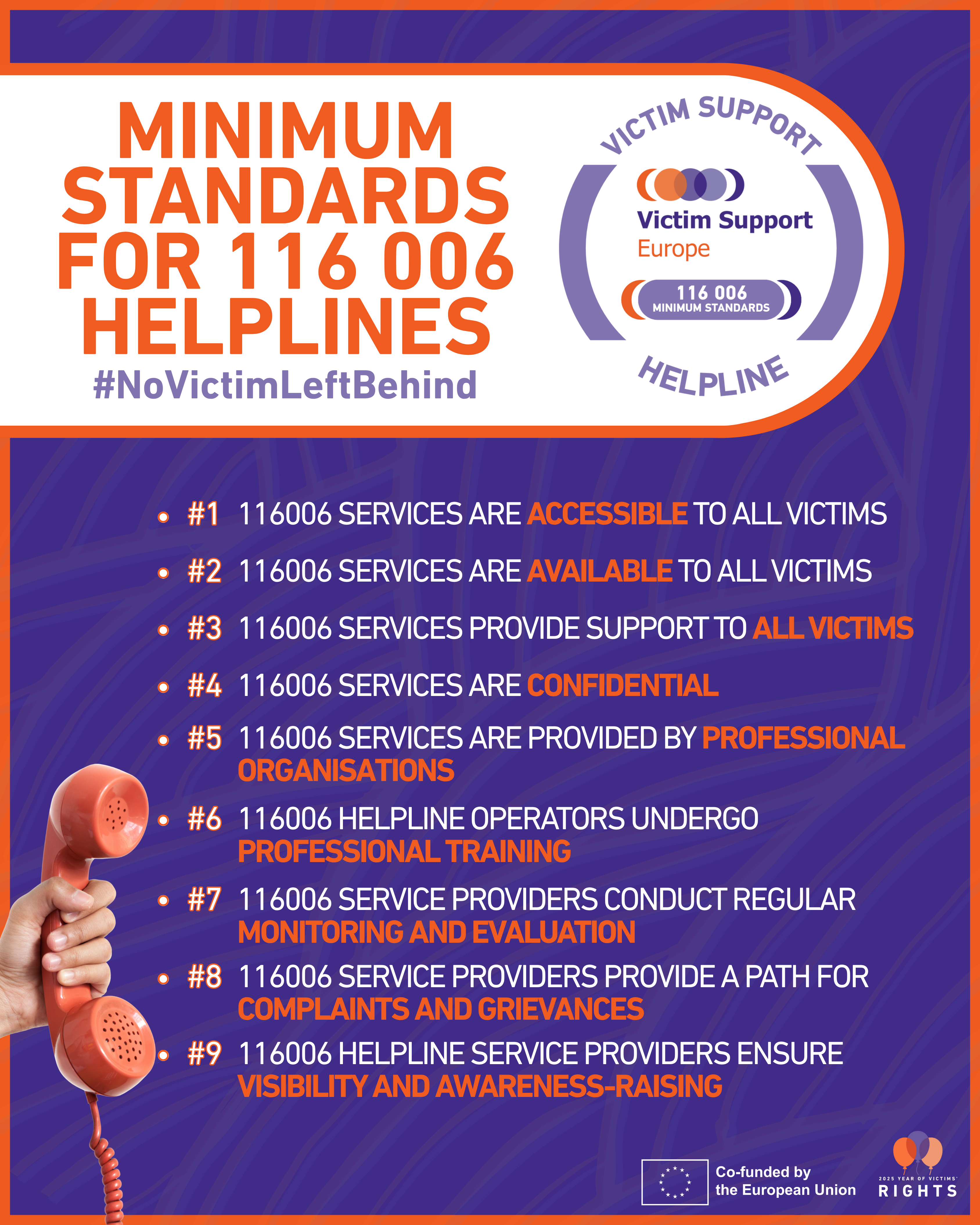
Session II, moderated by Carolina Soares, chairperson of VSE Working Group for 116 006 Helpline Standards examined the Minimum Standards for 116006.
Speakers highlighted how their organisations ensure accessibility, confidentiality, and quality, demonstrating that while structures differ, a strong commitment to standards is the foundation of victim-centred support.
A dynamic Q&A session concluded the event, with participants raising questions on organisational challenges, funding, anonymity, and adapting services to national contexts. The level of engagement reflected both the relevance of the topic and the growing momentum for improving victim support systems across Europe.
With the revised Victims’ Rights Directive now adopted, the need for 116006 in every EU Member State is not only clear – it is mandatory. VSE invites all participants, partners, and supporters to strengthen this push by signing the pledge, Support Equal Access to the 116006 Victim Helpline Across Europe.
