

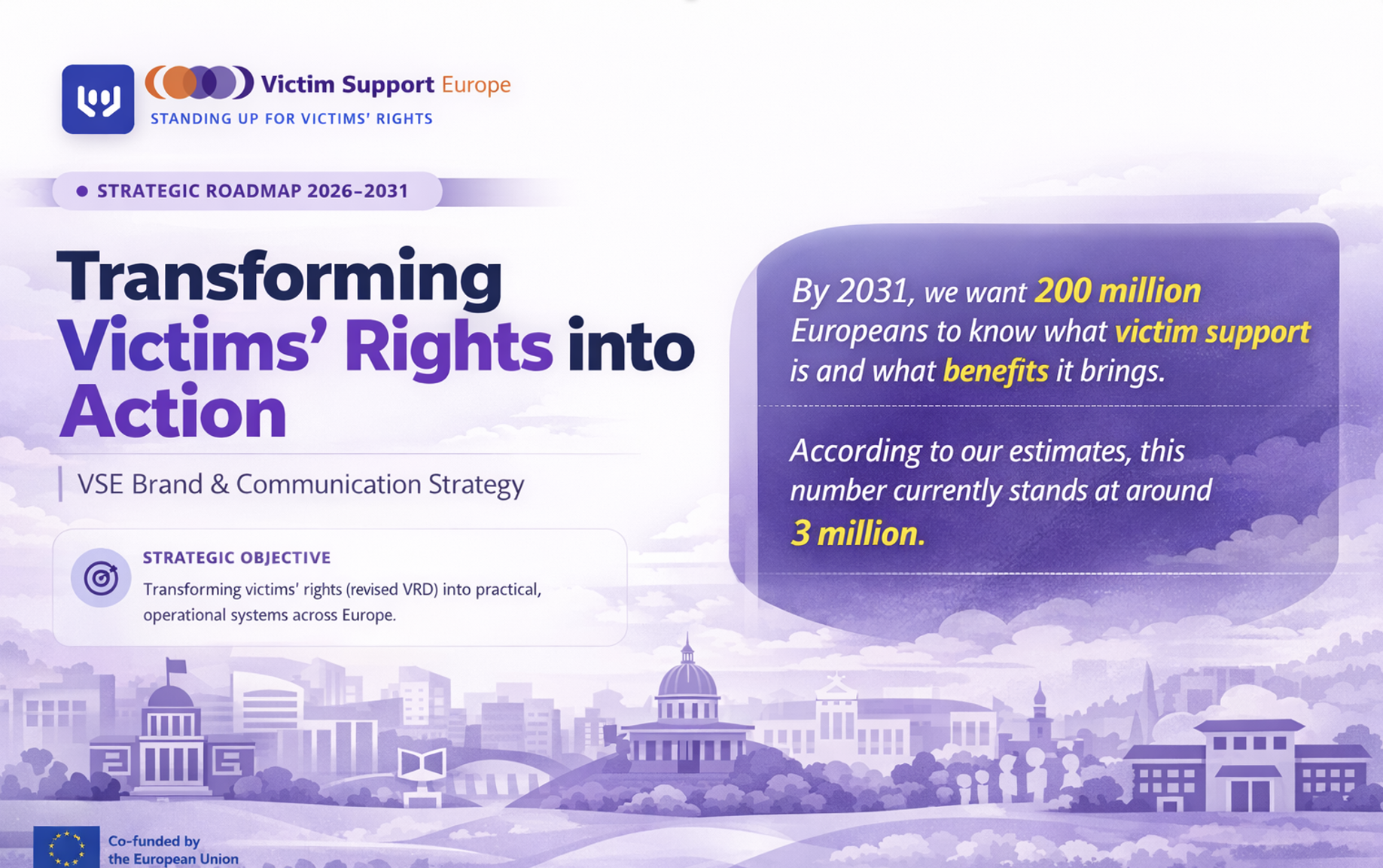
Brussels, March 2026 — Victim Support Europe (VSE) has unveiled its 2026 Communications Strategy, marking the first phase of a broader 2026–2031 Brand and Communications Strategic Roadmap designed to strengthen VSE’s position as a leading voice for victims’ rights across Europe.
The strategy builds on the organisation’s growing visibility and establishes a clear shift toward engagement, participation, and impact, aligning communications with VSE’s broader mission to transform victims’ rights from legal commitments into operational support systems.
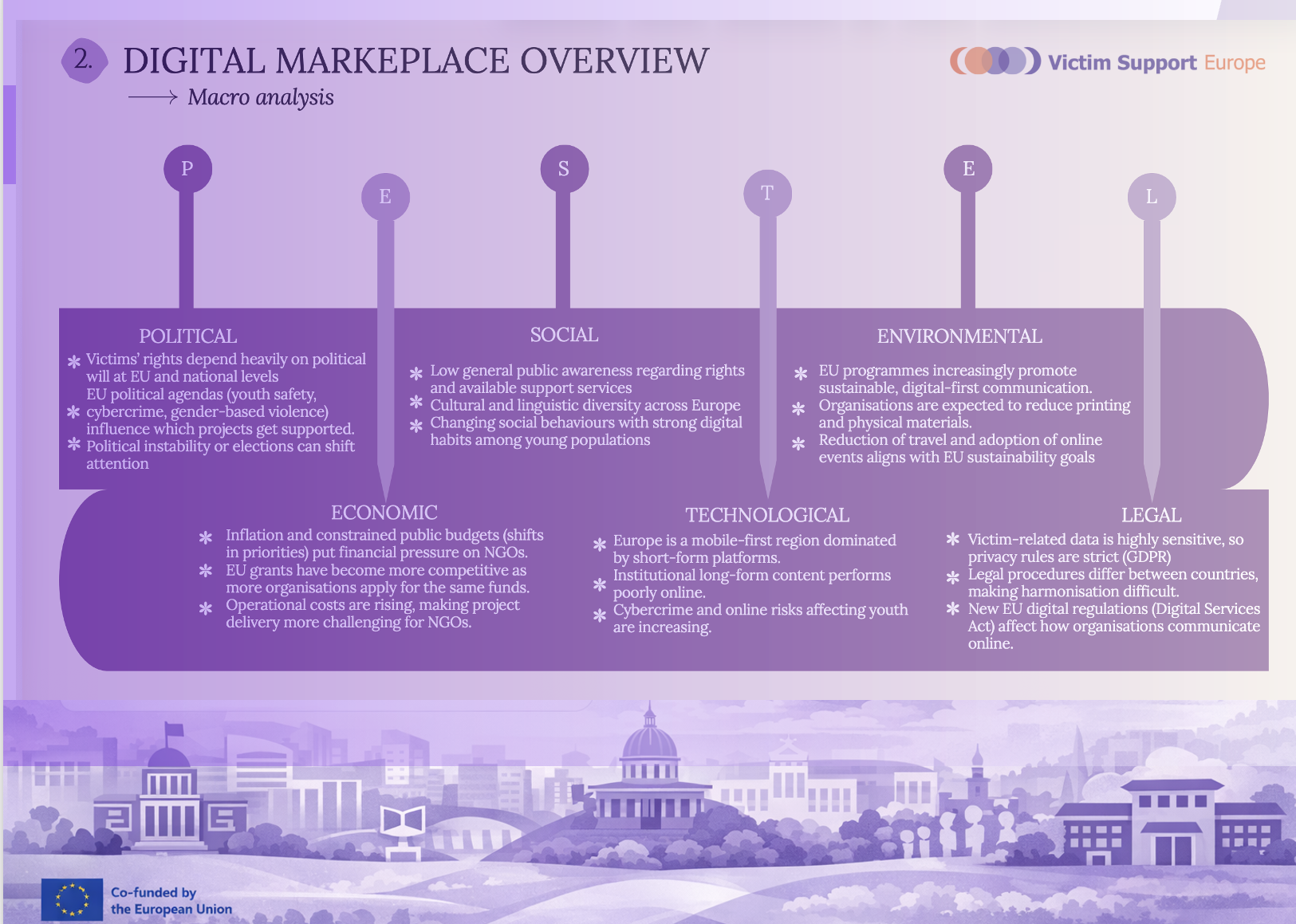
Developed through extensive research and consultation, the strategy draws on insights from a communication & brand research conducted by the VUB spin-off ‘We Are Sapience’, consultations with the VSE Board, annual performance reports produced by VSE’s communications team, and a digital performance analysis carried out by Master’s students at Solvay Brussels School of Economics and Management.
These findings helped define VSE’s brand direction and communications priorities for the coming years.
A Strong Baseline: Visibility Achieved
The new strategy builds on the significant communications momentum achieved in 2025.
Through the Year of Victims’ Rights campaign and a wide range of content initiatives, VSE generated 3.76 million impressions, demonstrating the organisation’s ability to reach large audiences primarily through organic communications.
Performance highlights included:
- 3 million website impressions per year and approximately 5,000 monthly visitors
- Strong social media reach, including 299,000 impressions on LinkedIn
- A quarterly newsletter reaching over 1,300 subscribers
- The launch of VSE’s podcast series, with each episode reaching around 50 listeners per month.
- Editorial visibility on external platforms such as the United Nations Office on Drugs and Crime (UNODC)
These results were achieved through a diversified content strategy combining campaign webpages, interviews, opinion pieces, podcasts, videos, and social media storytelling.
The key insight from the analysis: VSE has successfully built visibility. The next challenge is turning that visibility into meaningful engagement.
From Visibility to Engagement and Action
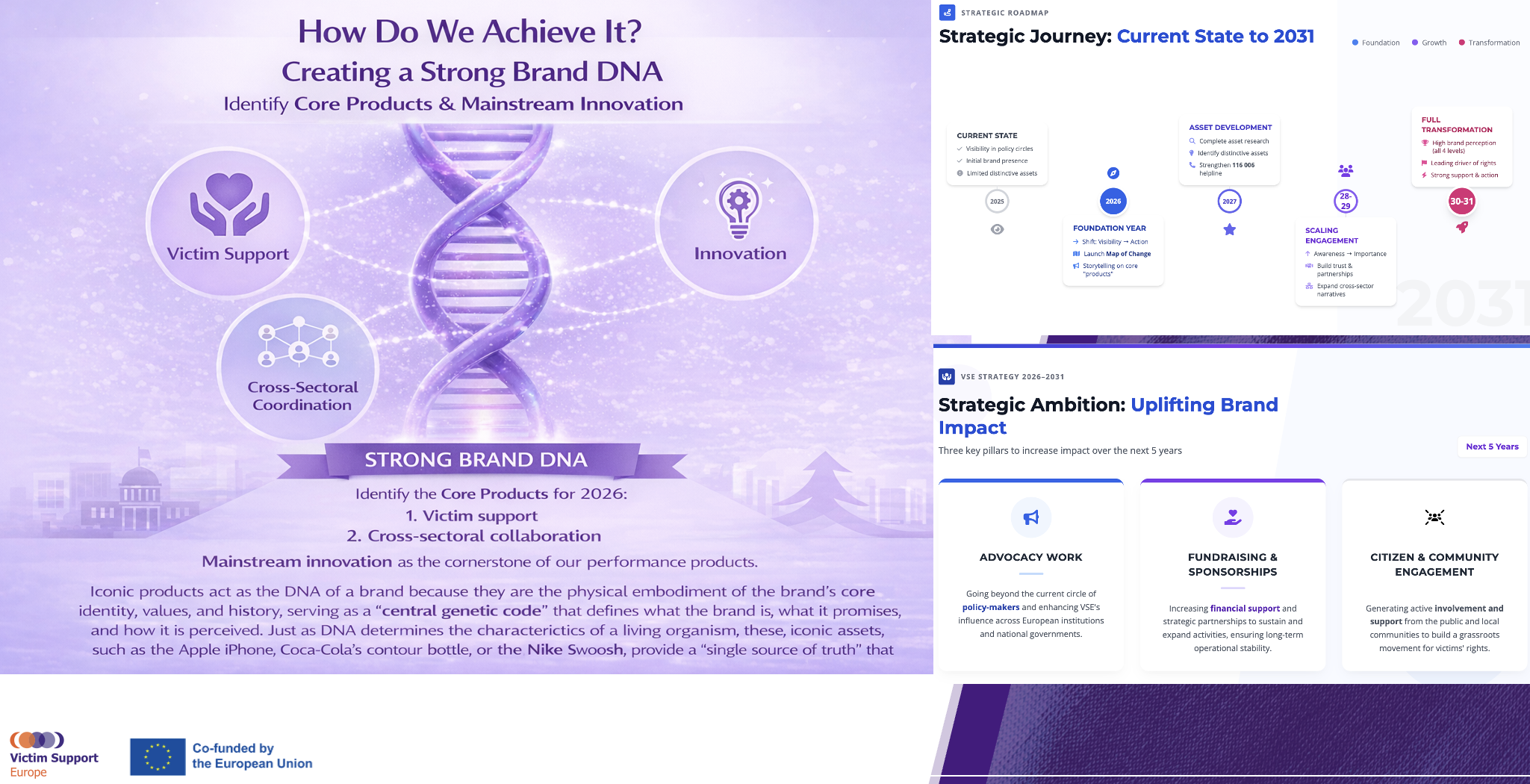
As the first phase of the 2026–2031 Brand and Communications Strategic Roadmap, the 2026 Communications Strategy introduces a clear strategic shift:
From visibility → to engagement → to action.
The overarching objective is to position VSE as a key driver in transforming victims’ rights from legislation into operational systems across Europe, particularly in the context of the revised Victims’ Rights Directive.
Through communications, VSE aims to support the practical implementation of victims’ rights at national and local levels by sharing frontline experiences, policy insights, and concrete examples of how support systems work in practice.
The ambition is simple: audiences should not only see VSE content — they should click, listen, share, participate, and act.
Strategic Pillars for Engagement
The 2026 strategy introduces several key pillars that will guide VSE’s communications activities.
Interactive Storytelling
Communications will increasingly highlight real-life stories from practitioners, policymakers, and victims’ support services, encouraging audiences to engage through comments, shares, and discussions.
Policy-Driven Narratives
Content will focus on the practical implementation of the Victims’ Rights Directive, connecting policy developments with frontline experiences and leadership insights from VSE.
Organic-First Growth
Building on the success of 2025, VSE will continue prioritising organic reach, supported by selective paid amplification through LinkedIn promotion and the Google Ads for Nonprofits programme.
Member and Partner Co-Creation
VSE will strengthen collaboration with its members, partners, and expert networks to co-create content and amplify shared advocacy goals.
Innovation and Interactivity
New digital formats — including LinkedIn carousels, interactive polls, and enhanced event sessions — will be introduced to encourage deeper audience participation.
Communications Approach for 2026 Campaigns
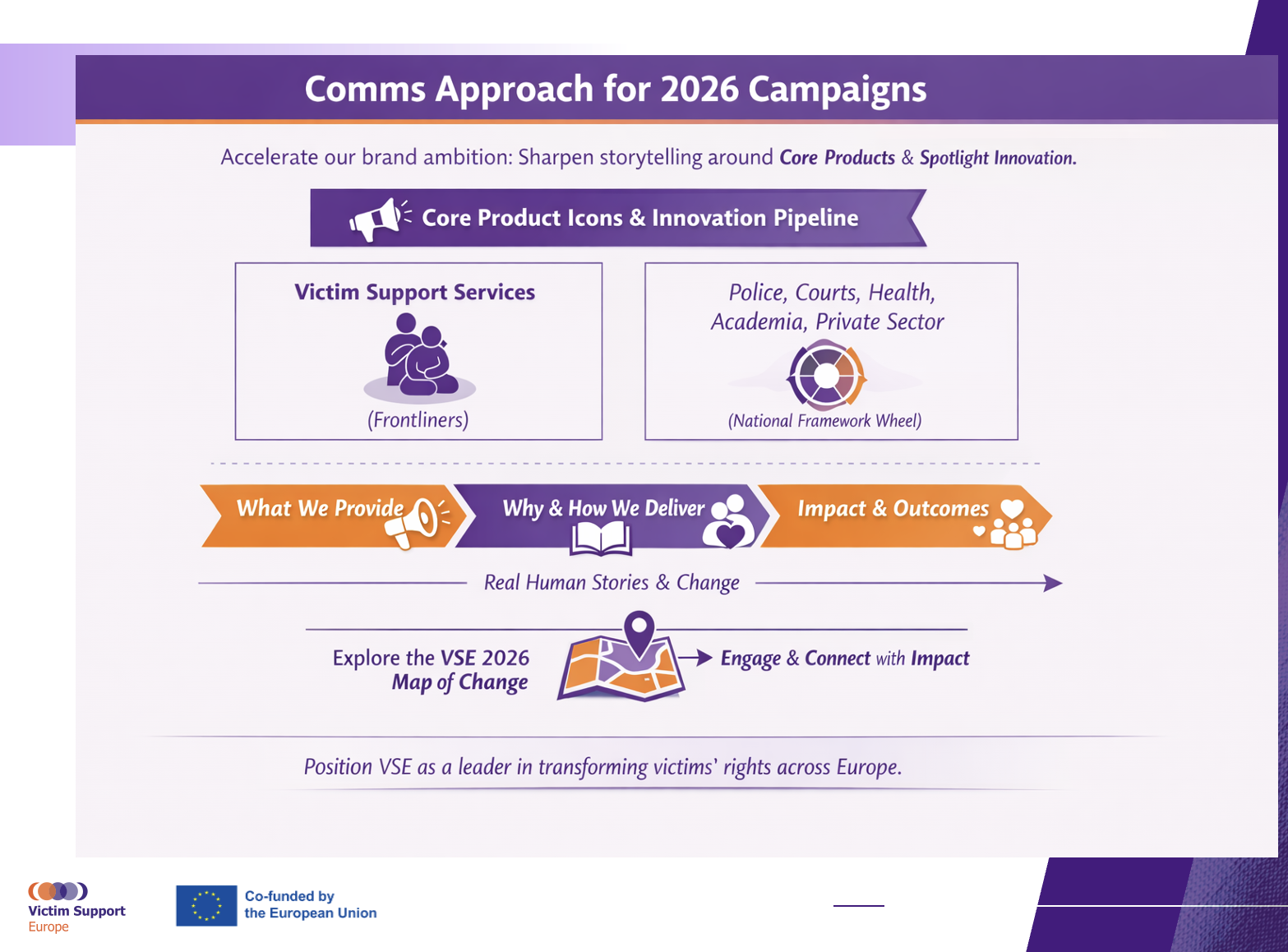
In 2026, VSE will accelerate its brand ambition by sharpening storytelling around its core “product icons”: victim support services and the wider network of actors who make victim support systems work. Communications will highlight both frontline victim support professionals and the broader victim support framework—including police, courts, health services, academia, and private-sector partners.
Rather than focusing only on what VSE delivers, the campaigns will emphasise why it matters and how change happens in practice. Through human-centred narratives and real experiences, audiences will see how coordinated systems improve safety, recovery, and justice for victims.
Each story will conclude by inviting audiences to explore the VSE 2026 Map of Change, a visual showcasing initiatives and innovations across Europe. The Map will serve as a key engagement tool, connecting stories with tangible impact and encouraging practitioners, policymakers, and partners to learn from, replicate, and contribute to successful victim support solutions.
Expanding the Network of Voices
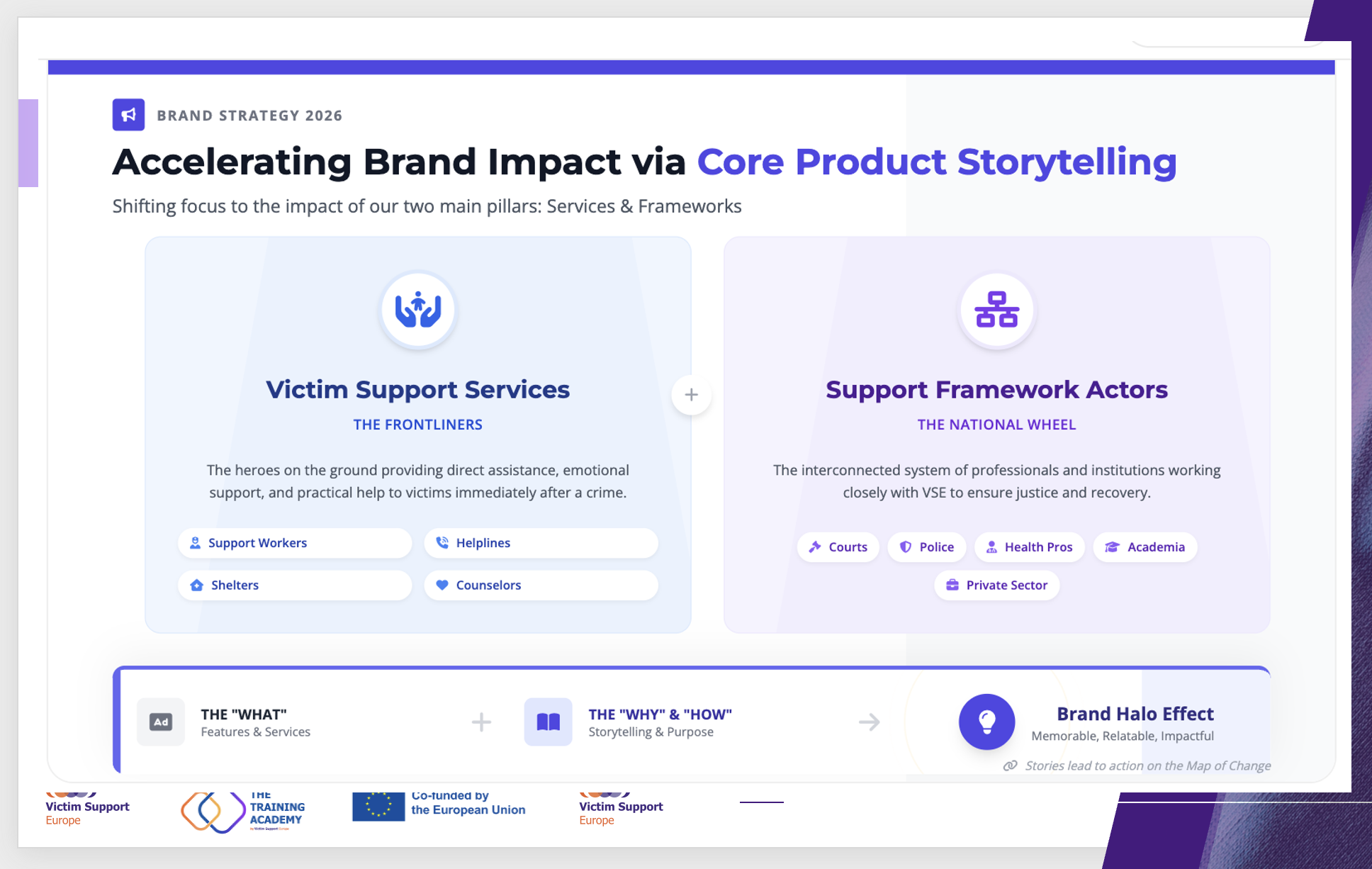
A central element of the new strategy is strengthening human-centred communications and trusted voices across VSE’s network.
New initiatives will include:
- Thought leadership activation, involving experts, practitioners, and policymakers in content and events
- Employee advocacy, encouraging staff and members to amplify VSE messaging on LinkedIn
- National expert and influencer collaboration to strengthen campaign visibility at country level
- Engagement with parliamentarians and policymakers, expanding the VSE Parliamentarians Platform
- Volunteer and youth mobilisation, particularly through the Youth Platform and victims’ advocates networks
By broadening participation, VSE aims to strengthen the credibility and reach of its advocacy work.
The Website as an Engagement Hub
The strategy also includes a website revamp in 2026, positioning the platform as the central hub for VSE’s campaigns and engagement activities.
New features will include:
- Dedicated campaign landing pages
- Clear calls to action
- Improved navigation and accessibility
- Integration with podcasts, campaigns, and events
The objective is to transform the website from a primarily informational platform into a space for participation and action.
Measuring Impact
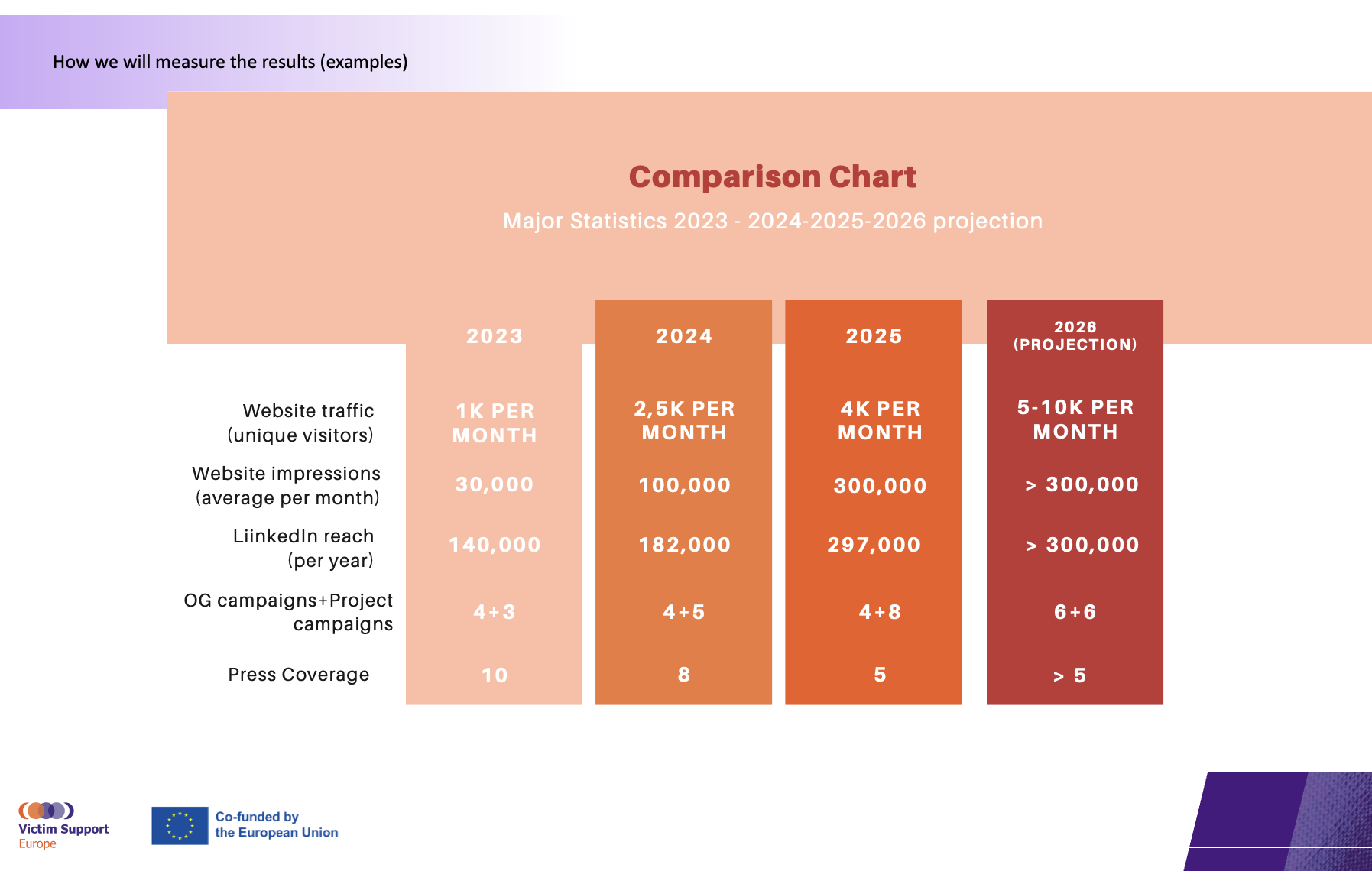
Under the new strategy, success will be measured not only by reach but also by the quality of audience engagement.
Key targets for 2026 include:
- Increasing monthly website visitors from 3–4K to 5–10K
- Growing podcast audiences to over 150 listeners per episode
- Expanding the newsletter community to 1,500 subscribers
- Improving social media click-through and engagement rates
- Increasing participation in events, campaigns, and collaborative initiatives
Performance will be monitored through a continuous learning cycle, enabling VSE to refine content, test new formats, and optimise communications over time.
Building the Future of the VSE Brand
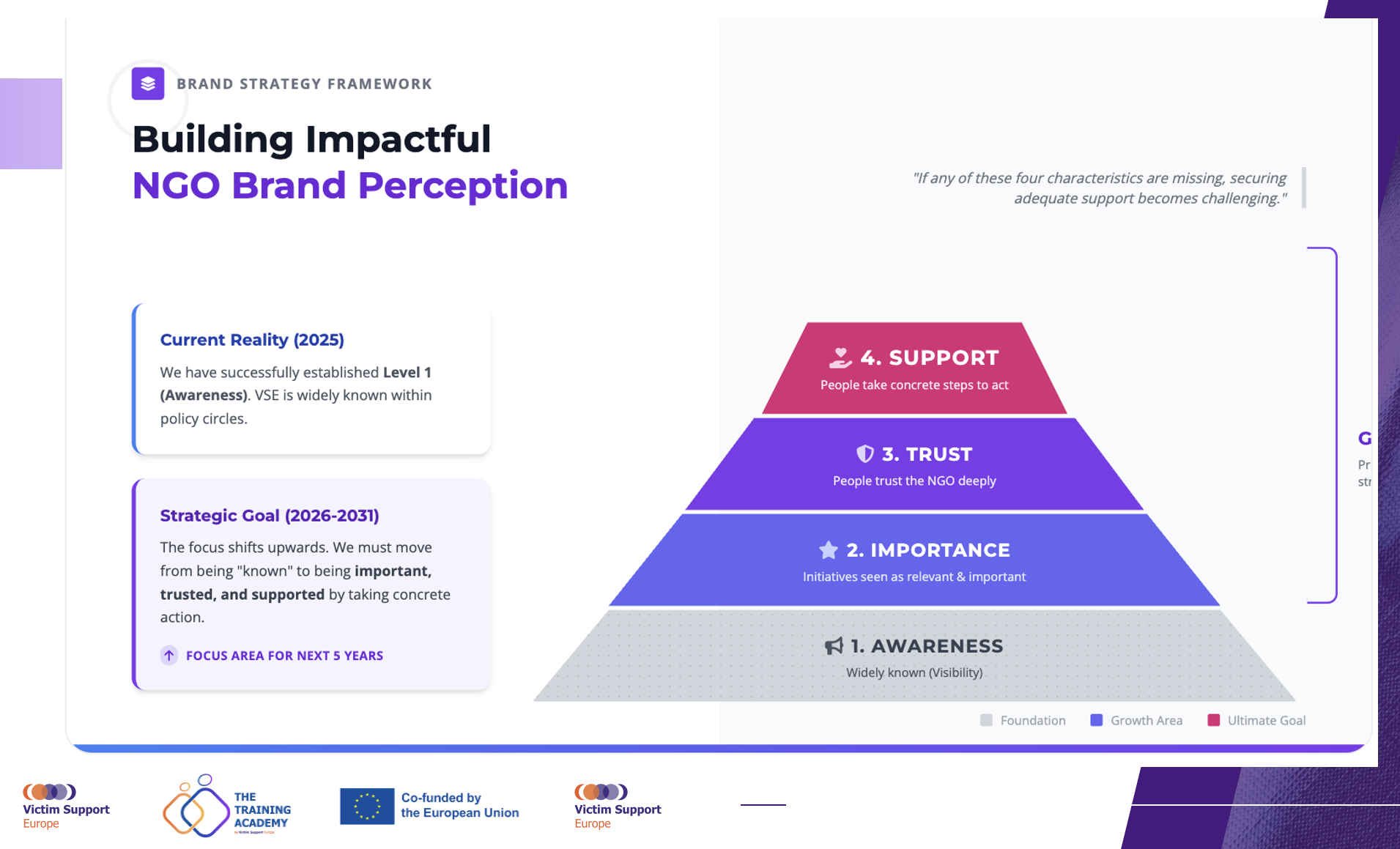
The 2026 Communications Strategy represents the starting point of VSE’s longer-term Brand and Communications Strategic Roadmap for 2026–2031.
While 2025 demonstrated the organisation’s ability to achieve large-scale visibility with limited resources, the coming years will focus on deepening engagement, strengthening partnerships, and driving real change for victims across Europe.
Through evidence-based storytelling, expert collaboration, and interactive communications, Victim Support Europe aims to ensure that the revised Victims’ Rights Directive translates into tangible improvements in support and protection for victims throughout Europe.
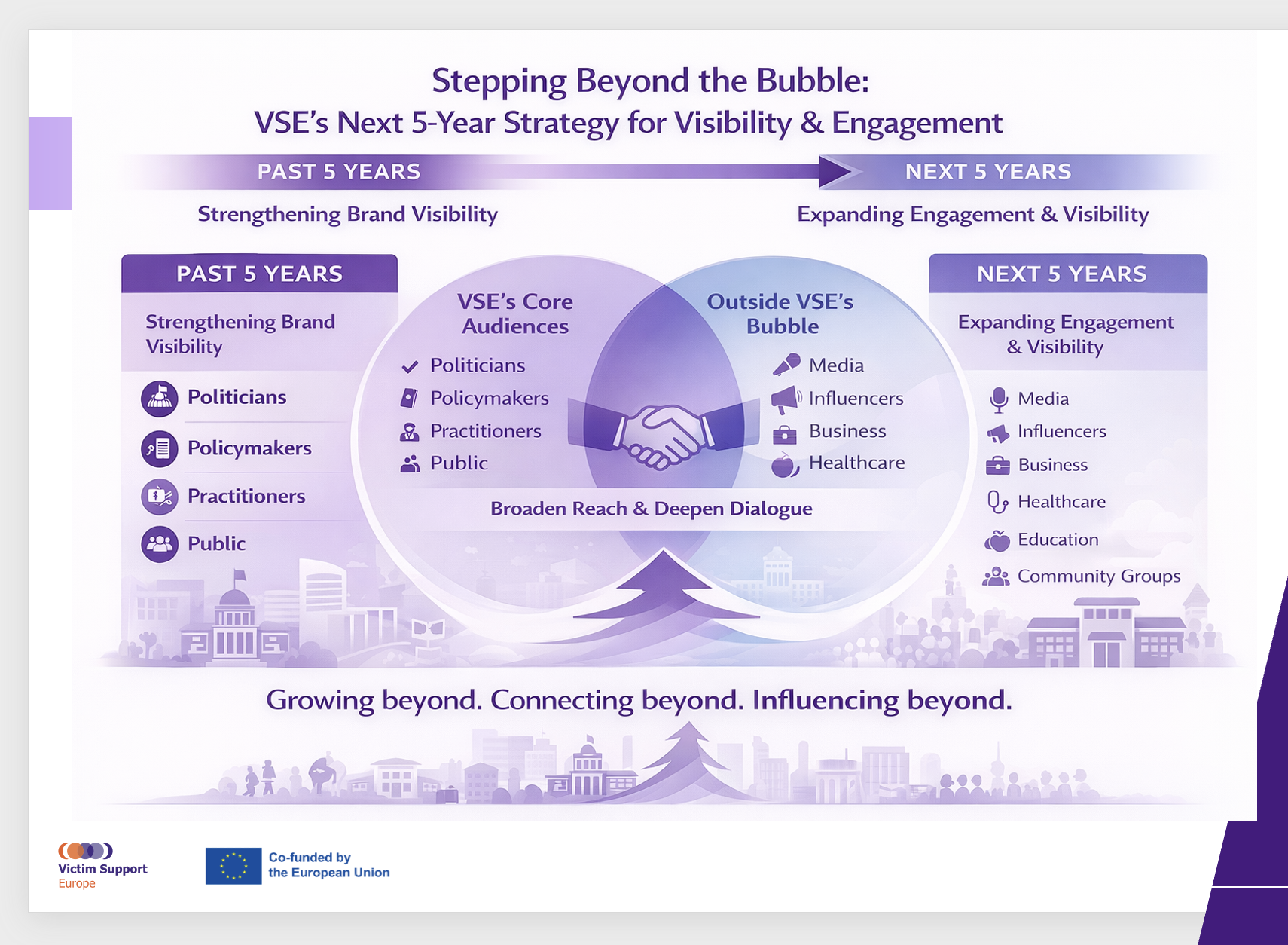
A central ambition of the 2026–2031 Brand and Communications Roadmap is to significantly expand public understanding of victim support. By 2031, VSE aims for 200 million Europeans to know what victim support is and understand the benefits it provides.
Achieving this goal will require expanding VSE’s visibility beyond the traditional victims’ rights community, reaching audiences across multiple sectors. This includes strengthening engagement with business leaders, influencers, healthcare professionals, academia, law enforcement, youth communities and the media.
By broadening the conversation and building partnerships across these sectors, VSE seeks to ensure that victim support becomes widely recognised as an essential part of safe, resilient, and just societies across Europe.
