

For more than a decade after the adoption of the 2012 Victims’ Rights Directive, victims’ rights across the European Union were recognised in law but implemented unevenly in practice. Successive evaluations by the European Commission identified persistent shortcomings: many victims were still unaware of their rights, struggled to access specialist support services, received inconsistent information from authorities, or were not adequately protected from secondary victimisation during criminal proceedings. Access to justice often depended not only on the nature of the crime but also on where the victim lived, the capacity of national support systems, and the degree of coordination between police, prosecutors, courts and victim support services.
Against this backdrop, the adoption of the revised Victims’ Rights Directive marks a significant milestone for victims’ rights in Europe. More than a technical amendment to existing legislation, it represents a recognition that justice systems must be designed around the needs of victims as much as around the rights of defendants. The revised Directive strengthens victims’ access to justice through a range of practical measures, including easier crime reporting1, enhanced rights to receive timely and personalised information, the establishment of the EU-wide 116 006 victims’ helpline2, stronger individual assessments to identify victims’ specific support and protection needs3, better protection of victims’ personal data during criminal proceedings 4, and improved access to specialist support services, particularly for children and victims with specific needs.
These reforms did not emerge overnight. They reflect years of evidence gathered by the European Commission, the European Parliament, practitioners, victim support organisations and civil society across Europe, all of whom consistently highlighted the gap between legal rights and victims’ lived experiences. Evaluations of the 2012 Directive demonstrated that while the legislative framework had substantially improved victims’ rights, implementation remained inconsistent across Member States, with significant disparities in access to support, information and protection. The revised Directive responds directly to many of these findings by placing greater emphasis on practical implementation, early intervention and coordinated victim support.
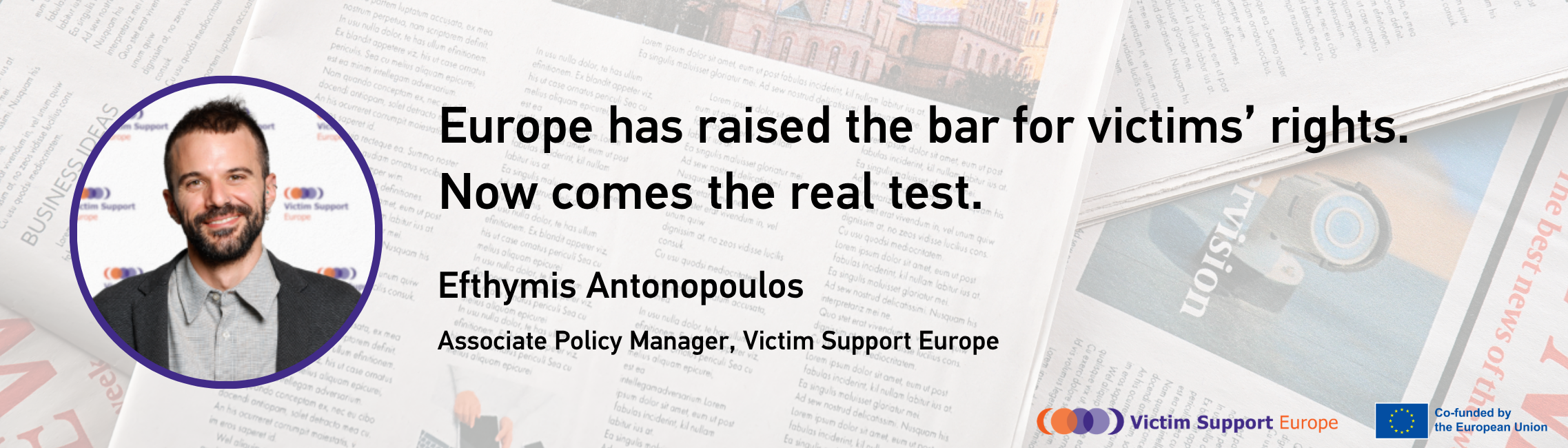
Its adoption deserves to be celebrated. But legislation alone does not change victims’ experiences. The real measure of success will be whether these new obligations are translated into consistent practice across every Member State, ensuring that every victim can exercise their rights regardless of where they live or the crime they have experienced.
A new standard for victims in Europe
The revised Directive raises protection and support standards in meaningful ways.
Following my reading of the revised legislation, victims will have better access to information and support through EU-wide victim helplines under 116 006, digital tools and clearer referral pathways. Reporting crime will become easier through online reporting mechanisms, third-party reporting options and adapted procedures for children and people whose liberty is restricted.
The revamped Directive also strengthens the protection of victims’ personal data by limiting the disclosure of sensitive information, such as victims’ contact details, during criminal proceedings. It improves access to legal aid for victims participating in criminal proceedings who lack the financial means to exercise their rights, and introduces tailored safeguards for children and persons with disabilities, including access to child-friendly and accessible support services. In addition, it seeks make victims’ right to compensation more effective by requiring Member States to strengthen the enforcement of compensation orders against offenders and, in cases of intentional violent crime where compensation is not paid within a reasonable period, allowing Member States—subject to national conditions—to advance compensation to victims and subsequently recover the amount from the offender.As included in the Directive, particular groups of victims stand to benefit significantly like child victims who will have access to more integrated support mechanisms. Child victims will benefit from integrated, child-friendly support services that bring together medical examinations, psychological support, individual needs assessments, assistance with reporting crimes, and interviews that can be video-recorded to reduce repeated questioning and minimise trauma. Where possible, these services should be provided through coordinated multi-agency mechanisms, ideally under one roof.
Victims with disabilities will receive greater procedural accommodations to ensure they can participate effectively in criminal proceedings. These may include accessible communication formats, interpretation or assistive technologies, accessible digital reporting tools, and adjustments to procedures that enable victims to exercise their rights on an equal basis with others. Victims of sexual violence will gain access to more coordinated support services (including medical and forensic examinations, trauma-informed psychological support and, where available under national law, sexual and reproductive healthcare5), while victims of terrorism will receive stronger protection from the harmful impact of content that glorifies, praises or justifies terrorist offenders and their crimes, helping to reduce the risk of retraumatisation and secondary victimisation6.
These changes matter because they move rights from abstract principles towards practical realities. But legislation alone does not change lives.Rights on paper do not automatically become rights in practice.
Europe has become increasingly ambitious in strengthening victims’ rights, yet implementation remains uneven across Member States.Even where rights exist, victims frequently struggle to exercise them because information is inaccessible, overly complex, not adapted to their needs, or simply not provided when it matters most. Victims often struggle to understand their rights because information is inaccessible, overly legalistic or not provided at the right time. Support services also remain unevenly distributed across the EU. While countries such as Spain (through its coordinated response to gender based violence) and Finland (where the RIKU model provides nationwide general victim support) and the Netherlands (where Schlactofferhulp Nederland offers an integrated victim support system with strong coordination between justice, law enforcement and specialist services), the European Commission has found that in many Member States support services remain concentrated in urban areas, leaving victims in rural and remote regions with limited access to specialised assistance. Referral systems are also frequently organised around specific crime types—such as domestic violence or trafficking—meaning that victims of other crimes may struggle to access appropriate support or navigate between multiple services, as reported by the EU FRA.
Evidence from the BeneVict project highlights these challenges. Individual needs assessments, which are essential for identifying protection needs and preventing secondary victimisation, remaininconsistent. Translation and interpretation services often suffer from shortages and varying quality. Compensation procedures can be difficult to navigate, while professional training remains fragmented and irregular.
As a result, victims continue to experience a patchwork of protection depending on where they live. Justice should never become another source of harm and it is implementation where trust is built.
The effectiveness of legislation depends not only on how laws are written, but on whether governments invest in making them work.Implementation requires sustainable delivery mechanisms: awareness campaigns, professional training, coordinated referral systems, monitoring structures and long-term support services.
Governments must also adopt more evidence-based approaches like better data collection, monitoring and evaluation can help identify gaps and improve outcomes. Clear targets should be established from the outset, with progress measured transparently and consistently. Moreover, sharingknowledge across Member States can further strengthen implementation and reduce duplication of effort. Without effective implementation, even the strongest rights risk becoming symbolic rather than transformative.
Victims’ rights are everyone’s responsibility
Victims’ rights cannot remain confined to criminal justice systems.
Victims live in communities where they interact with healthcare providers, schools, employers, social services and local authorities. Supporting victims is therefore not solely the responsibility of courts or justice ministries; it is a collective responsibility.
Too often, victim policy remains trapped in institutional silos. Yet, effective victim support contributes to broader societal goals, including social cohesion, resilience, equality and trust in public institutions. Victims’ rights should be mainstreamed across policy areas including health, education, employment, digital policy and security. A whole-of-society approach is needed, bringing together governments, practitioners, communities and civil society. Better support systems benefit not only victims but society as a whole by encouraging reporting, strengthening trust and improving public confidence.
The next era of victims’ rights starts now
The revised Directive provides stronger tools to support millions of people affected by crime every year. But the next phase will require leadership, coordination and sustained commitment.
As Member States begin transposing the Directive and the next EU Strategy on Victims’ Rights will start taking shape, implementation must remain at the centre of the agenda. Victims’ rights cannot be delivered through short-term projects and fragmented funding. Sustainable investment, strong national strategies and meaningful partnerships with civil society are essential.
The success of the revised Directive will not be measured by the number of articles adopted in Brussels but by whether victims across Europe feel informed, protected, respected and heard. No victim should be left without support because of age, disability, gender, legal status, geography or administrative barriers.
Europe has already created stronger rights. The task now is to deliver them. The next era of victims’ rights is about building coherent, coordinated and victim-centred systems that turn legal promises into everyday reality. Civil society and victim support organisations will be indispensable in that effort, ensuring that policies remain grounded in evidence, informed by lived experience and focused on what matters most: improving the lives of victims.
