
Explaining a referral system through theatre: a Victim Support Europe experiment
At victim support conferences, policy and frontline practice are often communicated through PowerPoint presentations, panel discussions, video demos or inspirational speeches. We spend hours examining frameworks, referral pathways and promising practices. Yet despite increasingly sophisticated systems and concepts, one question remains: how often do we share our experience in a way that truly inspires people to learn more, to replicate successful approaches and to improve practice in their own context?
One of the most memorable moments of the 2026 Annual Conference came not through a panel discussion or technical presentation, but through theatre. Nine Months Earlier: A Victim Journey Rewritten by Frontline Practice invited participants to step inside a referral mechanism and witness, through the eyes of a victim, how coordinated support can change the course of a life.
As Sarah De Valckenaere, Head of the Police Victim Support Unit for Deinze–Zulte–Lievegem and one of the performers, reflected:
”Theatre offers something that few conference formats can. An hour in a theatre is not simply an exercise in receiving information; it is an experience. The emotions of the audience, the energy of the performers, and the atmosphere of the room all become part of the story being told. Unlike a presentation, where participants observe a process from a distance, theatre places them inside it. And honestly, after coming to VSE’s office in Brussels, and spending the past three months rehearsing at home and online, it really felt worth it to bring this to life like this.
Sarah De ValckenaereHead of the Police Victim Support Unit for Deinze–Zulte–Lievegem
-
This matters because referral mechanisms are ultimately not about procedures, charts or institutional responsibilities. They are about people. They are about moments of recognition, decisions made under pressure, missed opportunities and interventions that can alter the course of someone’s life. While diagrams can explain how a system functions, they often struggle to convey what that system feels like from the perspective of the victim moving through it.
The challenges explored in Nine Months Earlier are familiar to victim support professionals across Europe. Referral mechanisms may be well designed on paper, yet they can break down in practice through fragmented coordination, unclear responsibilities or a lack of victim-centred approaches. Rather than discussing these challenges in abstract terms, the performance brought them vividly to life through storytelling.
Inspired by Violet’s Tale by British singer-songwriter Ren, the story followed a young woman trapped in a cycle of violence. The audience was first confronted with the devastating consequences of a system that failed to recognise and respond to the warning signs. The narrative then rewound nine months and posed powerful questions: what if somebody had acted sooner? What if the right support had been available at the right moment?
From there, the audience accompanied Violet through an alternative journey set in Belgium. Through a series of dramatic scenes, hospital staff, victim support professionals, police officers, justice assistants and compensation services worked together to provide coordinated support. What could have become a tragic story instead became one of intervention, protection and recovery.
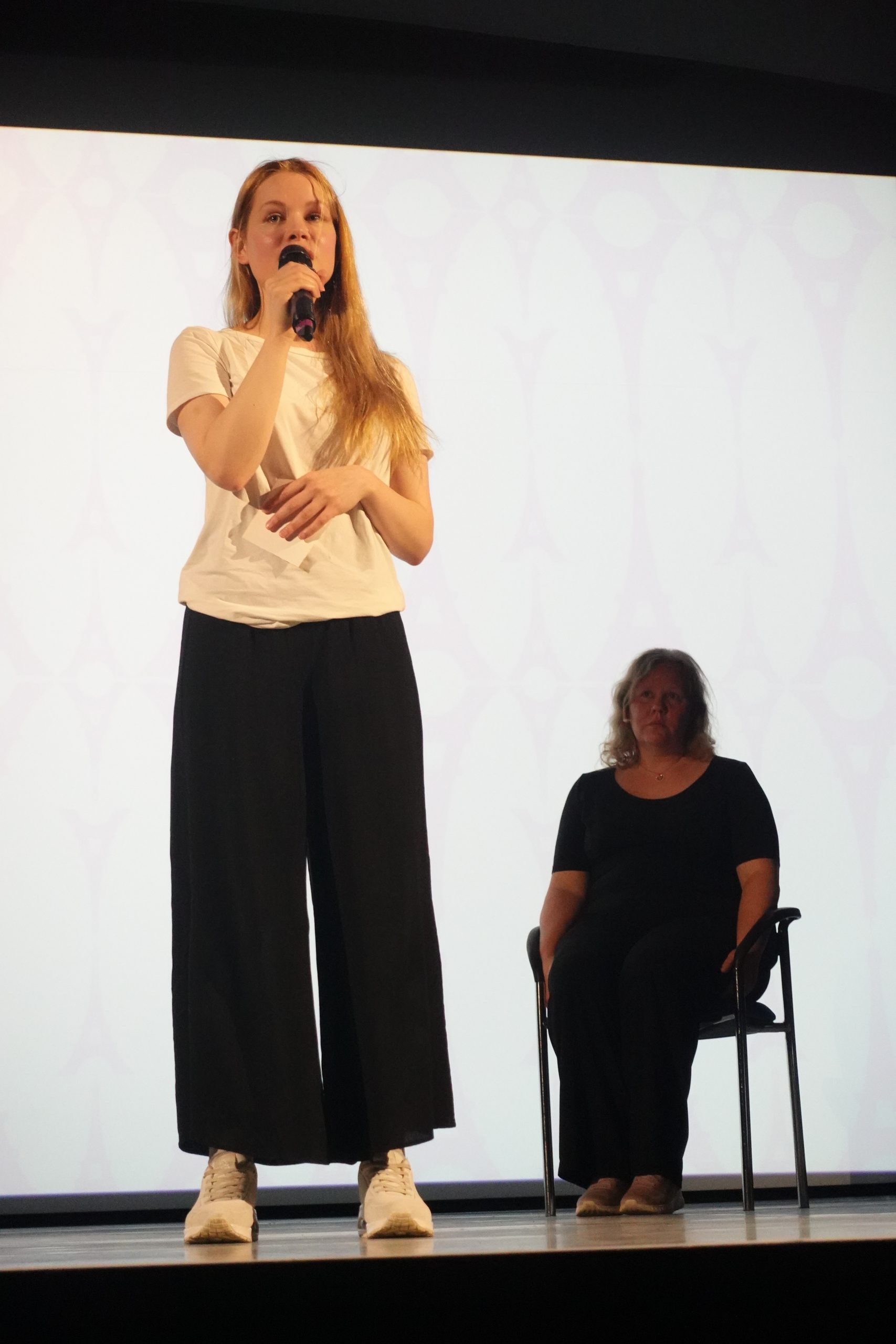
Crucially, all participants on stage were real-life professionals from across the victim support and justice system, stepping into their own institutional roles within the referral mechanism. The only fictional role was that of the victim, performed by actress Sarah Christoyannis, who embodied Violet’s journey through the system.
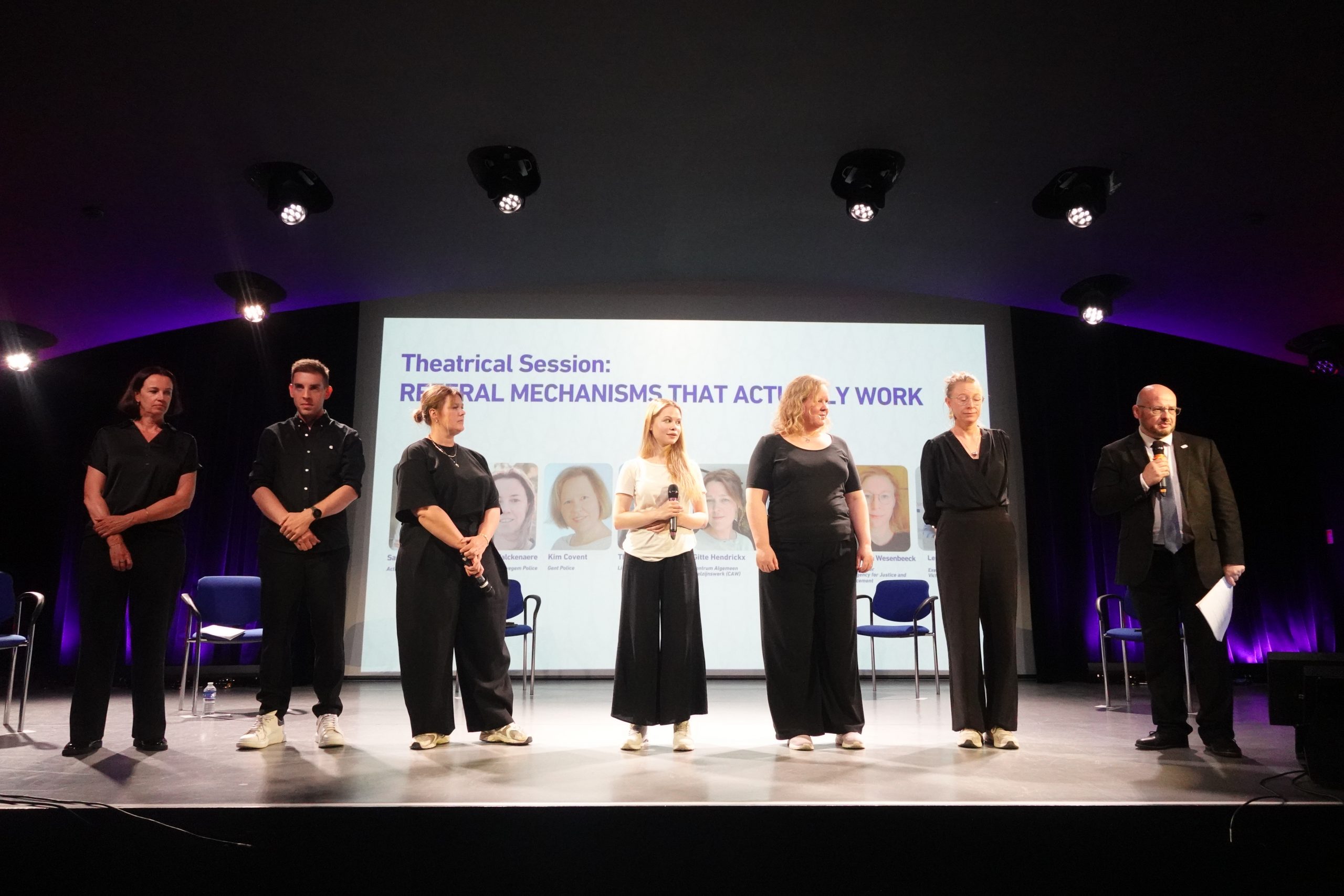
The performance featured contributions from Levent Altan as narrator and representative of the Compensation Authority, Sarah De Valckenaere as Police Victim Support Officer, Thomas Wyns representing the Family Justice Centre, Gitte Henrickx from CAW Victim Support Services, Kim Covent as Police Complaint Officer, Freya Van Wesenbeeck as Justice Assistant for Judicial Victim Support and Sarah Christoyanis as a victim.
For Kim Covent, Customer Coordinator at the Ghent Police Department and one of the performers, the production offered a rare opportunity to see victim support as a complete journey rather than a series of separate interventions. “We often see our own role in the process, and the roles of those we work most closely with in the pathway,” she reflected after the performance.
”But through the story, we could see the full circle — how every action and every conversation can influence what happens next for a victim.
Kim CoventCustomer Coordinator at the Ghent Police Department
-
The performance was designed not simply to explain referral mechanisms, but to allow participants to experience them. As Marina Kazakova, VSE’s Head of Communications and author of the script, explained, the initial concept came from VSE’s Executive Director, Levent Altan, who is known for his willingness to experiment with new forms of communication and learning. One evening, while listening to the music of Ren, an artist whose work often explores mental health, trauma and wider social issues, Levent was struck by the story of Violet, the central character in one of Ren’s songs. Ren draws on his own experiences of illness and vulnerability in his music, using it to give voice to stories of exclusion, pain and recovery. This led to the decision to reimagine Violet’s journey and ask how her life might have unfolded differently if she had been heard earlier and received support in time.
”We wanted participants to move beyond understanding the system on paper. We wanted them to see how it actually plays out in real life.
Marina KazakovaCommunications Manager, Victim Support Europe
-
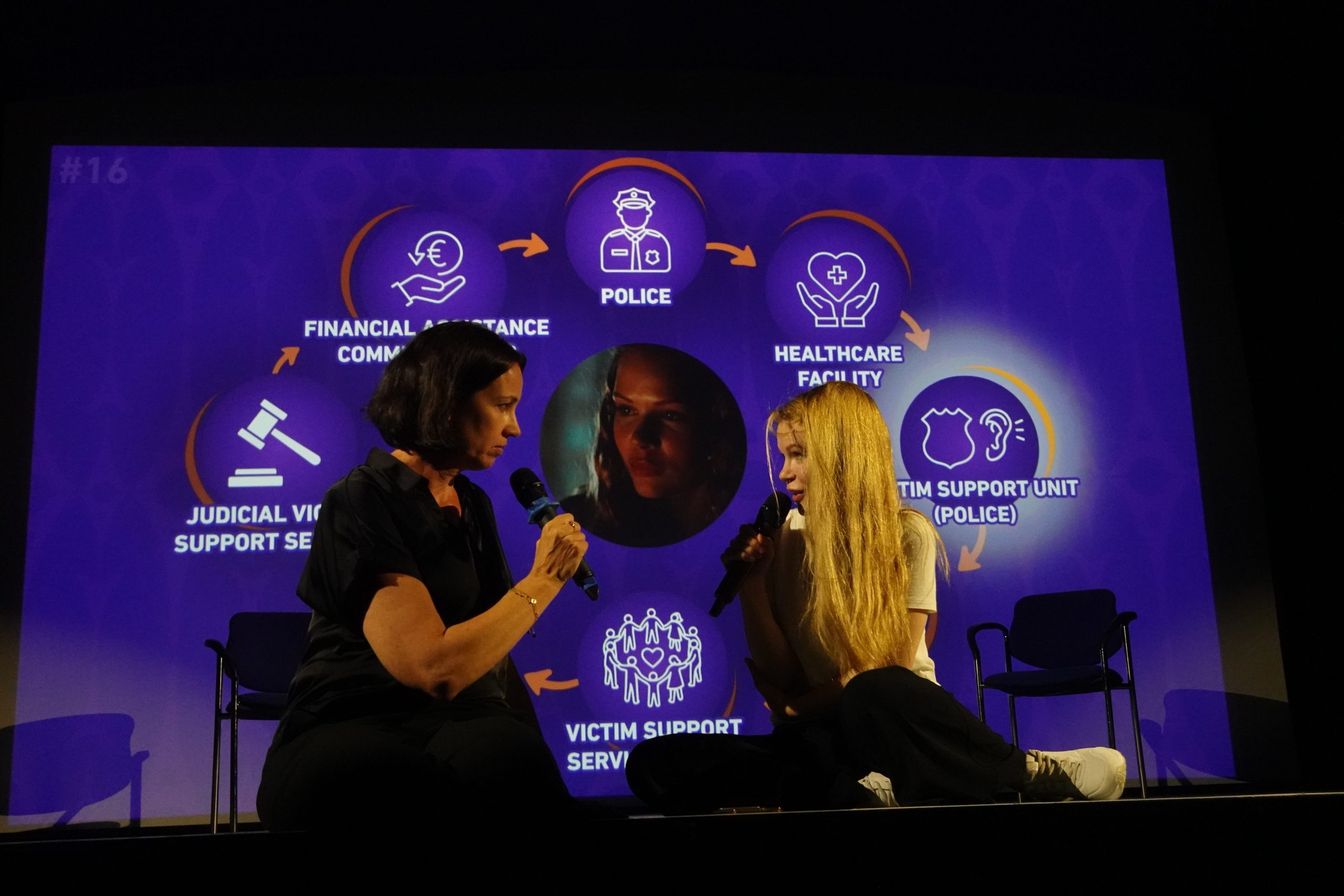
What made the session particularly distinctive was its combination of professional expertise and theatrical storytelling. Each performer represented a real institution within the referral mechanism and entered the story at the moment their service became involved. Alongside the performance, a live visualisation mapped referrals, handovers and decision points, enabling the audience to follow Violet’s progress through the support system in real time.
That visual layer was coordinated by Ryanne Meyer, VSE Communication Assistant, who operated the presentation and projection system throughout the performance. “The challenge was to make the mechanism visible without distracting from the story,” she said. “The audience could see not only where Violet was in her journey, but also how every referral connected to the next step towards safety, justice and recovery.”
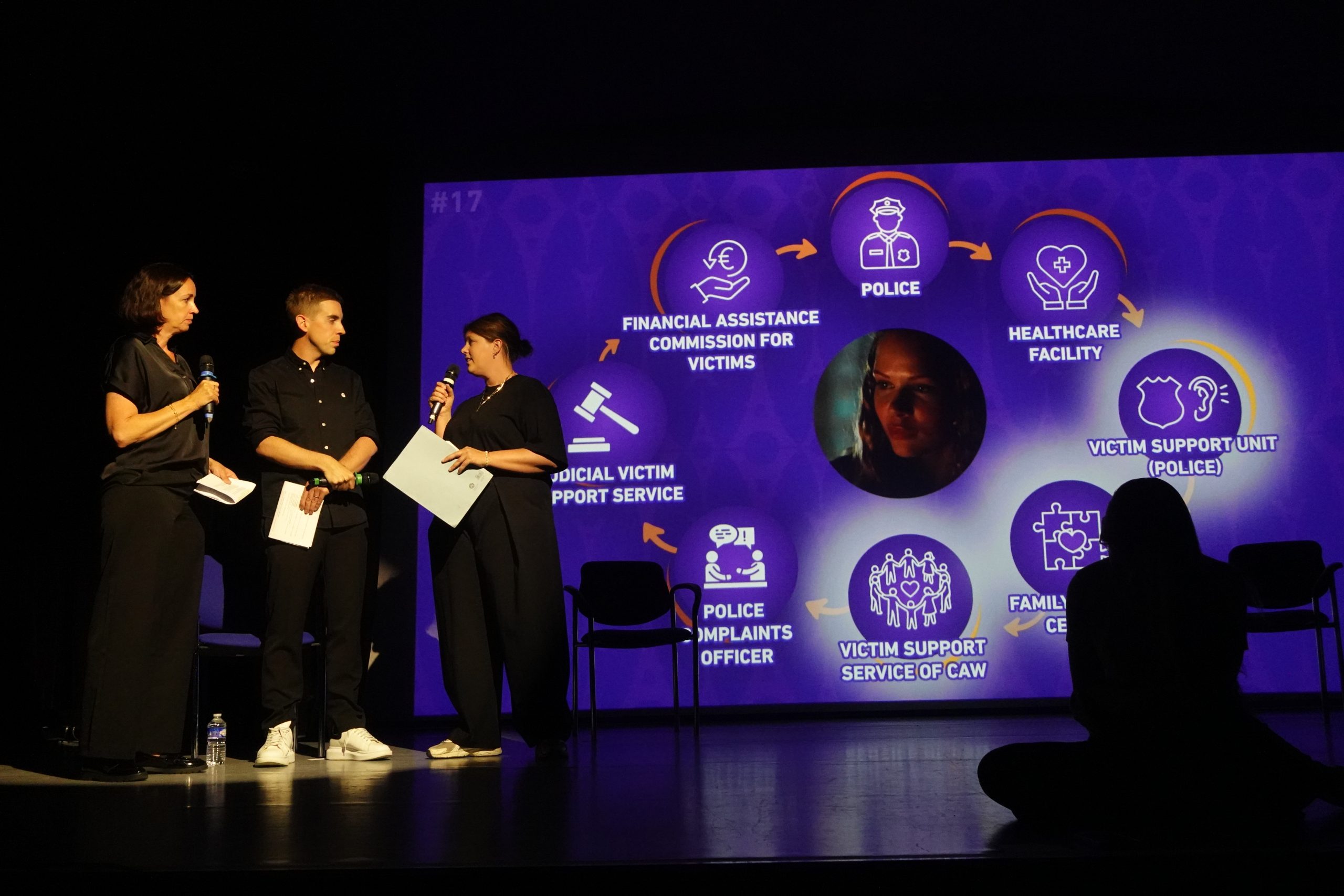
Throughout the session, examples of good practice emerged naturally through the narrative: trauma-informed communication, warm referrals, multi-agency cooperation, victim participation in criminal proceedings, access to compensation, and long-term recovery support. These were not presented as recommendations on a slide but as actions that directly influenced the outcome of a person’s life.
The impact of bringing complex concepts to life through theatre was also visible in the audience response. After the performance, many participants stayed behind to thank the team, and several asked whether the show could be brought to their own countries, seeing it as a powerful way to help explain and improve referral mechanisms in their national contexts.
