

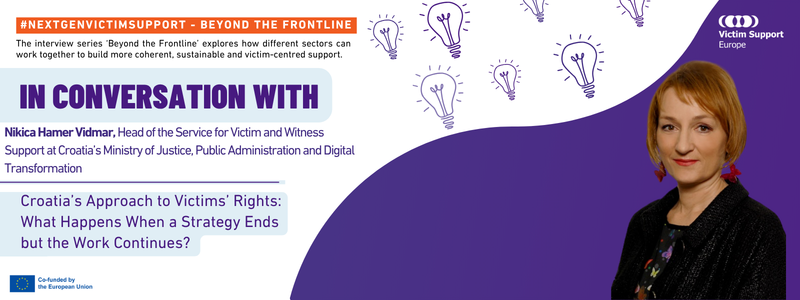
In this interview, Marina Kazakova of VSE speaks with Nikica Hamer Vidmar, Head of the Service for Victim and Witness Support at Croatia’s Ministry of Justice, Public Administration and Digital Transformation.
The conversation explores how Croatia has developed and maintained its victim and witness support system following the expiry of its national strategy in 2020. Rather than adopting a new overarching strategy, Croatia has focused on institutional coordination, specialised policy frameworks, legal protections, and cooperation between justice institutions, public authorities, and civil society organisations.
The interview looks at how victims’ rights are implemented in practice, the role of the Ministry and specialised court-based support departments, inter-institutional cooperation, access to services, prevention of secondary victimisation, support for vulnerable groups, monitoring, digitalisation, and Croatia’s priorities for the future.
A Professional Journey into Victim Support
Marina Kazakova, VSE: Nikica, where are you joining us from today? And if we travelled back to the beginning of your work on victims’ rights, what did your professional world look like then? How did you first become involved in this field?
Nikica Hamer Vidmar: In 1993, while I was a psychology student, I began volunteering with a civil society organisation that operated a telephone crisis line for victims of sexual violence.
Marina Kazakova, VSE: How has Croatia’s victim and witness support system evolved over the years?
Nikica Hamer Vidmar: The development of the system began in 2005, initially as a project financed by the UK Government and later supported by UNDP. In 2005, a volunteer-based programme was established at the County Court in Vukovar. In 2006, the civil society organisation Victim and Witness Support Service Croatia was established, providing an important foundation for the further development of support departments within the courts.
Also in 2006, the Department for Victim and Witness Support was established within the Ministry of Justice, where I was employed. It is now the Service for Victim and Witness Support. We cooperated with UNDP in developing the victim and witness support system.
During the first phase of the UNDP project, which ran from 2008 until mid-2011, support departments were established in Osijek, Vukovar, Zadar, and Zagreb, with staff employed by UNDP. Subsequently, in early 2011, three additional support departments were established in Split, Rijeka, and Sisak. At that point, support providers became employees of the courts and worked within Victim and Witness Support Departments.
Since 2023 and 2024, additional support departments have been established. There are now 16 departments in total: 14 at county courts and two at municipal courts—the Municipal Criminal Court in Zagreb and the Municipal Court in Split. One county court, in Dubrovnik, does not yet have a support department because of a lack of suitable premises.
There are also professionals whose experience illustrates this development particularly well. For example, Branka Lučić, a legal professional, was the first volunteer and subsequently spent 20 years as head of the Victim and Witness Support Department at the County Court in Vukovar. She is now Director of Court Administration at the County Court in Vukovar. Miren Špek was also a volunteer with Victim and Witness Support Service Croatia and is now the organisation’s Executive Director.
The work of the support departments at the courts and the Service for Victim and Witness Support is regulated by a number of legal and regulatory instruments, including:
Marina Kazakova, VSE: Which developments have had the greatest impact on the way victims are supported today?
Nikica Hamer Vidmar: Changes to the relevant legal provisions have had a significant impact, particularly amendments to the Criminal Procedure Act and the adoption of the Ordinance on the Means of Implementation of Victims’ Individual Needs Assessment. The introduction and clearer recognition of the concept of the “victim” and of victims’ rights have also been important developments.
Marina Kazakova, VSE: Victim support requires cooperation among justice institutions, the police, social services, healthcare providers, and civil society. How did your professional journey lead you into this field?
Nikica Hamer Vidmar: Before I started working in the Ministry of Justice in the Victim and Witness Support Department, I worked in a civil society organisation as a victim support provider on a telephone crisis line. I also worked as a psychologist in different centres for social welfare, in an orphanage, and in a secondary school.
In addition, I am a licensed psychotherapist and a licensed supervisor in psychosocial work. This professional experience gave me relevant knowledge and qualifications that I could use in supporting the development of Croatia’s victim and witness support system.
Marina Kazakova, VSE: Was there a particular experience that shaped your understanding of what victims need from institutions?
Nikica Hamer Vidmar: My work as a telephone counsellor on a crisis line for victims of sexual violence had a major influence on my understanding. I also received specific training in the field of trauma, which was particularly important.
Marina Kazakova, VSE: What principle has remained most important throughout your work?
Nikica Hamer Vidmar: Trusting the victim, empathy, timely support, a trauma-informed approach, professionalism, engagement, and motivation have remained central to my work. I try to use all my knowledge, abilities, and creativity, while respecting legal provisions, to address problems and situations and provide appropriate information and support.
My principles are involvement, cooperation, respect, acceptance, creativity, openness, shared goals, and adapting to individual and local needs and circumstances.
From a National Strategy to an Implementation and Cooperation Model
Marina Kazakova, VSE: Croatia previously had a national strategy for the development of the victim and witness support system, which expired in 2020. Rather than developing a new overarching strategy, Croatia has chosen to address different areas through specialised strategic documents, including those dealing with sexual violence and domestic violence.
Could you explain the thinking behind this decision? What lessons were learned from the previous strategy?
Nikica Hamer Vidmar: It is difficult to define strategic goals among stakeholders that are completely independent and have their own priorities, tasks, activities, and fields of work—for example, the police, healthcare system, courts, and social welfare system. They also have their own databases and sources of financing.
There are areas of overlap and cooperation regarding victims, but the boundaries defining where the responsibility and jurisdiction of a particular system begin and end are relatively clear. It can therefore be difficult to impose a goal or activity on a system whose primary objective is not victim support, because that system has its own specific objectives and provides multiple services. Social welfare is one example, where there may be other priorities that need to be addressed.
Marina Kazakova, VSE: What were the main challenges in implementing the previous strategy?
Nikica Hamer Vidmar: One challenge was incorporating the strategy’s goals and objectives into activities and standards that are acceptable to stakeholders, align with their existing procedures, and have not already been defined in other strategic documents, as measures and objectives should not be duplicated across different strategic documents.
Another challenge was introducing procedural changes when existing procedures were prescribed by legislation that could not easily be amended. It was also necessary to identify the legal instruments through which particular courses of action could be defined in a binding manner and to ensure that those measures were implemented in practice.
Maintaining Victims’ Rights as a Long-Term Priority
Marina Kazakova, VSE: When a national strategy ends, an important question is how its priorities continue to move forward. Without a single overarching strategy on victims’ rights, how does Croatia ensure that victims’ rights remain a long-term national priority? What mechanisms now guide the development of the victim support system?
Nikica Hamer Vidmar: The Service for Victim and Witness Support within the Ministry of Justice, Public Administration and Digital Transformation is responsible for the development of the general victim and witness support system.
Other important mechanisms include:
Marina Kazakova, VSE: Who identifies priorities and coordinates improvements?
Nikica Hamer Vidmar: Each state stakeholder has its own responsibilities. The Ministry of the Interior and the Ministry of Justice, Public Administration and Digital Transformation have leading roles because they are responsible for implementing relevant legal provisions.
Marina Kazakova, VSE: How do you ensure that progress continues beyond individual projects or political cycles?
Nikica Hamer Vidmar: Progress is supported by binding EU instruments.
The Role of the Service for Victim and Witness Support
Marina Kazakova, VSE: The Service for Victim and Witness Support within the Ministry of Justice, Public Administration and Digital Transformation acts as the central body responsible for coordinating and developing the victim and witness support system. How would you describe the role of the Service, and what are its main responsibilities?
Nikica Hamer Vidmar: The main responsibilities of the Service include:
The Service also provides information to victims about the release of offenders from prison. Information about regular or conditional release is provided to victims in accordance with the relevant catalogue of criminal offences and to those victims who wish to receive such information.
Victims are contacted in writing and by telephone. Where necessary, additional support is provided in cooperation with relevant organisations and institutions, including the police, social services, probation offices, prisons, and civil society organisations.
Victims may also provide their views when the prison authorities are considering whether to allow a prisoner to use certain benefits involving temporary release to their place of residence.
The Ministry also has responsibilities concerning state compensation for victims of criminal offences.
Marina Kazakova, VSE: How does the Service contribute to policy development?
Nikica Hamer Vidmar: We contribute through the work of the National Committee for Monitoring and Development of the Victim and Witness Support System, as well as by participating in working groups and providing comments on proposed legislative amendments.
Marina Kazakova, VSE: How do you coordinate the different institutions involved in victim support?
Nikica Hamer Vidmar: We somehow indirectly coordinate those organisations that we finance, including civil society organisations in the Network of Support and Cooperation for Victims and Witnesses of Criminal Offences and the National Call Centre for Victims of Crime—116 006, which also provides opt-in referrals.
Supporting Victim and Witness Support Departments in Courts
Marina Kazakova, VSE: How does the Service support victim and witness support departments within the courts?
Nikica Hamer Vidmar: This is a broad area, but in brief:
Victim and Witness Support Departments provide emotional support, practical information, and information about victims’ and witnesses’ rights. They provide support from the investigation phase through to the end of court proceedings.
They can also provide a “person of trust” to accompany a victim while the victim is testifying in court, either in person or via videoconference.
The departments also provide support at municipal courts and their misdemeanour departments, particularly in domestic violence cases.
Special attention and additional support are provided in war crimes cases handled by the courts responsible for such proceedings. Four county courts deal with organised crime and war crimes. In these cases, victim support departments proactively contact victims and witnesses, and the Ministry of Justice can organise transportation when necessary.
The departments can also provide recommendations concerning victim protection measures to the bodies responsible for conducting individual victim needs assessments, or provide relevant information at the request of those bodies.
Support is provided by court employees and volunteers.
Support is available during the pre-investigation and investigation phases, during trial proceedings, and after the conclusion of proceedings, particularly through information and referral.
The support departments are also members of:
Victims may be referred to the support departments by the police, when information about their rights is provided; by State Attorney’s Offices; by courts, with information about the support department attached to the summons; by judicial police officers when victims arrive at court; through court and Ministry websites; and by NGOs and the National Call Centre 116 006 through opt-in referrals.
The National Committee for Monitoring and Development of the Victim and Witness Support System
Marina Kazakova, VSE: Croatia has reactivated the National Committee for Monitoring and Development of the Victim and Witness Support System, bringing together representatives from the judiciary, ministries, police, prosecution service, the Bar Association, civil society organisations, and independent experts.
Why was it important to reactivate the Committee?
Nikica Hamer Vidmar: The Committee provides and supports intersectoral cooperation and the exchange of information concerning the implementation of provisions on victims’ rights and their application in practice.
Its tasks include standardising procedures for dealing with victims and witnesses across the criminal justice system, as well as within institutions where victims may come into contact with services before, during, or after court proceedings—for example, healthcare facilities and civil society organisations providing assistance and support.
The Committee develops recommendations for procedures, encourages activities by state and other bodies to promote the exercise of victims’ rights and inter-institutional cooperation, and continuously monitors the implementation of victims’ rights and the availability of support services.
It also can provide opinions on legislative proposals and other documents affecting the practical improvement of support for victims and witnesses and contributes to raising public awareness of victims’ and witnesses’ rights.
Marina Kazakova, VSE: What added value does the Committee bring?
Nikica Hamer Vidmar: It contributes to greater awareness and sensitivity regarding victims’ issues, a better understanding of the tasks and limitations of each system, networking among experts, and stronger cooperation in the field.
Marina Kazakova, VSE: How does the Committee improve cooperation between different institutions?
Nikica Hamer Vidmar: It creates a basis for better implementation of measures by improving understanding and awareness of victims’ issues. It also enables experts to become involved in additional activities, such as conferences, lectures, and working groups.
Marina Kazakova, VSE: Does bringing all actors together help move from fragmented responsibilities towards a more unified system?
Nikica Hamer Vidmar: That is our expectation. However, the challenge is that each system is independent and operates within its own tasks and procedures.
Inter-Institutional Cooperation
Marina Kazakova, VSE: Victims often interact with many different parts of the state: the police, courts, prosecutors, healthcare providers, social services, and support organisations. How does Croatia ensure that these different actors work together around victims’ needs? Is there a clear coordination structure?
Nikica Hamer Vidmar: Coordination is defined to a significant extent through legal provisions and a number of protocols, including:
- the Protocol on Procedures in Cases of Domestic Violence;
- the Protocol on Procedures in Cases of Sexual Violence;
- the Protocol on Procedures in Cases of Child Abuse and Neglect;
- the Protocol on Procedures in Cases of Violence among Children and Youth;
- the Protocol on Procedures Regarding Unaccompanied Children;
- the Protocol for the Identification, Assistance, and Protection of Victims of Human Trafficking;
- the Protocol on the Integration and Reintegration of Victims of Human Trafficking;
- the Protocol on Procedures for the Voluntary and Safe Return of Victims of Human Trafficking;
- the Protocol on Procedures in Cases of Hate Crimes;
- the Protocol on Procedures and Communication to Strengthen Inter-Agency Cooperation in the Implementation of Mental Health Policies; and
- the Protocol on Initiating Psychological Crisis Interventions within the Education System.
Marina Kazakova, VSE: Are responsibilities sufficiently understood by all actors?
Nikica Hamer Vidmar: It is impossible to ensure 100% application of all provisions because implementation depends on the human factor, professional background, understanding, personal experience, attitudes, and the presence of prejudices.
However, training, meetings, working groups, and conferences help disseminate good practice and common standards.
Marina Kazakova, VSE: Where do you still see challenges in cooperation?
Nikica Hamer Vidmar: Challenges remain in systems that are relatively closed because of their purpose and organisational structure. There is also a need to respect confidentiality and the secrecy of proceedings.
From Formal Cooperation to Practical Referral
Marina Kazakova, VSE: Many countries struggle to turn inter-institutional cooperation into something that works in everyday practice. How does Croatia ensure that cooperation between institutions is not only formal, but genuinely improves victims’ experiences? Are there established referral pathways between institutions?
Nikica Hamer Vidmar: There is an opt-in referral pathway between the police, civil society organisations, the National Call Centre 116 006, and victims.
The court, State Attorney’s Office, investigator, and police are obliged to inform victims, in an understandable manner, about their rights under the law and about the rights they have as victims when they first participate in an action or procedure.
These bodies must treat victims with consideration and ensure that they understand the information provided to them. They must also explain, in an understandable manner, what participation in proceedings as a victim means.
Victims can be referred to the National Call Centre 116 006, Victim and Witness Support Departments, or civil society organisations that are members of the Network of Support and Cooperation.
Marina Kazakova, VSE: How do institutions share information and coordinate support?
Nikica Hamer Vidmar: Before a victim is examined, the body conducting the investigation, in cooperation with relevant bodies, organisations, or institutions providing assistance and support to victims of crime, conducts an individual assessment of the victim.After that individual needs assessment should be conucted by State Attorney’s Officers and by the judges.
The assessment determines whether the victim requires special protection measures and, if so, which measures should be applied. These may include special arrangements for interviewing the victim, the use of communication technologies to avoid visual contact with the perpetrator, and other measures provided for by law.
The assessment takes into account the victim’s personal characteristics, the type and nature of the offence, and the circumstances in which the offence was committed. Particular attention is given to victims who have suffered significant harm because of the seriousness of the crime, victims of crimes committed because of a personal characteristic, and victims whose relationship with the perpetrator makes them particularly vulnerable.
This includes, in particular, victims of terrorism, organised crime, human trafficking, gender-based violence, intimate partner violence, sexual violence and sexual exploitation, hate crimes, and victims with disabilities.
The assessment is carried out with the participation of the victim and takes into account the victim’s wishes, including their wish not to use particular special protection measures provided for by law.
There is a specially designed form for individual needs assessment. It is shared among relevant stakeholders as part of the court case file, allowing those involved—particularly judges—to see the results of the assessment conducted by police or prosecution officers.
Victims can be referred by the police, State Attorney’s Offices, and courts.
Also other stakeholder can send their reccomenations to police, State Attorney’s Officers and judges, according the assessed victims needs.
The police provide victims with a form containing information about their rights, as well as a third page listing organisations and NGOs that provide support. These include the National Call Centre 116 006, local Victim and Witness Support Departments, members of the Network of Support and Cooperation, and other local organisations.
Courts provide information about support departments together with the summons. Information is also provided by judicial police officers when victims arrive at court and through court websites. The Ministry also provides detailed information through its website.
Victim support departments are members of county teams for the prevention and combating of domestic violence and violence against women, as well as city and municipal teams for the prevention and combating of violence and other threats coordinated by the police.
In practice, information is often shared through personal relationships and established professional cooperation, particularly in smaller communities. Victim support departments communicate with relevant stakeholders to obtain information needed to support victims. The same applies to the Service for Victim and Witness Support within the Ministry, which maintains direct communication and cooperation with different stakeholders.
Marina Kazakova, VSE: What makes cooperation successful in practice?
Nikica Hamer Vidmar: Personal contact, regular meetings, membership in local and regional teams, joint participation in training and conferences, and personal and professional interest and engagement are all important.
Consistency and Quality of Support
Marina Kazakova, VSE: One of the tasks of the National Committee is to develop recommendations to standardise the treatment of victims and witnesses across institutions. How consistent is the experience of victims when they enter the Croatian support and justice system? Are there differences between regions or institutions?
Nikica Hamer Vidmar: Differences between regions and institutions are common, given differences in geographical area, staffing levels, and local approaches. However, all institutions must adhere to the same standards, rules, and regulations.
Marina Kazakova, VSE: How do you ensure that victims receive the same quality of support regardless of where they live?
Nikica Hamer Vidmar: There are formal standards, including the Ordinance on the Work of Victim and Witness Support Departments. There are also regular training sessions and meetings, written instructions, and supervision.
For civil society organisations that are members of the Network of Support and Cooperation and for the National Call Centre 116 006, victim support activities are defined by the Ministry of Justice, which provides financial support. This includes requirements set out in funding agreements, internal written instructions, training, and other measures, all in accordance with national legislation and professional standards.
Marina Kazakova, VSE: What areas require further improvement?
Nikica Hamer Vidmar: Continuous training and meetings are needed because of staff turnover and changes in legal provisions. Supervision should also be strengthened as a form of professional support for employees.
Exercising Victims’ Rights in Practice
Marina Kazakova, VSE: Croatia has established important legal protections for victims. However, the experience of victims depends on how these rights are implemented in practice. What are the biggest challenges in ensuring that victims can fully exercise their rights? Is the main challenge awareness, resources, coordination, or something else?
Nikica Hamer Vidmar: It is a combination of all these factors. There are also sometimes complicated and time-consuming procedures, as well as objective difficulties faced by victims themselves.
Victims may feel discouraged, reluctant, or unable to seek and receive help because of trauma. There are also differences in the level of coordination between regions and differences in available resources.
Marina Kazakova, VSE: Do victims always know where to seek help?
Nikica Hamer Vidmar: In recent years, as information has become available through different platforms and at different stages of the process, victims have become increasingly informed and encouraged to seek help and participate actively.
Marina Kazakova, VSE: How do you identify gaps in implementation?
Nikica Hamer Vidmar: Gaps can be structural, cultural, regional, and related to staffing. There are also frequent changes to legal provisions, particularly as Croatia aligns its legislation with EU requirements. This can make it difficult to implement some practices for a sufficiently long period to test and evaluate them properly.
Victim and Witness Support Departments within Courts
Marina Kazakova, VSE: Croatia has established specialised Victim and Witness Support Departments within courts. How important are these departments within the wider victim support system, and what kind of support do they provide?
Nikica Hamer Vidmar: Victim and Witness Support Departments provide emotional support, practical information, and information about victims’ rights. They can also provide a person of trust in the courtroom, recommendations concerning protection measures for victims to the bodies responsible for individual needs assessments, and relevant information at the request of those bodies.
They:
Marina Kazakova, VSE: How do these departments cooperate with other services?
Nikica Hamer Vidmar: They cooperate on a daily basis with judges, prosecutors, social services, NGOs, and other local stakeholders.
They are members of:
Marina Kazakova, VSE: How has their role developed over time?
Nikica Hamer Vidmar: Their role has expanded as legal provisions have changed, particularly in relation to individual needs assessments and their involvement in criminal proceedings from the investigative phase onwards.
Marina Kazakova, VSE: What further improvements would strengthen their work?
Nikica Hamer Vidmar: Additional staff are needed at county courts, as well as new staff at municipal courts. It would also be useful to provide support at smaller local municipal courts through mobile teams, or to establish mobile field teams covering several smaller courts within their jurisdiction.
Improved databases would also strengthen the system.
The Role of Civil Society
Marina Kazakova, VSE: Civil society organisations are represented on the National Committee and play an important role in supporting victims. What role do NGOs play in Croatia’s victim support system? What can civil society organisations provide that state institutions cannot?
Nikica Hamer Vidmar: Civil society organisations can provide field-based support and reach smaller cities and smaller courts. They can also provide additional legal and psychological assistance that cannot be provided by Victim and Witness Support Departments at courts or by the Ministry’s Service for Victim and Witness Support.
Marina Kazakova, VSE: How can cooperation between government institutions and NGOs be strengthened further?
Nikica Hamer Vidmar: Cooperation is currently very strong. It could be strengthened further if the Ministry were able to employ more staff within the Service for Victim and Witness Support, allowing coordination and local cooperation to become even more visible.
Additional financial resources would also enable the Ministry to provide wider local support by financing NGOs within the Network and supporting the creation of additional local branches.
Preventing Secondary Victimisation
Marina Kazakova, VSE: A key objective of victims’ rights systems is to ensure that victims do not experience additional harm when seeking justice or support. How does Croatia work to prevent secondary victimisation? Are police officers, judges, prosecutors, healthcare workers, and social services professionals trained in victim-centred approaches?
Nikica Hamer Vidmar: The Police Academy and Judicial Academy provide training related to victim-centred approaches. We do not have information on the extent of such training among healthcare workers.
Social services professionals receive different forms of training, and the Training Academy for Social Services Professionals is introducing additional training, including training focused on sensitivity to victims’ issues.
Marina Kazakova, VSE: How important are trauma-informed practices?
Nikica Hamer Vidmar: They are very important because they help professionals understand the processes and reactions that victims experience and how trauma c an affect their functioning.
These reactions can make it more difficult for victims to protect themselves, seek and receive professional help and support, report crimes, and actively participate in criminal proceedings.
Marina Kazakova, VSE: Where do the remaining challenges lie?
Nikica Hamer Vidmar: One challenge is reaching all employees in institutions that come into contact with victims. In recent years, there has been significant staff turnover, particularly among younger employees, which means that frequent education and training are necessary to ensure that employees understand procedures, practices, and victims’ rights.
Frequent changes to legal provisions that define and expand victims’ rights also create a continuing need for training sessions and meetings.
Responding to the Needs of Different Groups of Victims
Marina Kazakova, VSE: Different victims have different needs. How does Croatia adapt support for victims of domestic violence?
Nikica Hamer Vidmar: Support is guided by the National Plan and Action Plan for the Implementation of the National Plan for Protection Against Violence Against Women and Domestic Violence for the Period up to 2027, coordinated by the Ministry of Labour, Pension System, Family and Social Policy of the Republic of Croatia.
The Ministry also provides financial support to NGOs operating shelters and to NGOs providing regular support to victims of domestic violence. Financial support is also provided for the 24/7 operation of the National Call Centre 116 006, in addition to the financial support provided by the Ministry of Justice, Public Administration and Digital Transformation.
There is also a National Helpline for Victims of Domestic Violence (116 016), coordinated by the NGO Autonomous Women’s House Zagreb (AŽK).
Marina Kazakova, VSE: What about victims of sexual violence?
Nikica Hamer Vidmar: There is a National Plan and Action Plan for Combating Sexual Violence and Sexual Harassment, coordinated by the Ministry of Labour, Pension System, Family and Social Policy.
One of its objectives is the establishment of four centres for victims of sexual violence. The Ministry also provides financial support to NGOs that provide assistance and support to victims of sexual violence.
There is also a Centre for Victims of Sexual Violence, coordinated by Women’s Room.
Marina Kazakova, VSE: How are the needs of children who are victims of crime addressed?
Nikica Hamer Vidmar: The Ministry of Labour, Pension System, Family and Social Policy provides financial support to NGOs that provide assistance and support to child victims.
There is also a National Plan for Children’s Rights in the Republic of Croatia for the Period from 2022 to 2026.
Children who experience violence in school can receive support from crisis intervention teams organised by the Ministry of Education and the Ministry of Health. The Ministry of Health also provides support through local mental health centres organised within public health institutes and through psychological teams in community health centres.
The Ministry of the Interior also provides an opt-in referral service for children in cooperation with the NGO Brave Phone, which also operates the National Helpline for Children (116 111).
There is also a Hotline for Missing Children in Croatia (116 000), coordinated by the Centre for Missing and Exploited Children.
Marina Kazakova, VSE: How are victims of human trafficking supported?
Nikica Hamer Vidmar: The Government Office for Human Rights and Rights of National Minorities coordinates activities concerning victims of human trafficking. Its responsibilities include:
The Office also provides financial support to NGOs that provide assistance and support to victims of human trafficking. The Ministry of Labour, Pension System, Family and Social Policy also provides financial support in this area, as well as accommodation for child victims, while accommodation for adult victims is provided by the Red Cross.
There is SOS Helpline for Victims of Human Trafficking, 0800 77 99.
Marina Kazakova, VSE: And what about persons with disabilities?
Nikica Hamer Vidmar: The Ministry of Labour, Pension System, Family and Social Policy provides financial support to NGOs working with persons with disabilities.
The Ombudsman’s Office for Persons with Disabilities also plays an important role, particularly in relation to training and cooperation.
Connecting Specialised Policy Areas
Marina Kazakova, VSE: Croatia has separate national mechanisms addressing issues such as violence against women, domestic violence, and human trafficking. How do these specialised policy areas connect with the broader victim support system? How do you avoid fragmentation between different strategies and committees?
Nikica Hamer Vidmar: The national bodies responsible for implementing national policy documents must take steps to prevent overlap.
Employees of the Service for Victim and Witness Support within the Ministry of Justice, as the coordinating body for general victim support, are members of different committees and working groups responsible for implementing different strategies. This creates a good platform for exchange of information and helps avoid fragmentation, particularly in relation to support for adult victims of criminal offences.
Marina Kazakova, VSE: How can different systems work together around the needs of victims rather than around institutional boundaries?
Nikica Hamer Vidmar: There should be general coordination, clearly defined victims’ rights, clear procedures, good cooperation and information exchange, regular training and meetings, and clarity regarding the tasks of individual bodies and services.
Accessibility of Victim Support Services
Marina Kazakova, VSE: A support system can only work if victims can access it. How accessible are victim support services across Croatia? Are services equally available in urban and rural areas?
Nikica Hamer Vidmar: We seek to ensure accessibility through 16 Victim and Witness Support Departments at 16 courts, the National Call Centre 116 006, which is free of charge, and a Network of 11 organisations covering 18 counties.
There are 20 counties in Croatia, so the Network does not formally cover the City of Zagreb, Zagreb County, and Split County. However, those areas have Victim and Witness Support Departments at the courts, as well as other NGOs providing assistance and support to victims.
Marina Kazakova, VSE: How do victims learn about available support?
Nikica Hamer Vidmar: They receive information through the media, leaflets, and information provided by the police, State Attorney’s Offices, courts, NGOs, social welfare centres, and other institutions.
Information is also disseminated through leaflets and posters and through public awareness activities organised by NGOs.
Marina Kazakova, VSE: Are there challenges related to resources, geography, or awareness?
Nikica Hamer Vidmar: There are challenges in some sparsely populated areas and counties where public transportation is limited, where there are fewer civil society organisations, and where there may be a lack of trained support providers.
Dislocated courts may also have less experience and a smaller number of cases involving particular types of offences, which can make it difficult to provide dedicated support officers.
Monitoring and Evaluation
Marina Kazakova, VSE: One of the responsibilities of the National Committee is to monitor the implementation of victims’ rights and the availability of support services. How does Croatia measure whether the system is improving? Are there national indicators or evaluation mechanisms?
Nikica Hamer Vidmar: At present, there are no regular national indicators. However, we are in constant cooperation with field workers and NGOs that conduct research and participate in working groups. They report on progress and problems identified in practice.
Marina Kazakova, VSE: Are victims’ experiences included in monitoring?
Nikica Hamer Vidmar: Yes, particularly when research is conducted by NGOs.
Marina Kazakova, VSE: How are recommendations translated into practical improvements?
Nikica Hamer Vidmar: Mostly through changes to legal provisions or through the introduction of additional services and financial support for programmes and projects arising from national strategic plans.
Examples include the National Plan and Action Plan for Combating Sexual Violence and Sexual Harassment and the National Plan and Action Plan for the Implementation of the National Plan for Protection Against Violence Against Women and Domestic Violence, which are coordinated by the Ministry of Labour, Pension System, Family and Social Policy.
Digitalisation and the Future of Victim Support
Marina Kazakova, VSE: Digital tools are increasingly influencing how victims access information and support. How is Croatia using technology to improve victim support? Are there examples where digital solutions have improved accessibility?
Nikica Hamer Vidmar: I am not aware of specific digital solutions of this kind. However, the National Call Centre 116 006 has launched a chat service, which operates from 8:00 to 22:00.
Marina Kazakova, VSE: What opportunities do you see for the future?
Nikica Hamer Vidmar: Translation services could improve accessibility.
There is also potential to use digital tools to provide victims with information about their rights and relevant decisions at all stages of proceedings, so that they receive information in a timely manner.
However, this would require all relevant stakeholders—the police, State Attorney’s Offices, courts, and Ministry of Justice—to use the same database or to share data. At present, this does not appear feasible.
Croatia in the European Context
Marina Kazakova, VSE: Across Europe, countries are taking different approaches. Some have developed dedicated victims’ rights strategies, while others rely more heavily on institutional coordination and specialised frameworks. Where does Croatia’s approach fit within this wider European landscape? What aspects of the Croatian model could inspire other countries?
Nikica Hamer Vidmar: The development and implementation of dedicated victims’ rights strategies are welcome. However, without coordination and specialised frameworks, it is difficult to establish a system that is at least somewhat uniform and standardised.
Croatia is a relatively small country, and centralised coordination of victim support departments at courts and the NGO Network of Support is possible because one service within the Ministry of Justice coordinates general victim support for adult victims.
At the same time, different ministries coordinate and finance other thematic areas and policies, including NGOs working with victims of sexual violence and domestic violence. As a result, there is not one general national coordination mechanism covering all victims. However, there is good cooperation among stakeholders and ministries, including through the participation of ministry representatives in working groups responsible for developing national strategies.
The Croatian model could offer lessons for other countries through its coordination structure, particularly its focus on standardisation and the availability of services.
Marina Kazakova, VSE: What lessons could Croatia learn from countries with dedicated national strategies?
Nikica Hamer Vidmar: It would be very interesting for us to learn how national strategies that involve the actions and cooperation of various stakeholders succeed in ensuring that stakeholders whose primary responsibilities are not focused on victim support can nevertheless focus on victims and achieve the objectives set out in relation to victims’ rights and support.
This is particularly relevant to systems such as social services and healthcare, which have many other responsibilities and objectives in addition to supporting victims.
Marina Kazakova, VSE: Do you think Croatia might consider developing another overarching strategy in the future?
Nikica Hamer Vidmar: Developing another overarching strategy in the future is a strategic question.
The rules governing the drafting of strategic documents require their content to be clearly defined and require different strategic documents to avoid overlapping. This makes adopting a comprehensive strategy involving all stakeholders challenging, particularly because strategic documents already exist for specific areas and victims’ rights are clearly defined in a dedicated chapter of the Criminal Procedure Act.
Looking Ahead
Marina Kazakova, VSE: What are the main priorities for the future development of Croatia’s victim and witness support system? What would you most like to see achieved in the next five years?
Nikica Hamer Vidmar: I would like to see:
Marina Kazakova, VSE: What remains the biggest challenge?
Nikica Hamer Vidmar: The biggest challenges are the need to use digital technologies to make it easier to reach victims and provide information and support, as well as the need to employ additional staff.
Marina Kazakova, VSE: What is the one improvement that would make the greatest difference for victims?
Nikica Hamer Vidmar: Sociocultural change and financial independence.
Five Years From Now
Marina Kazakova, VSE: If we return in five years and ask victims themselves whether Croatia’s system has improved, what is the one thing you would hope they say has changed? Not institutions. Not policies.Victims. What would you want them to say?
Nikica Hamer Vidmar: I would want them to say that support is more available and visible, and that professionals who come into contact with victims are sensitive, act professionally, and respond in accordance with victims’ needs.
