Security notice: Stay alert: Victim Support Europe will never charge for our services, request passwords, ask for payments or offer financial recovery or compensation. Always check the sender's address carefully and confirm that the message comes from a trusted source.

About 2Gether4Victims & INVICTUS

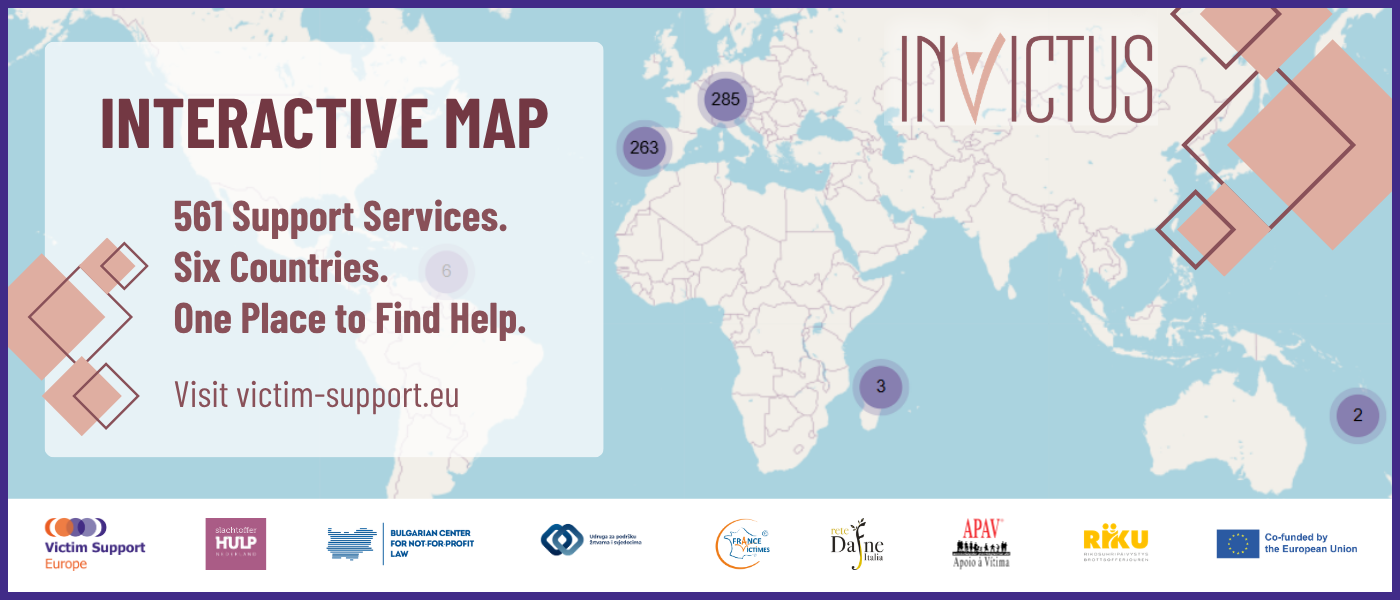
The INVICTUS project – Improving National Victim Services Through Transnational Unity and Strategy – aims to strengthen national victim support frameworks through participatory research in six countries: Bulgaria, Croatia, Finland, France, Italy, and Portugal. Partners are mapping existing services, identifying gaps and good practices, and developing collaborative solutions to improve national action plans.

For more information, visit the project’s dedicated website:

INVICTUS Project Homepage


The 2Gether4Victims project brings together 11 partners from seven countries to improve support services and individual needs assessment for victims of gender-based and domestic violence (GBV/DV). The project examines how generic and specialist victim support services can work together to provide a more coordinated, evidence based, and victim-centred responses. It identifies gaps and good practices in the GBV/DV support across the EU and develops recommendations for improving services.

For more information, visit the project’s dedicated website:

2Gether4Victims Project Homepage

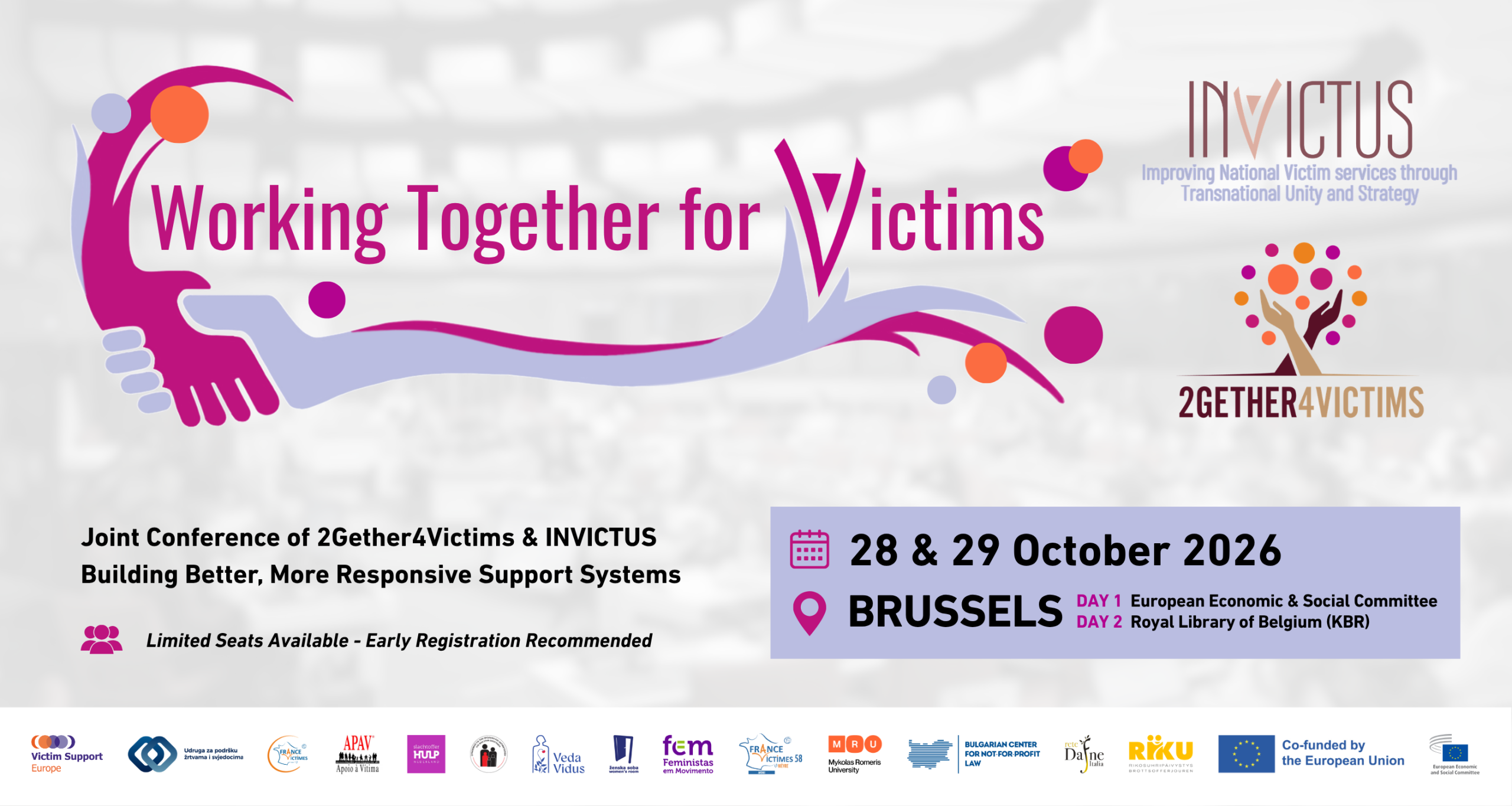
Victims Support Europe and partners are proud to invite you to the Joint Final Conference– “Working Together For Victims,” taking place on the 28th and 29th of October 2026. 

Practical Information & Registration

WHEN: 28 & 29 October 2026

WHERE: Brussels, Belgium

DAY 1: 

European Economic & Social Committee, VMA Building

Rue Van Maerlant 2, Brussels, Belgium

Meeting room:     VMA22

Access: How to get to the EESC

DAY 2:

Royal Library of Belgium (KBR)

Mont des Arts 28, 1000 Brussels

Please note that due to limited capacity of the venue, early registration is recommended. Attendance is allocated on a first-come, first-served basis. If you wish to inquire about remaining seats for in-person attendance in Brussels, please contact Victim Support Europe.

Programme

DAY 1 – Wednesday 28 OCTOBER 2026 

Location: European Economic and Social Committee, 

Rue Belliard 99/101, 1040 Brussels 

8:30 am – 9:30 am  Registration  
9:30 am – 10:00 am  Welcome Remarks and Introduction to the Conference 

Key Note Speakers  

  • Marieta Tosheva (European Commission) Legal and Policy Officer at DG JUST – Criminal Procedural Law Unit
  • Dovile Juodkaite (European Economic and Social Committee) International cooperation manager at Lithuanian disability forum 
  • Aleksandra Ivankovic (VSE) Deputy Director 
10:00 am – 11:00 am  Why is there a need for Individual Needs Assessment (INA) and tools to support all victims?  

INA as cornerstone that makes comprehensive victim support work 

Moderated by: Antonio De Martin (VSE) Development, Innovation & Knowledge Management Director

With contributions from: Project INVICTUS partners

  • Oleksandr Glagola (VSE) Senior Project Officer 
  • Daria Dušević, Senior Expert Advisor – Victim and Witness Support (Ministry of Justice of Croatia) 
  • Isabelle Sadowski, Deputy Director & Pauline Okroglic, Lead Legal Officer (France Victimes)  
  • Maatu Arkio (Victim Support Finland – RIKU), Head of Service Development 
11:00 am – 11:15 am  Coffee break 
11:15 am – 12:45 pm  What are the next steps once INA is concluded?  

The need for referral and information processes and tools for diverse victims 

With contributions from: Project INVICTUS Partners and Project 2G4V Partners (TBC) 

Referral: 

  • Oleksandr Glagola (VSE) Senior Project Officer 
  • Maja Štahan, Deputy Director and Coordinator of National Call Centre for Victims of Crime, (Croatian Victim and Witness Support Service
  • Angelo Puccia, Senior Project Manager (Rete Dafne Italia) 

Information Provision: 

  • Oleksandr Glagola (VSE) Senior Project Officer 
  • Carla Ferreira, Deputy Chief Executive & Matilde Marques, Project Officer (APAV)
  • Svetlana Latcheva, Director (Complex for Social Services for Children and Adults Who Have Experienced Violence – Bulgaria)
12:45 pm – 2:00 pm  Lunch break 
2:00 pm – 3:30 pm  How can victim support services become responsive to victims’ gender-specific needs? 

The need for gender-sensitive support for victims of GBV

  • Áine Hanrahan (VSE) Associate Policy Officer 

Indicators and standards of what makes gender-sensitive support

  • Ramunė Jakštienė (Mykolas Romeris University) Associate Professor  
  • Matylda Pogorzelska (Fundamental Rights Agency) Project Officer at the Justice, Digital and Migration Unit (online contribution) 
  • Sami Nevala (Fundamental Rights Agency) Project manager at the Justice, Digital and Migration Unit; Justice and Security Sector (online contribution) 
3:30 pm – 3:45 pm  Coffee break 
3:45 pm – 5:15 pm  Panel discussion: What is needed for victims of different genders to access support services and how an intersectional approach can help? 

Moderated by: Bruno Monteiro (VSE) Senior Project Advisor 

With contributions from:  

  • Nives Jozić Kvastek (Women’s Room) Professional Associate on Programmes and Projects 
  • Miren Spek (Victim and Witness Support Service Croatia) Executive Director 
  • Elisabete Brasil (Feministas em Movimento) Coordinator of Service for Victims of Domestic and Gender-Based Violence – Lisbon 
  • Rogers Kasagga (People Like Us) Executive Director 
  • Susan Atuhura (People Like Us) Programs Officer
5:15 pm – 5:30 pm  Concluding remarks and invitation to Day 2 

DAY 2 – Thursday 29 OCTOBER 2026 

Location: Royal Library of Belgium (KBR) 

Mont des Arts 28, 1000 Brussels 

9:00 am – 9:30 am  Registration 
9:30 am – 10:00 am  Welcome Remarks and Introduction to Day 2 of the Conference 

Key Note Speakers 

  • Rune Vanleeuw (European Commission) Legal Officer at DG JUST – Gender Equality Unit 
  • Áine Hanrahan (VSE) Associate Policy Officer 
10:00 am – 11:00 am  Panel discussion: How can organisational self-assessment help to reform support services to achieve gender-sensitive support? 

Moderated by: Bruno Monteiro (VSE) Senior Project Advisor

With contributions from:  

  • Leonor Bénard da Costa (APAV) Project Manager 
  • Nicole Van Gelder (Slachtofferhulp Nederland) Researcher 
  • Filio Kyriacou (Association for the Prevention and Handling of Violence in the Family) Project Manager 
11:15 am – 11:30 am  Coffee break 
11:30 am – 12:45 pm  Challenges and Opportunities for achieving Gender-sensitive support: sharing stories from the piloting process 

Moderated by:  Áine Hanrahan (VSE) Associate Policy Officer 

With contributions from: 

  • Renata Romano (Victim Support Malta) Head of Service 
  • Ardita Ramizi Bala (Woman Wellness Center) Executive Director
  • Eloise Rolin (ANDAVI) Jurist 
12:45 pm – 1:00 pm  Conference Concluding Remarks 

Speakers

Marieta Tosheva

Legal and Policy Officer

European Commission DG JUST

Dovile Juodkaite

Member

European Economic and Social Committee

Aleksandra Ivankovic

Deputy Director

Victim Support Europe

Antonio De Martin

Development, Innovation & Knowledge Management Director

Victim Support Europe

Isabelle Sadowski

Deputy Director

France Victimes

Pauline Okroglic

Lead Legal Officer

France Victimes

Daria Dušević

Senior Expert Advisor

Ministry of Justice of Croatia

Maatu Arkio 

Head of Service Development

Victim Support Finland – RIKU

Maja Štahan 

Deputy Director and Coordinator of National Call Centre for Victims of Crime

Victim and Witness Support Service Croatia

Angelo Puccia

Senior Project Manager

Rete Dafne Italia​

Carla Ferreira

Deputy Chief Executive

APAV

Matilde Marques

Project Officer

APAV

Svetlana Latcheva

Director

Complex for Social Services for Children and Adults Who Have Experienced Violence, Bulgaria​

Áine Hanrahan

Associate Policy Officer

Victim Support Europe

Ramuné Jakštienė

Associate Professor

Mykolas Romeris University​

Matylda Pogorzelska

Project Officer

Fundamental Rights Agency

Sami Nevala

Project Manager

Fundamental Rights Agency

Nives Jozić Kvastek 

Professional Associate on Programmes and Projects 

Women’s Room

Miren Špek

Executive Director

Victim and Witness Support Service Croatia

Elisabete Brasil

Coordinator of Service for Victims

Feministas Em Movimento

Rogers Kasagga

Executive Director

People Like Us

Susan Atuhura

Programmes Officer

People Like Us

Rune Vanleeuw

Legal Officer

European Commission DG JUST

Leonor Bénard da Costa

Project Manager

APAV

Nicole Van Gelder

Researcher

Slachtofferhulp Nederland

Filio Kyriacou

Project Manager

Association for the Prevention and Handling of Violence in the Family​

Renata Romano

Head of Service

Victim Support Malta

Ardita Ramizi Bala

Executive Director

Woman Wellness Center

Eloise Rolin

Jurist

ANDAVI

More Information Coming Soon

Contact

For questions about the conference, please contact:

Patrycja Kowalczyk at p.kowalczyk@victimsupporteurope.eu or Jora Lumezi at project@victimsupporteurope.eu

Other 2Gether4Victims & INVICTUS News

2Gether4Victims: Spring School

– May 2026

INVICTUS: Summer 2026 Update

– June 2026

Project Related Materials

Disclaimers

The project 2Gether4Victims (2G4V) – 101097005 is funded by the European Union. Views and opinions expressed are however those of the author(s) only and do not necessarily reflect those of the European Union or the European Commission. Neither the European Union nor the granting authority can be held responsible for them. 

During the present event, sensitive topics related to crime, victimisation, and professional interaction with victims will be discussed. Throughout the event’s duration, you may encounter reflections and case-based examples that may include descriptions of traumatic events, including violence, abuse, and distressing personal experiences. Some content may be emotionally challenging.   

In the context of the 2G4V project, victims of gender-based violence or domestic violence (GBV/DV) include men, women, and gender-diverse persons (non-binary, trans). It is important to have in mind that some people who are transgender identify as non-binary but there are also transgender people who identify as man or woman. So, men, women, and non-binary are categories that can all include transgender people. Being a woman or man is diverse and intersectional per se. Women are all people who identify as women. Men are all people who identify as men. This is regardless of whether they are trans, inter, cis or another gender identity. 

To ensure the safe participation of all, the consortium requires participants to commit to the following as best they are able: 

–  Hear and actively listen to others with respect and understanding. 

– Approach the opinions of others without discrimination and judgment.  

– Be open and respectful towards other opinions, knowing that all participants represent different countries, cultures, organisations, and may work within a specific context completely different to yours. 

– Understand that other participants may be working on a specific victim or crime. Their opinions and views may stem from this context and are their own responsibility. 

– Give other participants the space to speak and share their perspective. 

– Engage with curiosity if you hear something that you do not agree with. 

– Ask questions if you do not understand what has been said or if you are in doubt about what has been said. 

– Recognise that English is not the first language of all participants.  

– Not interrupt or speak over any participants. 

– Commit to look after your own wellbeing during the event as well as account for others. 

– Ask for help or support whenever you need, the consortium is available for you.