

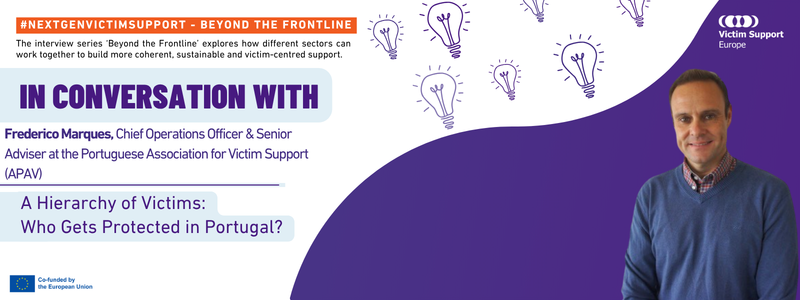
Portugal has developed a comparatively strong and increasingly specialized system for protecting victims of domestic violence. Yet this progress reveals a striking imbalance: while domestic violence has become a clear political and institutional priority, victims of other crimes often remain without the same level of protection, support, or access to justice.
In this interview, we speak with Frederico Marques, Chief Operations Officer / Senior Adviser at the Portuguese Association for Victim Support (APAV), about this gap and what it reveals about Portugal’s approach to victims’ rights.
The conversation examines the country’s legal and policy framework, the different protections available to domestic violence victims and other crime victims, and the practical barriers that continue to limit victims’ rights. It also explores coordination between police, prosecutors, courts and support organizations, the abandonment of Portugal’s first national strategy for the rights of crime victims, and the challenges of monitoring implementation.
The interview further considers victims’ experiences, access to support, risk assessment, compensation and protective measures, before turning to the central question: what would it take for all crime victims—not only victims of domestic violence—to become a genuine political priority in Portugal?

Photo courtesy: APAV
Understanding Portugal’s Landscape
Marina Kazakova (VSE): Frederico, how would you describe the current landscape of crime and victim protection in Portugal?
Frederico Marques (APAV): To understand the Portuguese context, we need to start with a key fact: Portugal has relatively low reported crime rates compared to neighboring countries. However, domestic violence is a massive issue for us. Around 30,000 domestic violence crimes are reported every year, making it the most reported crime in the country.
Given this scale, the high number of domestic homicides each year, the thousands of children affected, and the social alarm these situations cause, domestic violence has become the top political priority in crime prevention. Since 1999, we’ve had successive national plans to tackle it. We have a robust legal framework: a dedicated Domestic Violence Act that enshrines a broad set of rights, not just in criminal proceedings, but also in housing, employment, vocational training, and social support. Our Criminal Policy Act, when it comes to victims, focuses primarily on domestic violence victims and, more broadly, on those considered especially vulnerable.
We’ve invested heavily in training police and judicial professionals. The Public Prosecution Service and police forces now have specialized departments and teams. A risk assessment tool, introduced over a decade ago, allows authorities to evaluate the danger victims face and act accordingly, enabling urgent protective measures like restraining orders or tele-assistance. The system is designed to protect these victims as quickly as possible.
On top of that, we have a national support network coordinated by a government body, the Commission for Citizenship and Gender Equality (CIG). Services have expanded significantly, including court-based support and psychological counseling for children. While not flawless, this system means domestic violence victims increasingly encounter better-prepared professionals, faster interventions, and stronger coordination among responders.
Marina Kazakova (VSE): If the system has developed such a comprehensive response to domestic violence, what happens to victims of other crimes?
Frederico Marques (APAV): Now, for all other crime victims? The picture is completely different.
There’s no strategic plan. No comparable focus in criminal policy legislation. No dedicated public policies aimed at protecting these victims. In early 2024, the previous government approved what was called the First National Strategy for the Rights of Crime Victims, with 92 measures across six action áreas, including prevention, information and access to justice, victim protection, compensation, and integrating victim-centered approaches into professional cultures. But the current government abandoned it. Today, we have no integrated, coordinated strategic vision for improving the situation of all other crime victims.
Even the legal framework transposing the 2012 EU Directive is far less comprehensive than the Domestic Violence Act. Here’s a telling detail: since its approval in 2009, the Domestic Violence Act has been amended more than ten times, always to strengthen victims protection. The Victim’s Statute, which covers everyone else, has had just one minor change in eleven years. That gap speaks volumes about political commitment.
A Hierarchy of Victims: Concrete Examples
Marina Kazakova (VSE): Frederico, you describe this as creating, in effect, a hierarchy of victims. Can you give some concrete examples of how this works in practice?
Frederico Marques (APAV): Let me illustrate the disparity with specific examples.
Marina Kazakova (VSE): Let’s start with risk assessment. Why is this such an important difference between domestic violence victims and other victims?
Frederico Marques (APAV): A domestic violence victim who reports a crime will typically receive an immediate risk assessment, regularly updated thereafter. This is crucial for managing danger, giving judges confidence to apply protective measures, and informing decisions about shelter placement. Now imagine a woman who’s the victim of attempted murder or serious assault by a partner or someone close, but in a context that doesn’t technically qualify as domestic violence. She won’t get a risk assessment. Despite the law requiring individual protection needs assessments for all victims, eleven years after its adoption, no mechanism has ever been created to make it happen.
Marina Kazakova (VSE): What about access to justice? Are there similar disparities there?
Frederico Marques (APAV): A domestic violence victim who wants to take an active role in criminal proceedings is exempt from court fees and benefits from a presumption of financial hardship for legal aid purposes. A victim of attempted murder or robbery? They’ll have to pay court fees and lawyer costs unless they can prove severe economic hardship, because Portuguese legal aid rules are extremely restrictive.
Marina Kazakova (VSE): Is the same disparity visible in the way victims are connected to support services?
Frederico Marques (APAV): Absolutely. The Domestic Violence Act mandates that police refer victims to support services at the time of reporting. No equivalent requirement exists for other victims. In practice, many domestic violence victims are indeed referred; other victims, far less so.
Marina Kazakova (VSE): Victims are legally entitled to information about their rights. Does that translate into meaningful access to those rights in practice?
Frederico Marques (APAV): All victims do receive a written document outlining their rights. Updated in 2021, it’s fairly comprehensive and written in accessible language. But it’s not available in other languages, isn’t provided through alternative channels beyond the police station, and lacks legal assistance to help victims understand how to actually exercise those rights. Accessing updates on case progress remains difficult.
Marina Kazakova (VSE): Frederico, beyond these formal differences, what practical barriers do victims still face?
Frederico Marques (APAV): Online reporting mechanisms are rudimentary. Awareness of rights is low. For instance, victims of violent crime and domestic violence can, under certain circumstances, receive state compensation, but this is barely publicized. Protective measures are still entering magistrates’ routines and aren’t applied as often as they should be. Critical decisions affecting victims’ rights are frequently delayed due to staff shortages.
And here’s perhaps the most striking gap: victims generally have no way to challenge violations of their rights. The only exception relates to compensation for especially vulnerable victims. If a judge fails to determine compensation, the sentence can be declared null. But for everything else? There’s no remedy. These rights remain, in many ways, paper-thin.

Photo courtesy: APAV
Coordination: Two Different Realities
Marina Kazakova (VSE): How does coordination between the different authorities and support services work for domestic violence victims?
Frederico Marques (APAV): For domestic violence, there’s a national support network coordinated by CIG, complemented by local networks involving prosecutors, police, health services, education professionals, child protection commissions and support organizations. A centralized database managed by CIG allows organizations to check shelter availability and make referrals. In practice, though, coordination works better locally than nationally. Key actors like police forces still lack uniform inter-agency procedures, so effective collaboration tends to happen through direct personal relationships between professionals on the ground.
Marina Kazakova (VSE): And what happens when the victim is not a domestic violence victim? Is there an equivalent national coordination structure?
Frederico Marques (APAV): For all other victims? There’s no national structure whatsoever. APAV (the Portuguese Association for Victim Support) is the only national organization with a mission to support all crime victims. Through our network of nearly 90 local services, we try to ensure some consistency in how victims are approached. But across professional groups, clear referral and coordination procedures are largely missing. The approach remains siloed rather than integrated.
Marina Kazakova (VSE): What role does APAV play in trying to close that gap?
Frederico Marques (APAV): At APAV, we focus heavily on a pedagogical role: raising awareness among professionals about the importance of respecting victims’ rights. Here’s an example. Some years ago, the right to be accompanied by a support worker during court proceedings used to depend on us requesting permission from the judge, and those requests were sometimes denied. Today, we accompany thousands of victims annually in legal proceedings, and in the vast majority of cases, it’s the judicial authority asking us to be there. That shift reflects a growing understanding that respecting victims’ rights isn’t just good for victims; it makes the justice system work better.
Other protective measures, like preventing contact between victim and defendant in court spaces or remote hearings via videoconference, are also gradually becoming standard practice, largely thanks to sustained advocacy by support organizations.

Photo courtesy: APAV
Monitoring and Accountability
Marina Kazakova (VSE): What has been lost with the abandonment of the National Strategy for the Rights of Crime Victims?
Frederico Marques (APAV): The strategy clearly identified which government ministry was responsible for each of its 92 measures, which public and social sector entities would be involved in implementation, and how progress would be monitored. With it gone, the best we can hope for is the occasional isolated initiative. There is currently no entity responsible for implementation or monitoring, and no indicators or targets to assess progress.
Marina Kazakova (VSE): Are there at least mechanisms for measuring whether policies aimed at victims are working?
Frederico Marques (APAV): In domestic violence specifically, CIG publishes quarterly indicators: restraining orders applied, victims sheltered, defendants detained, children at risk due to domestic violence exposure. These give us a snapshot, but they don’t directly show whether public policies are producing positive change.
And this is where hearing from victims themselves becomes essential. If we only ask professionals, we risk an overly optimistic picture. We know from experience that professionals’ perceptions tend to be more generous than victims’. The people who are supposed to benefit from these measures are the ones who can tell us whether they actually work.
Marina Kazakova (VSE): Do you have an example of an initiative where listening to victims has demonstrated that a policy actually makes a difference?
Frederico Marques (APAV): A recent example: the COVIS project evaluated court-based support services that have been gradually rolled out across Portuguese courts for domestic violence victims. Both prosecutors and victims confirmed that these services brought real change: greater calm, greater security for victims participating in criminal proceedings, which made them more willing to cooperate, leading to more credible testimony, more indictments, and potentially more convictions. Victims themselves recognize these services as invaluable, as the difference between navigating the justice system alone and having someone by their side. Based on this positive evaluation, the plan is to extend these services nationwide by 2028.
What Portugal Needs Most
Marina Kazakova (VSE): If you could identify one major obstacle preventing Portugal from providing better protection to all crime victims, what would it be?
Frederico Marques (APAV): The most pressing issue right now is the shortage of resources, and it cuts across everything: support organizations, prosecutors, police. The situation within the Public Prosecution Service and police forces is particularly alarming. Victims see their cases drag on far longer than they should, and, critically, they don’t get the immediate response the system should provide when their situations are urgent.
Marina Kazakova (VSE): How is APAV coping with the growing demand for support?
Frederico Marques (APAV): Support organizations like APAV are creative with limited resources. Through mobile teams, specialized units for specific forms of victimization, the 116 006 helpline, the Safe Internet Line, and other channels, we keep reaching more victims. But resources don’t match the scope of what’s needed. We’re already feeling the strain in providing psychological support and court accompaniment.
Marina Kazakova (VSE): What would happen if Portugal introduced a system in which every victim who wanted support was automatically referred to a victim-support organization?
Frederico Marques (APAV): If Portugal adopted a system like those in other European countries, where all victims who wish to be referred to support services must be, neither APAV nor any other organization on the ground would have the capacity to respond. We need to seriously address how to expand the response capacity of every service and entity dealing with crime victims.
Marina Kazakova (VSE): So, ultimately, what is the single biggest change you believe Portugal needs to make?
Frederico Marques (APAV): What Portugal needs most is for all crime victims, not just domestic violence victims, to become a genuine political priority.
This isn’t only about money, though funding is critical. When we compare public funding for victim support organizations across the EU, the gap is brutal. What Portugal allocates is a fraction of what other countries invest.
Some are wealthier, yes, but it’s not just about GDP. It’s about whether victims are treated as a political priority.
That would mean coordinated national public policies for all victims, clear and standardized procedures across all professional groups, and a genuine commitment to ensuring that every crime victim receives the treatment they need to overcome, or at least minimize, the impact of what they’ve endured.
