

Victim support does not begin and end at the frontline.
For someone experiencing violence, the journey through the support system can involve police, courts, health and social services, employers, security teams and other organisations. Each may hold a different piece of the picture, with different mandates, responsibilities and understandings of risk. But what happens when those pieces do not connect?
For Kim Covent, this is not simply a question of administrative efficiency. It can become a question of safety.
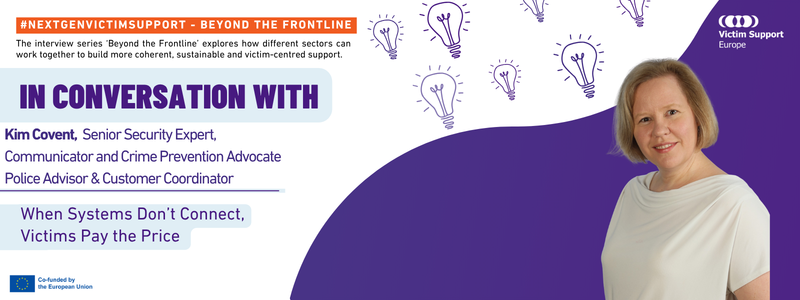
Kim Covent is a senior security expert, communicator and crime prevention advocate specialising in insider threat, crisis dynamics and human-centred risk, with a strong focus on victim protection. She works internationally as a trainer and speaker and is also a Police Advisor & Customer Coordinator, where she handles citizens’ administrative complaints against the police, with a particular focus on trust-building and emotion management.
In Snakes & Ladders: Measuring the Risks of Police-Corporate Security Non-Collaboration in Domestic-Workplace Violence, co-authored with Varsha Avadhany, Kim argues that institutional non-collaboration should itself be understood as a risk factor. Domestic violence can spill over into workplaces in predictable ways, while crucial information about risk may remain trapped within institutional silos. When this happens, victims can be left exposed—and may even be forced to carry information between organisations, repeatedly explain their experiences and coordinate their own protection.
The paper introduces a two-tier assessment tool that examines both the risk of domestic-workplace spillover and the readiness of institutions to work together. Its Snakes & Ladders model offers a simple way to visualise this dynamic: effective coordination creates “ladders” towards safety, while institutional failures can become “snakes” that increase exposure to harm.
As part of NextGenVictimSupport: Beyond the Frontline*, a campaign highlighting the next generation of coordinated victim support across Europe and showing how police, courts, health and social services, NGOs, academia and the private sector can work together to improve outcomes for victims, Kim reflects on what fragmentation looks like from a practitioner perspective, where coordination most often breaks down, and how cross-sector collaboration can become a practical safety mechanism for victims.
The victim should not have to become the coordinator
Marina Kazakova (Victim Support Europe): Kim, when did you first realise that failures in coordination between institutions could actively shape outcomes for victims?
Kim Covent: It really clicked for me while I was working closely with a colleague from the corporate security side. We realised that we were dealing with the same victims, the same frameworks and the same risks, but from completely different angles. And despite all that effort, harm still wasn’t necessarily being prevented. We were, in some ways, duplicating work without actually improving the outcome.
That was the moment when I started thinking about the gap itself as something more than inefficiency. It was a risk factor in its own right. I think many people working in this field have seen or felt that. But there is some hesitation to say it so explicitly because, once you name non-collaboration as a risk factor, you’re also acknowledging that the way institutions interact can actively contribute to harm.
Marina Kazakova (Victim Support Europe): What does that fragmentation feel like for a victim moving between different services?
Kim Covent: It feels heavy. Very heavy. Victims are essentially telling their reality twice, repeatedly. First in their personal sphere, often to the police. Then again in their professional environment—to a colleague, a manager, perhaps security.
Those aren’t neutral conversations. Every time, the victim is exposed again and is reliving harmful situations. And then something else happens: the victim starts becoming the link between systems that should be talking to each other.
They have to keep everyone updated. They are also constantly wondering: What can I say here? What shouldn’t I say there? Am I allowed to share this? Will it be taken seriously?
It’s cumbersome, draining and, honestly, discouraging. At some point, a person may simply start thinking: Is it even worth going through all of this again? That is a terrible position to put someone in when they are already trying to stay safe.
Marina Kazakova (Victim Support Europe): So, who is coordinating safety in practice when the systems themselves aren’t connected?
Kim Covent: The coordination falls to the victim. And that comes at a very heavy cost. It also assumes a level of capacity that not everyone has. People who have less access, less knowledge or less stability are the first to fall through that model.
This is why coordination isn’t simply an administrative improvement. For some victims, whether institutions coordinate may determine whether they can navigate the system at all.
From separate systems to a shared picture
Marina Kazakova (Victim Support Europe): Beyond the Frontline looks at victim support as a shared responsibility across sectors. What do we fail to see when every institution focuses only on its own mandate?
Kim Covent: We miss how predictable a lot of this actually is. In our paper, we describe spillover as the movement of risk across domains, typically from the domestic sphere into the workplace. That movement isn’t random.
It follows behavioural patterns—overlaps in control, escalation and fixation—that don’t simply stay contained in one environment. They travel. And they often intensify when a relationship changes, when separation happens or when access is threatened.
When sectors operate in isolation, each one might see a piece of that pattern, but nobody sees the trajectory. That’s the real issue. We’re not simply missing information. We’re missing the escalation pathway.
Marina Kazakova (Victim Support Europe): What prevents police, victim support, employers and other actors from forming that shared picture?
Kim Covent: Very simply: different mandates, different thresholds, different languages, different timelines and different accountability structures. Each system can be internally coherent while remaining externally disconnected. Everyone may be looking at the same person, but they aren’t necessarily seeing the same risk. That’s one of the most important things to understand about institutional fragmentation. It’s not necessarily that professionals don’t care or aren’t competent. The system itself can make it difficult for them to construct the full picture together.
Marina Kazakova (Victim Support Europe): Kim, can you give an example of information that may exist in one system but never reach another actor who could use it preventively?
Kim Covent: Police contact history is a very concrete example. If there have been repeated calls relating to domestic disturbances, or if a victim has already reported violence, that information may be well documented within police systems. But it doesn’t automatically reach the workplace, even when the risk of spillover is increasing.
And the reverse can happen too. A workplace may see stalking, repeated unwanted contact, someone monitoring an employee’s schedule, or unusual attempts to gain access.
Those observations may remain within HR or security. So, the problem isn’t necessarily that information doesn’t exist. The problem is that information doesn’t move.
When the workplace becomes part of victim support
Marina Kazakova (Victim Support Europe): Kim, your research focuses particularly on domestic violence spilling over into the workplace. Why is the private sector important to the victim-support conversation?
Kim Covent: Workplaces are among the most predictable places where a victim can be found. They are not traditionally seen as part of the domestic violence response system, but they can become an important part of the victim’s safety environment.
A perpetrator may know where someone works, when they work, who their colleagues are or how to access the workplace. So, if the workplace doesn’t recognise that domestic violence can become a workplace safety issue, an important part of the risk picture is missing. We already have a legal and policy basis that recognises this connection.
ILO Convention 190, together with Recommendation 206, explicitly recognises that violence and harassment—including domestic violence—are not purely private matters. They can affect the world of work, and employers can have a role in prevention and response. So, the conceptual step has already been taken. The gap is in translation.
We need to translate that recognition into protocols, training, communication channels, responsibilities and actual safety measures.
Marina Kazakova (Victim Support Europe): What happens to victims when workplace information, police intelligence and support-service insights remain siloed?
Kim Covent: The spillover risk becomes very real. Nobody follows the trajectory. Nobody sees how the behaviour is evolving across contexts. As a result, interventions remain reactive and fragmented and often happen too late. For the victim, safety starts depending on chance rather than design. They are left navigating systems that don’t connect, and their protection becomes inconsistent.
Marina Kazakova (Victim Support Europe): What would better collaboration look like from the victim’s perspective?
Kim Covent: When it works, it’s almost invisible. Imagine a child in a high-conflict divorce where there are safety concerns. If coordination is effective, the mother isn’t navigating the situation alone. Police, social services, lawyers, the court and even the school are aligned around the same objective: the child’s safety.
If there is a protection order, for example, it isn’t simply known within one system. The school knows who is and isn’t allowed to pick up the child. That’s what good coordination looks like. The victim doesn’t necessarily see the machinery behind it. They simply experience a system that is connected.
Snakes and ladders: making coordination visible
Marina Kazakova (Victim Support Europe): Kim, you use the Snakes & Ladders metaphor to describe coordination. What does that mean in practice?
Kim Covent: I’d make it very simple: Be a ladder. Every interaction can either accelerate safety or accelerate risk. In the Snakes-and-Ladders model, ladders represent the moments when coordination works. They are the points where information is shared, decisions are aligned and someone acts at the right time.
We want as many ladders as possible. Because every ladder gives the victim an opportunity to move forward towards safety. A snake, by contrast, is a failure point. Services don’t intervene in time. They don’t connect the right actors. They don’t use the tools that are already available. So instead of strengthening the victim’s support network, the system weakens it.
Marina Kazakova (Victim Support Europe): Which coordination failures are particularly important to address?
Kim Covent: There are ten recurring collapse points in the paper, but if I had to prioritise two, I would focus on dual case files and unsafe return-to-work situations. With dual case files, different institutions are essentially working on the same reality without a communication bridge between them. Everyone may be doing their job, but the overall picture remains fragmented.
The second is unsafe return to work. A victim may return to a workplace where the risk has already been identified somewhere else, but without coordinated safety measures around that return. That’s a very practical point where coordination can make an immediate difference.
Coordination needs to be designed—not left to goodwill
Marina Kazakova (Victim Support Europe): Your two-tier assessment tool looks at both case risk and institutional readiness. Why is that important?
Kim Covent: Because we need to shift the question from: What happened here? to: Are we structurally capable of working together before something happens?
If we accept that non-collaboration is a risk factor, then we have to look at the system itself. The tool also reduces our dependence on individuals. Right now, outcomes can vary significantly depending on who you happen to encounter. Some professionals are natural ladders. But victims shouldn’t depend on chance or personality. Coordination needs to become a feature of the system.
The law should serve safety
Marina Kazakova (Victim Support Europe): Privacy and confidentiality are often mentioned as reasons why organisations cannot share information. Where do you see uncertainty rather than actual legal restriction becoming a barrier?
Kim Covent: A lot of what is framed as legal restriction is, in practice, uncertainty. From a law-enforcement perspective, frontline officers aren’t always clear about what can be shared and under which conditions. Sometimes information could be shared—particularly with the victim’s consent—but the default becomes: keep it within the system, just to be safe.
On the corporate side, the hesitation tends to come from several overlapping fears. There is legal fear—concerns about liability. There is cultural fear—the idea that domestic violence is a private matter. And there is reputational fear—the concern about getting involved, getting it wrong or mishandling sensitive information. Those fears overlap, and they can all lead to the same outcome: inaction.
Marina Kazakova (Victim Support Europe): What would you say to an organisation that believes not sharing information is the safer option?
Kim Covent: I would turn the question around. Instead of asking: What happens if we share? Ask: What happens if we don’t?
Our paper argues that a lack of coordination is already a form of risk. So non-action isn’t necessarily the neutral or safer option. Sometimes the greater risk is allowing information to remain isolated when that information could help prevent harm.
From awareness to action
Marina Kazakova (Victim Support Europe): What is the first practical change that happens when institutions recognise that weak coordination increases risk?
Kim Covent: The first change is awareness. That may sound simple, but it matters. It doesn’t mean there will immediately be solutions to everything. It means the problem becomes visible. And from there, existing frameworks, national policies and international benchmarks can guide gradual improvement. Step by step. The important thing is that coordination weakness is no longer invisible or treated as somebody else’s problem.
Marina Kazakova (Victim Support Europe): Kim, what role can national victim-support frameworks play in making those gaps visible?
Kim Covent: They are in a unique position to operate in that grey area between systems. They can see where things don’t align because they are often close to the lived experience of victims moving through multiple institutions.
They can identify where information doesn’t transfer, where responsibilities are unclear and where victims are left to bridge gaps themselves. And importantly, they can push for those gaps to be addressed. That means not only asking, How can we cooperate better next time? It also means asking: Where did the system fail this person, and what allowed that failure to happen?
What can change tomorrow?
Marina Kazakova (Victim Support Europe): If you could improve one concrete thing tomorrow to better protect victims, what would it be?
Kim Covent: Victims of domestic violence should be actively protected against offenders at their place of work or study. That’s a very concrete starting point. If we know that risk can follow someone into those environments, then those environments need to be part of the safety conversation.
Marina Kazakova (Victim Support Europe): What would you want practitioners across police, justice, health and social services, victim support and the private sector to recognise about what they can achieve together?
Kim Covent: No single system sees the full picture. But together, they can. There’s a saying: it takes a village to raise a child. I would extend that. It also takes a village to keep that child, that woman, that person safe from harm. No individual institution can do everything. But collectively, institutions can create a much stronger protective network.
Beyond the frontline
Marina Kazakova (Victim Support Europe): When you say, “When information does not move, risk does,” what does that demand from victim-support systems across Europe?
Kim Covent: It matters now. Preventing domestic-workplace spillover requires more than better intentions or stronger mandates. It requires institutions to recognise that non-collaboration is not neutral. We need to disrupt that pattern. We need practitioners to knock on doors, ask questions, create connections and challenge the assumption that staying within institutional boundaries is always the safest option. The two-tier tool gives organisations a way to start doing that. Ask: Are we actually ready to work together? Do we know who to call? Do we understand what can be shared? Do we have protocols? Do we know what happens when someone returns to work? Have we learned from previous failures? And, perhaps most importantly: Are we creating ladders—or are we creating snakes?
Because the purpose isn’t simply to produce another framework. It’s to make coordination visible, testable and actionable. If we can identify where the system is likely to fail before the victim pays the price, then we have an opportunity to intervene earlier. That is ultimately what Beyond the Frontline is about: recognising that victim support is not the responsibility of one institution or one frontline professional.
It is a shared societal responsibility. And the measure of a good support system is not simply whether each organisation does its own job well.
It is whether, when a victim moves between systems, the protection moves with them. When information does not move, risk does.
