

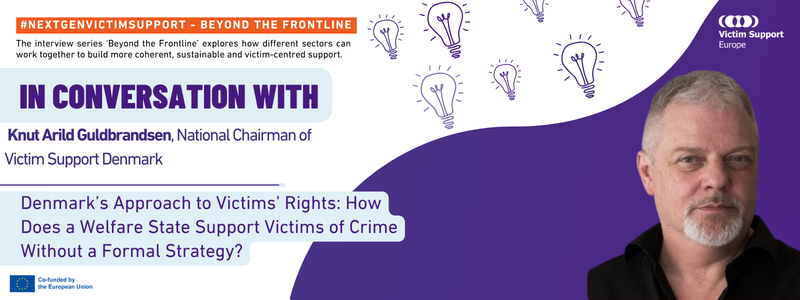
What happens when a country has no overarching national strategy for victims’ rights, yet has built a well-established system of support? In this interview, we speak with Knut Arild Guldbrandsen, National Chairman of Victim Support Denmark, about how Denmark’s approach to victims’ rights works in practice.
Drawing on more than two decades of experience in victim support, Guldbrandsen discusses the role of legislation, police, public institutions, civil society and volunteers, and explains how cooperation and trust help connect these different parts of the system. The conversation also explores access to support, vulnerable victims, secondary victimisation, compensation, digitalisation and the challenges ahead. At its centre is a broader question: can a strong victim support system develop without a formal national strategy – and what could such a strategy add?
Building a Victim Support System Without a National Strategy
Marina Kazakova, VSE: Knut, where are you sitting today while we are speaking? And if we travelled back to the beginning of your work on victims’ rights, what would your professional world have looked like?
Knut Arild Guldbrandsen: I have been involved in victim support since 2002, when I became part of a local initiative in North Denmark supporting people affected by crime and other traumatic events.
I started as a victim support worker and spent many years working directly with victims. Over time, I became increasingly involved in the organisational and national side of victim support. I joined the national board and later became National Chairman of Victim Support Denmark.
Today, my role has two sides. Nationally, I work with the overall framework for our local victim support services and with the political agenda concerning victims’ rights and conditions in Denmark. On a local level, I am the head of the local victim support that provides support to the citizens of North Jutland. So, my perspective is both strategic and very practical.
Back in 1997, the Danish government decided that there should be voluntary victim support in Denmark, and the responsibility for establishing such support was given to the Danish police. There should, on a local level, be victim support in every police district. Over the years, Danish Victim Support has developed considerably. What began as locally rooted voluntary initiatives has gradually become more organised, professional, and nationally coordinated. That development has required committed volunteers, stronger professional standards, better funding, and, importantly, close cooperation with the police and other organisations.
Marina Kazakova, VSE: Your experience shows how victim support has developed from locally rooted voluntary initiatives into a more organised and nationally coordinated system. At the same time, your own journey began very much at the level of direct contact with victims. Victims’ rights sit at the intersection of law, social policy, justice, and human support. What brought you into this field?
Knut Arild Guldbrandsen: I came into the field through practical victim support work. But over the years, supporting victims has become something very close to my heart.
What has kept me engaged is the very simple recognition that somebody needs to speak for victims and keep their needs on the agenda.
When a person has been exposed to crime or another potentially traumatic event, the system and response around them can be crucial. Having another human being who listens, helps them understand what is happening to them, and supports them in finding their way forward can make a difference.
For me, a good system therefore must start with the person, not with the institution. Rights and structures are essential, but ultimately the question is whether the victim experiences support when it is needed.
One of the most important developments in Denmark has been the growing quality and credibility of victim support. This has strengthened our relationships with the police, public authorities, and other civil society organisations. They increasingly recognise that we make a real difference to victims.
Marina Kazakova, VSE: You have described a system that has developed through practical experience, institutional cooperation, and an increasing professionalisation of victim support. Yet, as you have also noted, this development has not been guided by one overarching national strategy. Denmark does not have a single overarching national victims’ rights strategy. If you had to explain Denmark’s approach to someone outside the justice system over a cup of coffee, how would you describe it?
Knut Arild Guldbrandsen: The first thing I would say is that it is true that Denmark does not have an overarching national victims’ strategy – and developing one is high on our political agenda in Victim Support Denmark. But the absence of a formal strategy does not mean that there is no functioning system. There is.
The Danish model has developed through a combination of legislation, public institutions, professional practice, civil society, and cooperation.
There is a political and legal framework around victim support, and there is a close connection between Victim Support Denmark and the police. When a crime is reported, the police have an obligation to inform victims about the possibility of receiving victim support.
Victim Support Denmark is based on volunteers. The people who provide the actual support are trained volunteers, while over the years an organisational and financial structure has been built around them to ensure quality, training, and professional support.
At the same time, Denmark is a welfare state with many other services that may be relevant to victims – healthcare, the right to get help from a psychologist, municipal services, and specialised services for particular groups. Victim support therefore has to be understood as part of a broader ecosystem.
So, if I had to describe the Danish model very simply, I would say: legislation provides the framework, public institutions have responsibilities, civil society plays a major role, and cooperation connects the different parts.
Marina Kazakova, VSE: You have described Denmark’s model as a system in which legislation, institutions, civil society, and cooperation collectively provide direction. That raises the broader governance question of how long-term priorities are maintained when there is no single document bringing those priorities together. Many countries develop national strategies to set priorities, assign responsibilities, and measure progress. How does Denmark ensure that victims’ rights remain a long-term priority without a formal national victims’ rights strategy?
Knut Arild Guldbrandsen: There has been sustained political and professional attention to victims in Denmark, even though we have not had one document or strategy bringing everything together.
Legislation plays an important role, and different authorities have their own responsibilities. There is also political attention to victims’ rights, and organisations such as ours have an important responsibility to keep victims’ needs on the agenda and push for improvements.
In other words, direction is created by several actors rather than by one national strategy.
That can work – and in Denmark it has worked reasonably well – but it also makes the system more vulnerable. Much depends on committed people and organisations continuing to take responsibility, cooperate, and push the agenda forward.
A national strategy could make it easier to see the whole picture, define responsibilities, and maintain a common direction over time. That is why we would like Denmark to have one.
I would therefore not present Denmark as evidence that national strategies are unnecessary. I would rather say that Denmark demonstrates that strong structures can develop without one – while also showing why a strategy could strengthen what already exists.
Marina Kazakova, VSE: You have emphasised that Denmark’s system relies on several actors rather than on a single national strategy. If responsibility is distributed in this way, the next question is naturally about coordination. Victims may interact with police, prosecutors, courts, healthcare providers, municipalities, and support organisations. Who ensures that these different actors work together around the needs of victims?
Knut Arild Guldbrandsen: There is no single institution coordinating the entire Danish victim support system.
Coordination happens mainly through cooperation between the different actors and through the responsibilities assigned to individual institutions.
Some links are clearly defined. The police, for example, have an obligation to inform victims about victim support.
If I had to identify one public authority with a particularly central role, it would be the Ministry of Justice. When national initiatives concerning victims are established, or when reforms or national discussions are initiated, the Ministry is naturally an important actor.
But this is also an area where a national victims’ strategy could add real value. It could make the lines of responsibility clearer and create a more formal shared commitment to cooperation.
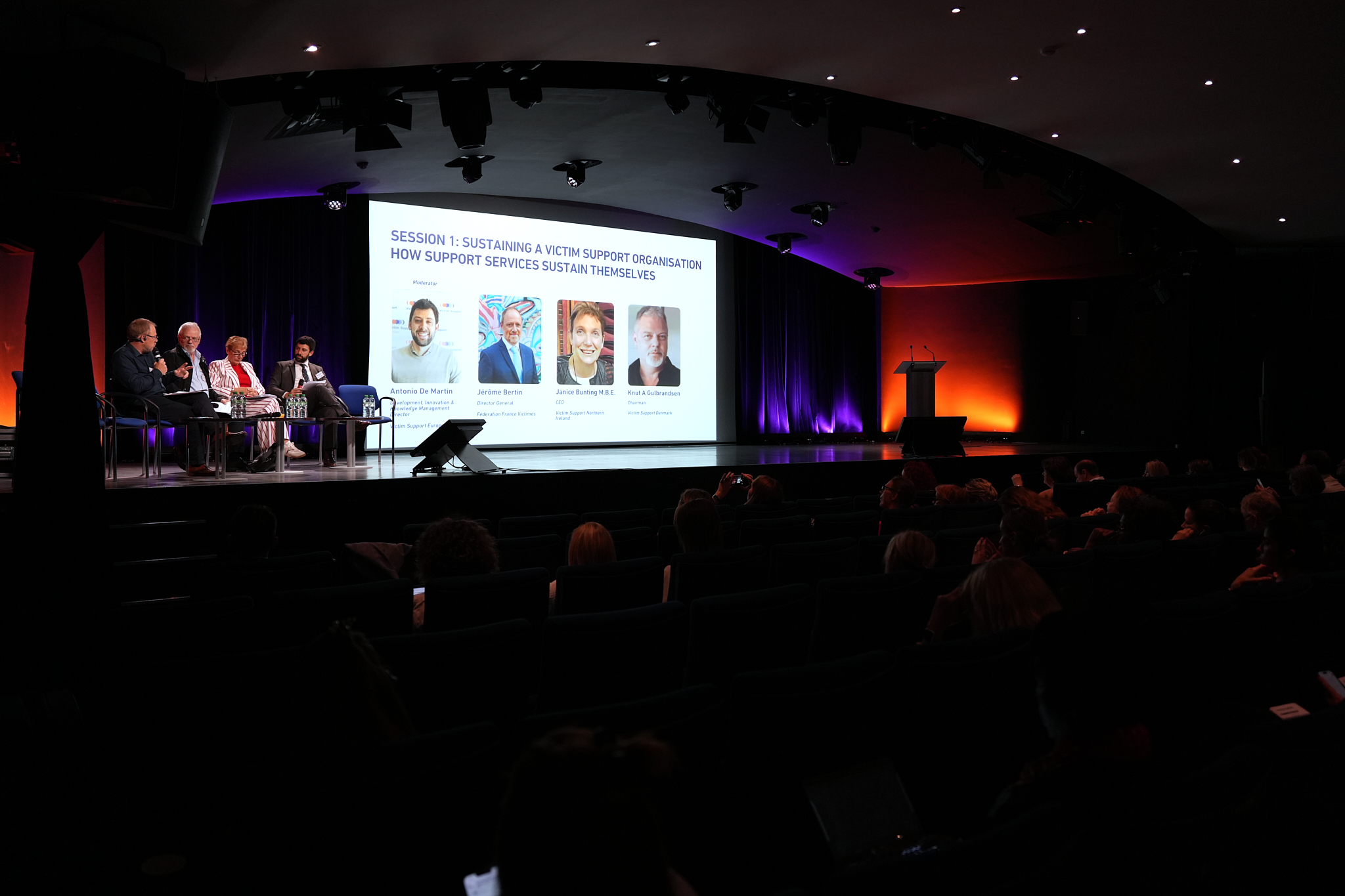
Knut taking part in the VSE AC 2026 in Paris
Photo courtesy: Ruben Dos Santos
From Legal Rights to Support in Practice
Marina Kazakova, VSE: You have explained that coordination is largely based on defined institutional responsibilities and cooperation rather than on a single coordinating body. But formal responsibilities only matter if they translate into something that victims can actually experience. Denmark provides victims with important legal protections. How does Denmark ensure that these rights are experienced by victims in practice?
Knut Arild Guldbrandsen: Different parts of the system have different obligations towards victims. The police, prosecution service, courts, and other relevant authorities each have responsibilities for information and support at different stages.
For many victims, the police are an important entry point. When a crime is reported, the police are required to inform the victim that victim support is available.
But support from Victim Support Denmark does not depend on reporting a crime. A person can contact us whether or not the crime has been reported.
That is important, but it also reveals one of the barriers. If you do not report the crime, you may never receive information about us through the police. Then our own visibility becomes extremely important, as do our relationships with other organisations that may meet victims.
Even within the formal system, information can occasionally be missed in a busy everyday life. So, one continuing challenge is simply making sure that victims know that help exists and know how to access it.
Written information on victims’ rights and services only has real value when the person who needs it knows about it and can use it.
Marina Kazakova, VSE: Your answer highlights an important distinction: having a formal right to information or support is not the same asactually knowing where to turn. This brings us directly to the organisation that often provides that practical point of contact.Denmark has a strong tradition of cooperation between public institutions and civil society, including through victim support services.What role do victim support organisations play within the Danish model?
Knut Arild Guldbrandsen: Victim Support Denmark has a central role because we are the only organisation that provides a general victim support service. Probably, we also have this role because of the political decision that we shall exist.
We are there for victims of all types of crime and accidents, and our services are also available to witnesses and relatives.
Our starting point is that everyone should have the opportunity to receive victim support – and then it’s up to the victims individually to decide whether they want to use that offer.
We provide counselling and psychosocial support. Sometimes a person needs one or two talks. Sometimes support is needed over a longer period, for example, in connection with criminal proceedings. So, we can offer services that are based on the victims’ individual needs.
Our cooperation with the police is particularly close, both nationally and locally, and over many years that cooperation has become very strong. We also cooperate with the Ministry of Justice, other authorities, and civil society organisations.
Our role has become clearer and more professional over time. One indication of this is that we are increasingly invited into discussions and partnerships concerning victims and their needs.
But one characteristic remains fundamental to our model: the person meeting the victim is a trained volunteer – another human being who has chosen to be there for them.
Marina Kazakova, VSE: You have described a model in which a voluntary organisation works closely with public authorities while retaining a distinctly human and individualised approach. That relationship depends not only on formal arrangements but also on confidence between the different actors and, ultimately, between victims and the institutions supporting them. The Danish welfare model is often associated with high levels of trust between citizens and institutions. How important is trust for making the victim support system work?
Knut Arild Guldbrandsen: Trust is extremely important. Denmark has traditionally had a high level of trust in public institutions, including the police. That matters because when the police tell a victim that victim support is available, people are more likely to see it as a credible and useful offer.
If citizens fundamentally distrusted public authorities, that pathway would be much more difficult.
In practice, trust and cooperation can compensate to some extent for the absence of a formal strategy. But I would turn the question around as well: you could have an excellent national strategy on paper, but if there is no trust and no cooperation, it will not achieve very much.
Trust must be earned and maintained. Institutions must do what they say they will do, and services must have the quality people are promised.
Long waiting times are an example of something that can damage trust. When victims must wait too long for justice or decisions, they can begin to lose confidence in the system.
Marina Kazakova, VSE: Trust can help connect institutions, but it also raises a question about consistency. If the system relies on cooperation between national and local actors, the experience of support may depend on where a victim lives. Denmark is a relatively decentralised system, with responsibilities shared between national and local actors. Do victims receive the same level of support regardless of where they live?
Knut Arild Guldbrandsen: Within Victim Support Denmark, our aim is very clearly that they do.
Our telephone and chat services are available nationally, and the same principles and standards apply throughout the country. We also offer face-to-face support, and where distance or mobility makes that difficult, support can be provided by video.
Physical distance can, of course, be more relevant in rural areas when someone wants an in-person meeting. But having several ways to contact us helps reduce that geographical barrier. Also, our volunteers mostly work from home, and therefore we can coordinate the service by finding a supporter close to the victim if personal service is needed.
Quality is also something we work with systematically. Our organisation is regularly accredited according to a quality model for counselling services in Denmark, and our volunteers receive structured training and continuing professional development.
Marina Kazakova, VSE: Your answer suggests that accessibility is not only about whether a service exists nationally, but also about whether victims can experience consistent, high-quality support wherever they are. That leads to another dimension of the victim’s experience: what happens when they interact with the justice system itself. A central objective of victims’ rights policies is to ensure that victims are not harmed again when seeking justice or support. How does Denmark work to prevent secondary victimisation?
Knut Arild Guldbrandsen: There is much greater awareness of trauma-informed approaches today than there was ten years ago.
Within Victim Support Denmark, this is fundamental to our work. Our victim support workers receive extensive basic training over a period of 12 weeks before they begin counselling victims, and trauma-informed practice is part of that training.
We also see increasing attention to trauma-informed approaches among public authorities, including the police. The basic understanding is that the way a victim is met, questioned, and guided through the system can either help or create an additional burden.
There is still room for improvement.
One area we are currently working on is support around court proceedings. We have a pilot project in which some of our victim support workers are being trained to provide more consistent and educated witness support. One of the aims is to reduce anxiety and the risk of secondary victimisation around court procedures.
Everyone can become better at this. The important development is that the awareness of the risk is increasingly recognised across the system.
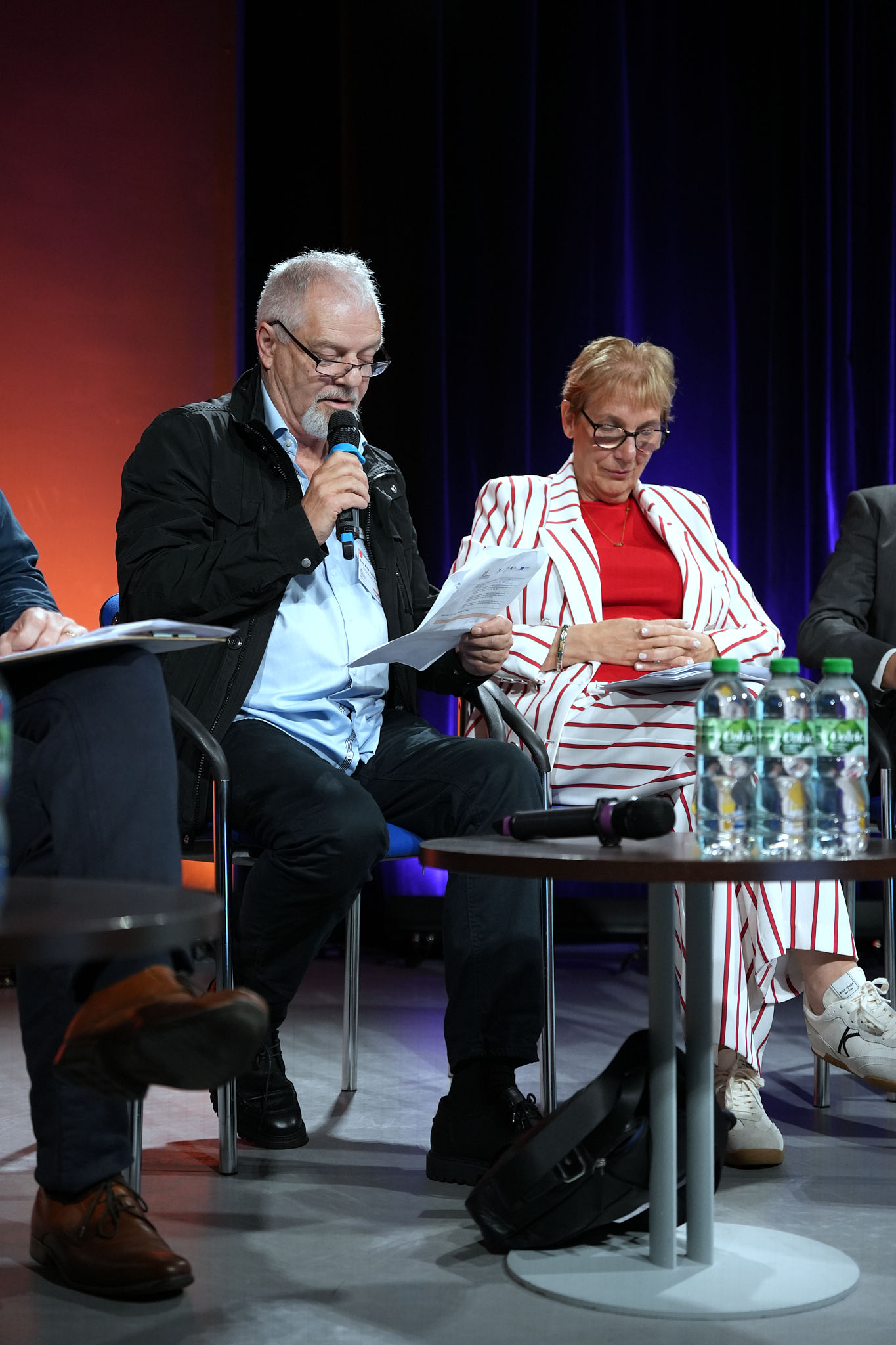
Knut’s intervention during the VSE AC 2026 in Paris
Photo courtesy: Ruben Dos Santos
Meeting Victims’ Different Needs
Marina Kazakova, VSE: The discussion so far has focused largely on the system as a whole and on the principle of universal access. But, as you have noted, victims do not all have the same needs or face the same barriers. How does Denmark adapt support for children, victims of domestic violence; victims of sexual violence, elderly victims, persons with disabilities; migrants and other vulnerable groups?
Knut Arild Guldbrandsen: The Danish approach combines universal services with specialised support.
Children are a clear example. There is strong attention to protecting children, including specialised regional Children’s Houses for children exposed to violence and sexual abuse. There are also public social services and civil society organisations specialising in children’s needs.
There are particular safeguards within the justice process as well. For example, children can be video interviewed in certain circumstances so that they do not have to repeat their experience in the courtroom, helping to reduce the risk of retraumatisation.
Victims of domestic violence and sexual violence also have access to specialised services, both within public institutions and civil society.
Victim Support Denmark complements these specialised services by being a universal service. A person does not have to belong to one particular victim category before contacting us.
When it comes to groups such as elderly victims, Victim Support Denmark has received funding to focus on that group of victims for the next five years. Together with relevant organisations, we will gather knowledge and improve services for the target group.
We still must get people with disabilities on our agenda, but they are welcome to contact us and receive regular victim support. Often, this happens through one of the professionals connected to the victim, and they can help with the practical difficulties that prevent access to a service.
Migrants are not an area we have been engaged in. I would be cautious about making a detailed assessment of every specialised service available. These groups can have particular needs and face particular barriers, but they are not all areas in which I would claim specialist expertise.
The important principle, in my view, is that universal victim support must be genuinely accessible while specialised services are available where particular needs require them.
Marina Kazakova, VSE: Your answer highlights the balance between universal access and specialised support. It also reinforces the importance of responding to the individual rather than assuming that every victim needs the same kind of assistance. Modern victims’ rights frameworks increasingly recognise victims as active participants rather than passive witnesses. How does Denmark support victims throughout criminal proceedings?
Knut Arild Guldbrandsen: For the victims we are in contact with, we start by asking what that individual victim needs.
Some people want support in preparing for court or would like a victim support worker to accompany them. Others have a strong personal network and do not need that kind of assistance. Our support should respond to the person rather than assume that everyone needs the same.
We can support victims over time and through the different stages they go through.
Now, however, there is a gap: not everyone coming to court will already be in contact with us. That is one reason why we are developing our witness-support service.
Our ambition is that people who are summoned to court can become aware that support is available and can receive help preparing for the experience.
So, I would say Denmark has important structures in place, but this is also an area where we see clear potential for improvement.`
Marina Kazakova, VSE: You have identified court proceedings as one area where further support could be developed, particularly for people who may not already be connected to victim support services. The justice process can also have consequences beyond the courtroom, including financial consequences. Victims often experience financial consequences as well as emotional harm. How accessible is compensation for victims in Denmark?
Knut Arild Guldbrandsen: Denmark has a Criminal Injuries Compensation Board through which victims can apply for compensation.
For certain types of crime, victims may have legal counsel who can provide important assistance in relation to compensation claims. Victims can also apply without such legal representation.
Victim Support Denmark can help people understand where and how to apply, although our volunteers are not lawyers and do not complete legal applications on behalf of victims.
The process has been made more accessible in some respects, but it can still be bureaucratic and difficult for some people.
One concern for us is digital access. The application process is electronic, and that can create difficulties for people who are unable to use the digital system. In those situations, there may be a need for additional support.
Waiting times are another concern. We have advocated for sufficient resources for, for instance, the police, the courts, etc., so that the waiting time for victims does not become part of the problem of recovering after being exposed to crime.
Compensation exists and can be obtained, but accessibility is not only about having a legal entitlement. The procedure must also be understandable, manageable, and reasonably quick.
Marina Kazakova, VSE: The issue of digital access illustrates an important tension: technology can make services more accessible, but it can also create new barriers for people who struggle to use digital systems. Technology is changing both crime and the way services are delivered. How is Denmark using digital solutions to improve support for victims?
Knut Arild Guldbrandsen: Denmark is a highly digital society, so digitalisation is naturally part of the environment in which victim support operates.
For example, after reporting a crime, people receive documentation through Denmark’s digital post system, and information about Victim Support Denmark is included. Public authorities also provide online information about victims’ rights and support.
Within Victim Support Denmark, accessibility is supported through different channels. People can speak with us by telephone, use our chat service, meet us face to face or, where appropriate, receive counselling by video.
For us, however, digitalisation must never remove the human dimension.
Technology can make information and support easier to access, but at the centre of our service there is still personal conversation between people.
We are also exploring new possibilities. Together with another organisation, we are developing a chatbot intended as a tool for victim supporters. It is still under development, but it is an example of how we are exploring technology while keeping professional judgement and human support at the centre.
Marina Kazakova, VSE: You have described a system that uses digital tools to expand access while deliberately maintaining a human element. This brings us back to the broader question of how the system knows whether these different approaches are actually working. When a country has a formal strategy, progress is often measured against specific objectives. How does Denmark evaluate whether its victim support system is working effectively?
Knut Arild Guldbrandsen: There is no single national set of indicators attached to a national victims’ strategy, because we do not have such a strategy. Within Victim Support Denmark, however, we work systematically with quality.
We are regularly accredited by a quality model used within the Danish counselling sector. We conduct user evaluations and ask victims about their experience of our support.
We also continuously train our victim support workers, so they remain up to date on new forms of crime, research, and evidence-informed approaches.
Other authorities also conduct their own evaluations and surveys from time to time, looking at citizens’ experiences and particular aspects of the justice system.
Victims’ own experiences are extremely important here.
A system cannot be judged only by whether procedures exist. We also need to know how people experience those procedures.
What Comes Next for Victims’ Rights in Denmark?
Marina Kazakova, VSE: Your answer suggests that Denmark evaluates its services through several mechanisms rather than against one overarching national framework. This brings us back to the central comparison underlying this interview: what does Denmark’s experience tell us when viewed alongside countries that have chosen a formal victims’ rights strategy? Across Europe, countries are choosing different paths: some develop national strategies, while others rely on legislation, institutions, and cooperation. Where does Denmark fit within this European landscape?
Knut Arild Guldbrandsen: Denmark has followed a somewhat different route from many other European countries. We do not have a national victims’ rights strategy, and because of Denmark’s particular position in relation to EU justice cooperation, our development has not simply been driven by the same European framework as in many other countries. Nevertheless, I think we have developed a strong victim support system.
One of Denmark’s strengths is our civil society tradition. Civil society has played an important role in Danish society for a very long time, and many social responsibilities are supported by strong cooperation between public institutions and civil society organisations.
Perhaps one lesson from Denmark is therefore that structures alone are not enough. You need organisations and people who understand the system they are part of, know where responsibilities lie, build relationships, and keep pushing for victims’ needs. We have been able to strengthen victim support by building credibility, cooperating with authorities, and engaging constructively with politicians and decision-makers.
Not having a strategy or being part of European directives should not prevent victim support from existing and developing. We kind of pretend that we have one and act like it. But Denmark can learn from other countries too. Countries with national strategies can provide a clearer common direction and make responsibilities more explicit. That is something we would like to achieve in Denmark: not to replace the cooperation that already works, but to give it a stronger common framework.
Marina Kazakova, VSE: You have described both the value of Denmark’s existing cooperation-based model and the potential value of giving that model a stronger common framework. Looking forward, what would need to happen to build on what already works while addressing the gaps you have identified? What are the biggest challenges and priorities for victims’ rights in Denmark over the next decade?
Knut Arild Guldbrandsen: For Victim Support Denmark, one major priority is clear: we would like Denmark to develop a national victims’ strategy. A strategy could create a common direction across authorities, institutions, and civil society and make clearer who is responsible for what. At the same time, we need to protect and strengthen the practical foundation of victim support. That means ensuring a sustainable financial basis so that professional staff can support our volunteers, strengthen our local victim support services, and continue to recruit and train enough volunteers as demand for our services grows.
There are also areas of the justice process that need further development, including support for victims around court proceedings and the quality and accessibility of legal assistance available to victims. The challenge is not to change everything at once. It is to continue developing what works, identify the gaps, and make realistic improvements while keeping victims’ actual experiences at the centre.
Marina Kazakova, VSE: You have identified several priorities for the coming years: a national strategy, sustainable resources, stronger support around court proceedings, and continued attention to victims’ actual experiences. All of these ultimately lead back to the same question: what should success look and feel like from the victim’s perspective? If we met again in five years and asked victims themselves whether Denmark’s system had improved, what is the one thing you would hope they would say? Not what policymakers say. Not what institutions report. But what victims themselves feel. What would you want their answer to be?
Knut Arild Guldbrandsen: I hope they will say something very simple: “I felt seen. I felt heard. And I felt supported.” I would hope they felt that somebody helped them regain an overview of their situation and that, at a very difficult point in their life, there was another human being there for them.
That is what many victims already tell us in our evaluations, and it means a great deal to us. But if I could add one more hope for five years from now, it would be that victims experience a justice process that moves more quickly. People understand that justice takes time. But when waiting times become too long, the waiting itself can become part of the trauma. Victims need to feel that they are treated properly and respectfully throughout the process, that what happens is fair, and that the process takes place within a time frame they can psychologically manage.
Ultimately, that is how I would measure progress – not only by what politicians or institutions say has improved, but by whether victims themselves feel that the system saw them, respected them, and helped them move forward.
