

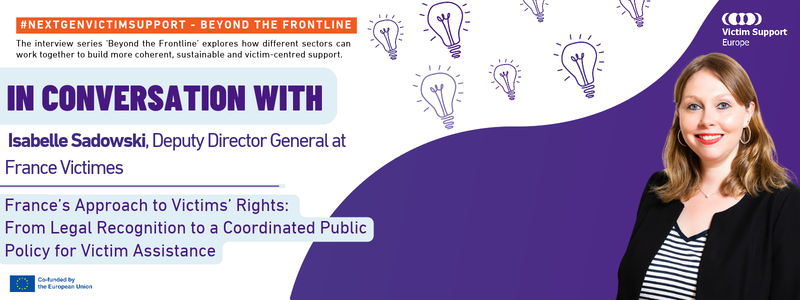
How can a country ensure that victims’ rights are not only recognised in law, but also effectively upheld in practice? In this interview, we speak with Isabelle Sadowski about France’s approach to victims’ rights, exploring the role of public institutions and victim support organisations, as well as the challenges of translating legal protections into meaningful, accessible support for victims.
This interview is part of a series published by Victim Support Europe, examining the state of victims’ rights across Europe. Through conversations with national experts and key stakeholders, the series explores how countries implement victims’ rights in practice, the legal frameworks and national strategies they have put in place, how responsibilities are coordinated across different actors, and where gaps and challenges remain.
Setting the scene
Marina Kazakova, VSE: Where are you sitting today while we are speaking, and could you describe your current role in relation to victims’ rights in France?
Isabelle Sadowski: I am Isabelle Sadowski, and I have been working for France Victimes, the French National Federation of Victim Support Associations, for over 20 years. I currently serve as Deputy Director General.
The Federation’s role is to coordinate the work of its network of 130 victim support associations across France, to strengthen and professionalise their practices, and to provide them with ongoing support in both victim assistance and the management of their organisations.
Victims’ rights have always been at the heart of my work. With a background in law, I regularly monitor legal developments and contribute to France Victimes’ advocacy by taking part in parliamentary hearings and consultations to ensure that the voice and experience of our network are reflected in legislative reforms concerning victims’ rights and victim support.
In my view, there was a clear “before and after” following the terrorist attacks of 2015 in terms of victims’ rights in France. Significant progress was made regarding the rights of victims of terrorism, but also more broadly in the field of victim support. France Victimes has consistently advocated for the standards and mechanisms developed for victims of terrorism to be extended to victims of other criminal offences.
Important reforms have also been introduced in the area of domestic and family violence. More generally, victim policy has gradually evolved from a focus on supporting victims to one centred on their protection. This shift became particularly visible from 2018–2019 onwards, following the Grenelle against domestic violence, the large-scale deployment of victim protection measures, and the influence of the 2012 EU Victims’ Rights Directive, notably through the development of individual assessments of victims’ specific protection needs (EVVI) in France, which represented a significant new area of work for victim support organisations.
Despite these advances, the main challenge remains the effective implementation of victims’ rights. French legislation provides victims with a wide range of rights, but their practical application is still too inconsistent. It often depends on the geographical area and on the professionals involved.
Another major challenge is ensuring proactive, long-term support. Victims should be contacted regularly to review their situation, assess whether their needs have changed, and identify any new support they may require. Too many victims report feeling abandoned once the initial stages of the criminal proceedings are over, and struggle to find continued assistance in the longer term.
Your journey into victims’ rights
Marina Kazakova, VSE: France has developed a strong legal and institutional framework for victims over several decades. What brought you personally into the field of victims’ rights and victim assistance?
Isabelle Sadowski: Working in the field of victim support is incredibly rewarding. It offers meaningful human connections, diverse situations, and, above all, purpose.
The Guigou Act of 15 June 2000 marked a major milestone in the development of victims’ rights in France, particularly by strengthening victims’ place within the criminal justice process. It was this legislation that introduced into the Preliminary Article of the French Code of Criminal Procedure the principle that the judicial authorities must ensure that victims are informed of their rights and that those rights are protected. The Act also formally recognised the role of victim support organisations by allowing public prosecutors to refer victims to these associations for assistance.
As regards public policy on victim support, the 2015 terrorist attacks were a turning point. They fundamentally changed the way victim support is understood, highlighting that it must be an interministerial responsibility rather than a matter for the justice system alone. Since then, several dedicated bodies have been established, including the current Interministerial Delegation for Victim Support (DIAV).
It is also essential to involve victims themselves in efforts to improve victims’ rights, alongside the expertise and perspectives of professionals. Public institutions are increasingly adopting this approach. This can be seen in the work of the DIAV, the Guarantee Fund for Victims in the area of compensation, the Independent Commission on Incest and Sexual Violence against Children (CIIVISE), and other bodies that actively seek to incorporate victims’ experiences into policymaking and reform.
France’s approach: a public policy rather than a single strategy
Marina Kazakova, VSE: Unlike some countries, France does not have a single national “Victims’ Rights Strategy.” Instead, victims’ rights are addressed through the broader politique publique d’aide aux victimes, supported by legislation, institutions, and specialised services. How would you explain the French approach to someone unfamiliar with it, Isabelle?
Isabelle Sadowski: France has indeed taken a historical approach that differs somewhat from that of several other European countries. Rather than adopting a single national strategy dedicated to victims’ rights, it has gradually developed a comprehensive public policy on victim support. This policy has been built step by step through successive legislative reforms, developments in criminal justice policy, and the creation of dedicated institutions.
Today, this policy is based on several pillars: a legal framework that has been significantly strengthened over the past twenty years, committed public institutions, and a nationwide network of victim support organisations carrying out public-interest missions in close partnership with the Ministry of Justice, providing comprehensive support to victims across the country.
This approach offers several advantages. It ensures that victims’ rights are not treated as a stand-alone policy area but rather as a shared responsibility involving a wide range of stakeholders: the justice system, healthcare services, law enforcement agencies, the education sector, social services, local authorities and civil society organisations. This is essential because victims’ needs extend far beyond the judicial response alone.
At the same time, such a system requires strong coordination; otherwise, it may become less visible and less accessible, both for professionals and for victims themselves.
A genuine national strategy on victims’ rights would help establish a common vision, shared objectives, performance indicators and long-term planning. It would also enhance the visibility of this public policy, strengthen coordination among all stakeholders and make it easier to assess the effective implementation of victims’ rights in practice. Such a strategy should be seen as a governance tool that builds on the existing framework, rather than as a replacement for it.
The institutional architecture of victim assistance in France
Marina Kazakova, VSE: France has developed an interministerial approach to victims’ rights, including coordination through the Déléguée interministérielle à l’aide aux victimes (DIAV). How is responsibility for victims’ rights organised within the French state?
Isabelle Sadowski: Historically, victim support policy in France has been led by the Ministry of Justice, which has a dedicated department for victim support and relations with victim support organisations, reporting to the Ministry’s General Secretariat. Other ministries involved in victim support, such as the Ministries of the Interior and Health, also have dedicated departments or units dealing with victim-related issues. This institutional framework is also based on close cooperation with the voluntary sector. In France, support for victims is largely provided by a nationwide network of victim support organisations accredited by the Ministry of Justice, which serve as an essential link between public institutions and victims.
However, ministries can still sometimes operate too much in silos, without sufficient coordination between their respective departments. One of the key roles of the Interministerial Delegation for Victim Support (DIAV) is precisely to promote a more cross-cutting approach to victim support policy by coordinating the actions of the different ministries in order to improve the overall support provided to victims. This approach has led to undeniable progress, particularly in the aftermath of the 2015 terrorist attacks. The DIAV could further strengthen its impact if it were provided with additional resources and if its interministerial role were reinforced. This would further enhance the coherence, visibility and effectiveness of France’s public policy on victim support.
The legal foundations of victims’ rights in France
Marina Kazakova, VSE: France is often recognised for having progressively strengthened the position of victims within criminal proceedings. What have been the most important milestones in the development of victims’ rights in French law?
Isabelle Sadowski: Victims’ rights in France have been developed progressively through a series of reforms that have fundamentally transformed the place of victims within the criminal justice system. For many years, victims were primarily regarded as individuals entitled to seek compensation for the harm they had suffered. Today, they are recognised as rights holders in their own right.
The Law of 15 June 2000, commonly known as the Guigou Law, is undoubtedly the most significant milestone. For the first time, the French Code of Criminal Procedure explicitly states that the judicial authorities must ensure that victims are informed of, and able to exercise, their rights. This law also formally recognised the role of victim support organisations, making them key actors in France’s victim support policy.
Subsequent reforms have continued to strengthen victims’ rights, particularly under the influence of European law. The 2012 EU Victims’ Rights Directive (further reinforced by the new Directive adopted in June 2026) marked a major step forward by promoting a more victim-centred approach, strengthening victims’ rights to information, protection and individual needs assessment.
Finally, the 2015 terrorist attacks represented a turning point in France’s victim support policy. They led to stronger interministerial coordination and a greater focus on addressing victims’ needs throughout their entire journey.
Today, the main challenge is no longer to create new rights, but to ensure that existing rights are effectively implemented in a consistent manner across the country and for all victims.
From rights on paper to rights in practice
Marina Kazakova, VSE: A legal right only has meaning if victims understand it and can use it. How does France ensure that victims can effectively exercise their rights?
Isabelle Sadowski: France has developed a wide range of measures aimed at ensuring the effective implementation of victims’ rights. Victims receive information from their very first contact with the police or gendarmerie, and this support continues throughout the criminal justice process through the courts, the Victim Support Offices located within courts, and, more broadly, through victim support organisations, which have an essential role in explaining victims’ rights, assisting them with administrative and legal procedures, and referring them to the appropriate services.
However, simply receiving an information leaflet does not necessarily mean that victims fully understand their rights or are able to exercise them. This is why human support remains indispensable. Victim support organisations are increasingly developing proactive outreach initiatives, contacting victims directly under a mandate from the judicial authorities rather than waiting for them to seek help themselves. This “outstretched hand” approach helps overcome many barriers: some victims are reluctant to ask for help, feel ashamed, or are simply unaware that victim support organisations exist. This proactive approach is generally very well received and makes a tangible contribution to the effective implementation of victims’ rights by facilitating access to information, support and assistance.
Nevertheless, victims’ experiences still vary considerably depending on the region, the professionals they encounter and the type of offence involved. The effective implementation of victims’ rights continues to depend to a large extent on local practices and on the quality of coordination between the different stakeholders.
The main challenge today is therefore no longer to create new rights, but to ensure that every victim, wherever they live, benefits from the same level of information, support and protection. This requires continued investment in the training of professionals, greater harmonisation of practices and regular evaluation of how effectively existing measures are implemented.
The role of victim support organisations in France
Marina Kazakova, VSE: France relies on a network of victim support organisations, including associations supported through public funding and coordinated through national structures. What role do victim support organisations play within the French model?
Isabelle Sadowski: More than forty years ago, under the leadership of Robert Badinter, France chose to rely extensively on a professional network of victim support organisations to provide assistance to victims. This partnership between public authorities and civil society organisations is one of the distinctive features of the French model.
Victim support organisations therefore play a central role in this public policy. Although they are supported and funded by public authorities and work in close cooperation with the judicial authorities, they remain independent organisations whose mission is to support victims and their families while respecting their needs, their pace of recovery and their choices. Their professionals – including psychologists, legal professionals and social workers – provide comprehensive, free, confidential and multidisciplinary support before, during and after criminal proceedings.
Over time, the role of victim support organisations has expanded considerably. Initially focused on providing information, listening and emotional support, they are now fully integrated into France’s victim support policy. They are mobilised from the very first hours following collective events, such as terrorist attacks, disasters or mass casualty events; they also develop proactive outreach initiatives towards victims and play an increasingly important role in protecting victims, particularly in cases of domestic violence.
This evolution also brings new challenges. Victim support associations are entrusted with an increasing number of responsibilities by the judicial authorities, including carrying out individual assessments of victims’ protection needs (EVVI) and supporting victims following decisions to discontinue criminal proceedings.
While this evolution reflects the confidence placed in their expertise, it also requires significant resources. The challenge is therefore to preserve what makes the French associative model so valuable: human, comprehensive and personalised support, built on a relationship of trust with victims, which should never be reduced to the mere delivery of procedural tasks.
Is France’s victim support system sufficiently coordinated?
Marina Kazakova, VSE: Victims may interact with police, prosecutors, courts, victim support associations, healthcare providers, and social services. From your perspective, does France provide a coherent victim support pathway?
Isabelle Sadowski: France has a well-established victim support system involving a wide range of stakeholders, including the justice system, law enforcement agencies, victim support organisations, healthcare professionals, social services, etc. However, the level of coordination between these actors remains uneven across regions and depending on individual circumstances.
For victims, the support available can sometimes be difficult to identify and understand. They don’t always know where to turn for help, particularly when they don’t wish to report an offence or are not yet ready to do so. The wide range of schemes, helplines, specialised services and access points can also make the system difficult to navigate. In this respect, victim support associations play an essential role as a general point of access, providing information, referrals and long-term support.
Referral mechanisms between professionals do exist, but they still depend too heavily on local practices and on how well the different stakeholders know and work with one another. Partnerships developed within police stations, gendarmerie units, courts, healthcare facilities and victim support offices have led to significant improvements. Nevertheless, referrals are not yet sufficiently systematic, and information relevant to the victim’s follow-up and support does not always flow effectively between institutions.
The main gaps in support tend to occur during transitions between different professionals or stages of the victim’s journey. These may arise after a crime has been reported, during sometimes lengthy periods without information on the progress of proceedings, when a case is closed without prosecution, following a court hearing, or at the compensation and enforcement stages. Victims may therefore feel that they themselves are responsible for ensuring continuity throughout their journey, completing all the necessary procedures and repeatedly telling their story to different professionals.
The key challenge for the coming years is therefore not so much to create new services as to better coordinate those that already exist, by developing a genuinely coordinated support pathway centred on victims’ needs: a clearly identifiable point of entry, systematic referrals, formalised handovers between professionals, and sufficiently continuous support to prevent gaps and disruptions. Victim support associations are a key link in ensuring continuity of support.
Coordination between justice institutions and victim support services
Marina Kazakova, VSE: How effectively do courts, prosecutors, police services, and victim support organisations work together?
Isabelle Sadowski: Cooperation between courts, public prosecutors’ offices, police and gendarmerie services, and victim support organisations is effective in France. It is based on a combination of formal arrangements and partnerships developed at local level.
A number of mechanisms provide a formal framework for this cooperation, including agreements between courts and victim support organisations, victim support offices within judicial courts, victim support services operating in police stations and gendarmerie units, specific arrangements for certain categories of victims, and joint participation in local coordination bodies. Public prosecutors also play an important role in referring victims to victim support associations, notably through formal referrals that enable services to proactively reach out to victims rather than waiting for them to seek support themselves.
However, the effectiveness of this cooperation still varies across the country. Beyond formal arrangements, it continues to depend to a large extent on mutual knowledge between stakeholders, the quality of professional relationships and established ways of working together. The existence of a formal partnership agreement does not, in itself, guarantee effective day-to-day coordination.
Professionals broadly share the objective of ensuring that victims’ needs are better taken into account, but their respective missions, timescales and priorities are not always the same. Judicial institutions and law enforcement agencies primarily operate within the framework of their specific responsibilities, whereas victim support organisations provide comprehensive, multidisciplinary and individualised support that doesn’t depend solely on the existence or progress of criminal proceedings. A genuinely victim-centred approach therefore requires these different perspectives and ways of working to be better coordinated.
Coordination could be further strengthened through more systematic formalisation of referral pathways, greater mutual understanding of each stakeholder’s respective role, regular opportunities for professionals to exchange information and experience, and protocols designed to ensure continuity of support. Another key challenge is to achieve a sufficiently consistent level of cooperation across the country, so that the quality of support received by victims does not depend primarily on the strength of local partnerships.
Finally, this coordination must preserve the specific role and independence of victim support associations. Their close integration within the criminal justice system is one of the strengths of the French model, but their role cannot be limited to supporting victims through criminal proceedings. They must be able to respond to victims’ needs regardless of whether a victim reports an offence, when proceedings are discontinued, or when their needs continue beyond the timeframe of the judicial process.
Preventing secondary victimisation
Marina Kazakova, VSE: A major challenge internationally is ensuring that victims are not harmed again by the justice process itself. How does France address the risk of secondary victimisation?
Isabelle Sadowski: The prevention of secondary victimisation is receiving increasing attention in France, although its integration into professional practice remains uneven.
Understanding of psychological trauma has improved significantly, particularly in the support provided to victims of sexual and domestic violence and to child victims. Many professionals now receive training on psychological trauma, coercive control, the impact of violence and the specific needs of victims. Victim support organisations also actively contribute to these training efforts. However, the level of knowledge and the extent to which these approaches are embedded in practice still vary between professionals, services and regions.
Risks of secondary victimisation therefore remain at different stages of the victim’s journey: having to repeat their story to multiple professionals, successive interviews or assessments, inadequately prepared confrontations with the offender, lengthy proceedings, lack of information about the progress or outcome of a case, or practices and attitudes that may make victims feel disbelieved or blamed. These experiences can exacerbate the initial trauma and undermine trust in institutions.
A recent legislative development in France nevertheless reflects a willingness to establish a more structured approach. The proposed legislation aimed at providing a comprehensive response to sexual and gender-based violence against women and children, which is currently being considered by Parliament, provides for the introduction of a definition of secondary victimisation into the Code of Criminal Procedure, together with a general principle of prevention. In particular, it seeks to limit the number of interviews, adapt practices to victims’ vulnerabilities and strengthen professional training. These provisions may still change during the legislative process.
The challenge now is to make the prevention of secondary victimisation a cross-cutting principle throughout the entire victim journey, regardless of the type of offence. This requires better integration of trauma-informed approaches into professional practice, individual assessment of each victim’s needs, limiting unnecessary procedures and repetition, and ensuring continuous information and support. The objective should be to ensure that the system itself never becomes a source of additional harm to victims.
Victim participation in criminal proceedings
Marina Kazakova, VSE: France gives victims important procedural rights, including the possibility of participating as a partie civile. How effective are these participation rights in practice?
Isabelle Sadowski: French law recognises victims as having an important role in criminal proceedings. In particular, they may join proceedings as civil parties (parties civiles), thereby becoming parties to the proceedings, being represented by a lawyer, requesting investigative measures (where permitted by law), seeking compensation for the harm they have suffered, and receiving support in exercising their rights at every stage of the proceedings.
This participation can contribute to victims’ sense of recognition and trust in the justice system by giving them an active role, rather than leaving them as mere spectators of the judicial process. It allows them to contribute to establishing the truth and to assert their rights. However, having procedural rights does not necessarily mean that victims feel genuinely heard.
Indeed, a gap may remain between the rights recognised by law and their effective exercise in practice. The complexity of proceedings, difficulties in understanding the roles of the different stakeholders, lack of information, lengthy delays or insufficient support can all limit some victims’ ability to fully exercise their rights. Certain stages are particularly sensitive, such as long periods without information or court hearings, where victims may sometimes feel that the opportunities to express themselves are limited.
Support therefore plays a crucial role in making these rights effective in practice. Lawyers and victim support organisations help victims understand the proceedings, prepare for the different stages and exercise their rights in an informed manner. Victim support offices within courts can also contribute to this support before, during and after hearings.
Access to victim support services
Marina Kazakova, VSE: A victim support system is only effective if victims can reach it. How accessible are victim assistance services across France?
Isabelle Sadowski: The geographical coverage of victim support services in France is generally satisfactory: there is at least one victim support organisation belonging to the France Victimes network in every department, ensuring a certain level of local accessibility, alongside a complementary network of specialised organisations. Information and referral mechanisms have also been developed to raise victims’ awareness of the services available to them.
Nevertheless, some groups still face specific barriers. In rural or remote areas, the main difficulties relate to distance, mobility and the availability of victim support services. For people with disabilities, accessibility remains uneven, not only in terms of physical premises but also information and communication tools. Victims facing language barriers may also experience difficulties accessing interpretation services and information they can understand.
Another challenge concerns victims who do not readily identify themselves as such, or those affected by less visible forms of crime. They may remain unaware of or disconnected from available services, even when they need support.
Finally, the increasing digitalisation of services presents both opportunities and risks. While it makes access easier for some victims, it may exclude others. The key challenge is therefore to maintain multiple ways of accessing support and to better adapt services to the needs of those who are hardest to reach.
Support for vulnerable victims
Marina Kazakova, VSE: Different victims require different forms of support. How does France adapt its approach for: children, victims of domestic violence, victims of sexual violence, elderly victims, victims with disabilities, victims of terrorism, victims of trafficking and organised crime?
Isabelle Sadowski: France has progressively developed tailored responses for certain particularly vulnerable victims. These are notably aimed at children, victims of domestic and sexual violence, victims of terrorism and victims of human trafficking, through mechanisms that combine, depending on the circumstances, legal, psychological, social and medical support, as well as protective measures.
However, this specialisation remains uneven. Some groups, particularly older people and people with disabilities, do not always benefit from services that are as clearly identified or accessible. More broadly, the availability of specialised support may vary across regions and depend on the availability of professionals with the necessary expertise.
The challenge, therefore, is not to set generalist and specialised support against each other. Every victim should have access to a common baseline of rights and services, while also being able to receive support tailored to their vulnerabilities and specific needs when their circumstances require it. Above all, it is important to ensure that the proliferation of services targeting specific categories of victims does not make the system more complex or create new inequalities.
Victims of terrorism and mass violence
Marina Kazakova, VSE: France has experienced major terrorist attacks that have shaped its approach to victim assistance. How have these experiences influenced France’s victims’ rights policies?
Isabelle Sadowski: The terrorist attacks that have struck France, particularly since 2015, have profoundly transformed victim support policy. They have highlighted the need for a coordinated response from the very first hours of a crisis, as well as comprehensive and sustained support extending well beyond the emergency phase.
The main lessons learned concern interministerial coordination, the rapid identification and provision of information to victims, the coordination of medical, psychological, legal, social and compensation-related support, and the need to ensure continuity between crisis management and long-term assistance. These experiences have notably contributed to stronger interministerial coordination and the development of tools to improve information-sharing between the different stakeholders.
They have also demonstrated that victims’ needs evolve over time and may persist for many years, particularly during trials, compensation procedures or commemorations. Several adjustments have therefore been made to existing arrangements. In terms of compensation, new categories of compensable harm have been recognised. The conduct of terrorism trials has also been adapted, notably to allow victims to speak earlier in the proceedings, unlike the usual course of a criminal trial.
Some of these lessons extend well beyond terrorism. Early coordination between stakeholders, the availability of a clearly identified point of contact, continuity of support and recognition of victims’ long-term needs are equally relevant to other incidents involving large numbers of victims – such as mass-casualty accidents, natural disasters or major emergencies – and can also help shape victim support policy more broadly.
Compensation and practical remedies
Marina Kazakova, VSE: Victims often face significant financial consequences following crime. How does France support victims in accessing compensation and remedies?
Isabelle Sadowski: France has developed a particularly comprehensive compensation system based on national solidarity, notably through the Guarantee Fund for Victims. This system aims to facilitate and accelerate compensation without requiring victims to have direct contact with the offender. Mechanisms such as the CIVI, FGTI and SARVI are therefore a key strength of the French model.
The main difficulty lies less in the existence of these mechanisms than in how easy they are to understand and navigate. Eligibility criteria, application deadlines, the assessment of harm and the relationship between these mechanisms and compensation awarded by the courts can all be complex for victims. Effective access to compensation therefore depends largely on the quality of the information and support they receive.
Progress has been made in improving information and simplifying procedures, but certain obstacles remain, particularly the length of some compensation processes, the complexity of medical assessments and the difficulty victims face, without support, in fully understanding their rights and assessing the extent of the harm they have suffered.
The challenge now is to make the compensation process simpler, clearer and more victim-centred, so that the existence of protective mechanisms translates into genuinely swift and equitable access to compensation.
Alignment with European victims’ rights standards
Marina Kazakova, VSE: France implements the EU Victims’ Rights Directive and participates in broader European cooperation.How does France assess its alignment with European victims’ rights standards?
Isabelle Sadowski: France has largely incorporated the requirements of the 2012 EU Victims’ Rights Directive into its national legislation. The Code of Criminal Procedure notably guarantees victims’ rights to information, support, protection and participation in criminal proceedings. Many French mechanisms, particularly the possibility for victims to join criminal proceedings as civil parties and the compensation schemes, go beyond the minimum European requirements. France already meets many of the minimum standards established by EU victims’ rights legislation, although further adjustments may be needed to ensure full compliance with new requirements and, above all, their effective implementation in practice.
For instance, the Individual Assessment of Victims (EVVI), introduced in 2015, represents one of the major developments resulting from the Directive. It provides for an initial assessment by law enforcement agencies, which may be followed by a more in-depth assessment carried out by victim support organisations upon formal request from the judicial authorities. However, its implementation remains insufficiently systematic and consistent across the country, limiting the effective identification of victims’ protection needs.
Victim support organisations play an essential role in ensuring that victims’ rights are effectively implemented, beyond their formal recognition in legislation. This is particularly true of the fundamental right of victims to information.
France must now continue its efforts to ensure that these rights are fully effective in practice and to incorporate the new requirements arising from the revision of the EU Victims’ Rights Directive adopted in 2026.
Victims’ voices in policymaking
Marina Kazakova, VSE: How are victims’ experiences and perspectives incorporated into the development of French victim assistance policies?
Isabelle Sadowski: Victims’ voices are playing an increasingly prominent role in public debate and are helping to shape French public policies, particularly in the areas of sexual violence, domestic violence and terrorism. Victims’ associations are also regularly consulted as part of institutional and parliamentary work, as well as national consultation processes.
The co-design of public policies with the involvement of victims is a positive approach and an increasingly common practice among public authorities. This trend should be encouraged and sustained, provided that victims’ participation is voluntary, appropriately supported and does not expose them to further victimisation.
However, it is important to ensure that a diverse range of victims are consulted, rather than hearing only from those who are most visible or organised. Feedback from victims’ experiences, regular consultations and the involvement of victims in evaluation bodies can help identify gaps between the rights formally recognised in legislation and their effective implementation in practice.
Accountability and monitoring of victims’ rights
Marina Kazakova, VSE: Legal protections require effective implementation. How does France monitor whether victims’ rights are respected in practice?
Isabelle Sadowski: Various judicial and administrative bodies can receive complaints when victims’ rights are not respected. Mediation mechanisms are also available in certain areas. The French Defender of Rights (Défenseur des droits) can intervene in specific matters, particularly those relating to public services or children’s rights. However, these mechanisms remain fragmented and do not provide for a comprehensive and systematic assessment of how effectively victims’ rights are implemented in practice.
Establishing a cross-cutting monitoring and evaluation mechanism to assess the effective implementation of these rights and identify potential shortcomings would undoubtedly be of significant value.
France’s strengths and remaining challenges
Marina Kazakova, VSE: Looking at France’s victims’ rights framework today, what would you identify as its greatest strengths? And what are the main challenges for the future?
Isabelle Sadowski: The French victim support model has several major strengths: a strong legal framework protecting victims’ rights, a well-structured and professional network of generalist victim support organisations, close cooperation with judicial institutions, a well-developed compensation system, and tailored responses to the specific needs of certain categories of victims. It is also based on a comprehensive approach to victim support, which goes beyond criminal proceedings and financial compensation alone.
Looking ahead, the main challenge is to ensure that existing rights are effectively implemented in practice. This requires strengthening the human and financial resources available to victim support services, in a context of growing and increasingly diverse needs, as well as improving coordination and continuing to develop professional practices towards a more victim-centred approach.
The funding of victim support organisations is a particular concern: their responsibilities are expanding, expectations are increasing, but resources do not always keep pace. It is essential to ensure that the development of specialised services does not undermine either generalist victim support or the quality of the support provided, both of which remain indispensable.
Finally, there is also a need for a broader shift in institutional culture: moving beyond simply guaranteeing rights in legislation to making their effective implementation, victims’ lived experiences and the prevention of secondary victimisation key criteria for evaluating public policies.
France in the European context
Marina Kazakova, VSE: France has developed a distinctive model based on legislation, public institutions, and victim assistance networks. When comparing France with other European countries, where does the French approach stand out?
Isabelle Sadowski: The French model stands out in particular for the role given to victim support organisations in the implementation of public policies. This close, day-to-day cooperation with judicial authorities, combined with an extensive legislative framework and well-developed compensation mechanisms, represents an approach that may be of interest to other European countries.
France can also draw inspiration from practices developed elsewhere, particularly regarding systematic referrals of victims, information sharing between institutions and the monitoring of victims’ journeys, as seen in countries such as the Netherlands and Belgium.
More broadly, European cooperation should provide opportunities to compare practices, assess their outcomes and identify solutions that genuinely improve victims’ experiences, without necessarily seeking to replicate an entire national model. Strengthening cross-border cooperation is also essential to ensuring continuity of support for victims beyond national borders.
Closing question — the future of victims’ rights in France
Marina Kazakova, VSE: If we return five years from now and look at victims’ rights in France, what is the one change you would hope victims themselves say they have experienced?
Not institutions.
Not lawyers.
Not policymakers.
Victims.
What would you want them to say?
Isabelle Sadowski: “I felt listened to, respected and supported. I didn’t have to fight for my rights or struggle on my own to find help. I understood what was happening, the decisions that were made, and I was able to move forward at my own pace. The justice system did not add to the suffering I had already experienced.”
This is undoubtedly the kind of testimony we would all hope to hear in five years’ time: that victims no longer have to expend so much energy simply to access the rights they are entitled to, and that their experience with institutions contributes to their recovery rather than leaving them exhausted
