

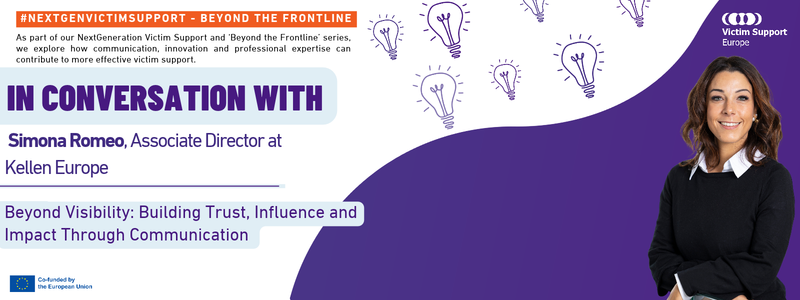
Through NextGen Victim Support campaign, VSE explores how communication, innovation and professional expertise can contribute to more effective victim support. This conversation with Simona Romeo highlights a key principle for organisations working in this field: technology and communication are most valuable when guided by a clear purpose, credible evidence and a genuine understanding of the people they aim to serve.
“If I had to guess, I believe we will be spending less time producing content and more time trying to convince people to pay attention to it.”
In a world where organisations are competing for attention across an ever-growing number of platforms, producing more content is no longer enough. The real challenge is to communicate with purpose, build trust and make expertise matter.
In this edition of NextGen Victim Support-Beyond the Frontline, Marina Kazakova, VSE, speaks with Simona Romeo, Associate Director at Kellen Europe, about what it takes to make communication truly effective. Drawing on her international experience in marketing, business intelligence, EU affairs and association communications, Simona shares practical insights on building credibility, engaging the media, using LinkedIn strategically and navigating the opportunities and limitations of AI.
Her expertise has also contributed directly to VSE’s communications activities this year. Simona led a VRComNet webinar on using LinkedIn strategically in association communciations and took on the role of speaker-challenger at Tech4Victims, critically examining the technology solutions presented by developers for victim support.
Her central message is clear: visibility alone is not enough. Trust, relevance and a well-defined purpose are what make communication count.
Setting the scene
Marina Kazakova, VSE: Simona, could you walk us through your professional journey and what led you into strategic communications within the EU and association sector?
Simona Romeo: I started my career in advertising sales, marketing and business intelligence, quite far from the Brussels bubble, I use to work for companies producing economic reports on emerging markets and I experienced living in the Middle East, LATAM, Africa and Southeast Asia. I later moved into EU affairs and communications, working with organisations such as CISPE, CERRE and AIOTI, and now Kellen Europe, where I’m Associate Director.
I think my commercial background has been quite useful. It taught me to focus on objectives, audiences and results. Something that sounds obvious but isn’t always the case in association communications. Additionally, I have been exposed to many C-level when I was very young which allowed me not to be afraid by job titles and focus on each person competencies.
What I enjoy about this sector is the variety. One day you’re working on a technical policy issue, the next you’re trying to explain why anyone outside Brussels should care about it. And that second part is often the real challenge.
Objectives, audiences and results in the commercial field
Marina Kazakova, VSE: You mentioned that your commercial background taught you to focus on objectives, audiences and results. You also highlighted how challenging it can be to explain complex issues to people outside Brussels. Looking back at your experience at CERRE and in industry associations, what most shaped your approach to making complex topics accessible without losing their substance?
Simona Romeo: Working at CERRE certainly influenced how I approach complex topics. When you’re dealing with research, regulation and technology, you learn very quickly that simplifying a message doesn’t mean making it superficial.
My experience with industry associations also taught me a lot about internal politics. Getting several companies to agree on a common message can sometimes be more complicated than communicating it externally!
Over time, I’ve become much more selective. I prefer fewer activities with a clear purpose over a very busy communications calendar that doesn’t necessarily achieve much.
Being visible versus relevant
Marina Kazakova, VSE: You make an important distinction between being visible and being relevant. If an organisation wants to move beyond impressions and follower counts, what should it do differently to become a trusted source of expertise?
Simona Romeo: I think we’ve become a little obsessed with visibility. Everyone wants more followers, more impressions, more engagement. But being visible doesn’t automatically make you relevant.
Brussels certainly doesn’t suffer from a shortage of newsletters or LinkedIn posts but for me, the real question is whether people understand what your organisation stands for and whether they would turn to you when they need expertise on a particular issue.
Credibility takes time to build, and you cannot compensate for a weak message by publishing it more often.
Communications in NGOs and associations
Marina Kazakova, VSE: Your point that visibility cannot compensate for a weak message is particularly relevant today, when organisations have more communication tools at their disposal than ever. How should NGOs and associations decide which channels and technologies are worth investing in, rather than simply adopting whatever is trending?
Simona Romeo: First, I would stop thinking about tools as the starting point. Having a LinkedIn account, a newsletter and an AI subscription doesn’t mean you have a communications strategy.
LinkedIn is extremely useful in Brussels, especially for reaching a very specific professional audience. Traditional media remain important when you want to influence a broader debate. Video and visual storytelling can help make difficult topics more accessible.
AI can certainly make our work more efficient, but it won’t fix a poor strategy. You can use it wisely to produce more compelling assets; however, AI doesn’t read your mind, it needs training, prompts so there is quite a lot of commitments in making it sound closer to what you have in mind.
The important thing is understanding who you’re trying to reach and choosing the right combination of channels.
Adapting organisations’ media outreach
Marina Kazakova, VSE: You emphasise that the right channel depends on the audience and the objective. This becomes particularly important for European associations, which need to communicate both in Brussels and across national contexts. How can they adapt their media outreach to different countries without losing the coherence of their overall message?
Simona Romeo: I think the two should complement each other rather than compete.
Brussels media are important for reaching EU decision-makers and stakeholders, but the more EU politics is influenced by Capitals, we see the relevance of national media growing within a Brussels focus communication.
The mistake is assuming that a Brussels press release will automatically interest a journalist in Italy, Germany or Poland.
National members are essential here. They understand their media landscape, the political context and which arguments resonate locally and how to put them forward.
The association should provide the common narrative and supporting evidence, while giving members enough flexibility to make the story relevant in their countries.
Capturing Journalists’ Interest
Marina Kazakova, VSE: You point out that national members understand their media landscapes and know which arguments resonate locally. But even with the right message and local knowledge, organisations still need journalists to take an interest in their work. What makes an NGO or association a genuinely valuable source for journalists, rather than just another organisation sending press releases?
Simona Romeo: The main question is easy but very few can usually answer: why a journalist should call you rather than someone else?
The ability of identifying topics where you as an organisation can contribute, the longstanding relationship with the journalist are important but also having a reality check on what can be considered newsworthy. When it comes to media relations, relevant insights are key, but timing, sometimes, is more.
Building trust
Marina Kazakova, VSE: You highlight the importance of relevant insights and good timing in media relations. But securing journalists’ attention is only part of the challenge; maintaining their trust is just as important, particularly on sensitive issues. What should organisations do to ensure that they remain accurate, reliable and responsive, especially when the evidence is incomplete or a situation is evolving?
Simona Romeo: Being accurate, responsive and consistent and knowing when not to comment.
Particularly on sensitive issues, credibility depends on being able to back up what you say. Journalists need reliable information, not just strong opinions.
I also think organisations should be comfortable admitting uncertainty when the evidence isn’t clear.
And, on a practical level, if a journalist contacts you with a deadline, responding three days later with a statement approved by 15 people probably won’t help.
Choosing communication platforms
Marina Kazakova, VSE: Your emphasis on knowing when not to comment is a useful reminder that effective communication is also about judgement and restraint. The same principle might apply to the choice of platforms: organisations do not need to be everywhere to be heard. How should NGOs assess whether platforms such as TikTok, Instagram Reels, Twitch or Discord are genuinely relevant to their audiences?
Simona Romeo: I’m not convinced every organisation needs to be on every platform.
We sometimes see associations opening new channels because everyone is talking about them, without really knowing what they’re going to publish or who they’re trying to reach.
TikTok or Instagram can be useful, particularly for public awareness campaigns, but the content has to be adapted to the platform. Posting a 90-second version of your policy statement probably isn’t going to attract Gen Z and additionally, getting the right follower base is a quite demanding exercise, so before opening a new account, you should be asking yourself if you have the time and resource to maintain it.
And I would be particularly cautious about Twitch or Discord unless there is a genuine audience and reason to be there.
Better to manage two channels properly than five badly.
Marina Kazakova, VSE: You argue that it is better to manage two channels properly than five badly. For organisations working in EU affairs, LinkedIn is often one of those essential channels. Yet many still use it mainly to announce events or share corporate updates. How can they turn LinkedIn into a strategic tool for demonstrating expertise, building relationships and reaching the people who matter?
Simona Romeo: LinkedIn is probably one of the most useful channels for organisations working in EU affairs, but I think we need to move beyond using it as a noticeboard.
Posting that your Director attended a conference is fine, but what did they actually say? What was his/her contribution?
I always encourage associations to share more expertise, opinions and practical insights, and to involve their own experts rather than relying exclusively on corporate accounts.
And please, let’s not confuse engagement with impact. A post with hundreds of likes isn’t necessarily more valuable than one that reaches the 20 people you need to influence.
Assessing influence and making policy issues accessible
Marina Kazakova, VSE: You make an important distinction between engagement and impact, noting that reaching 20 influential people can be more valuable than collecting hundreds of likes. This also raises the question of how communications success should be measured. Beyond social media metrics, how can organisations assess whether their communications are influencing the debate and supporting their wider objectives?
Simona Romeo: Too many organisations start thinking about communications once a policy development happened. Communication teams shouldn’t be working in silo and react quickly when something just happened, sloppiness could be an unwanted consequence of being too fast.
If policy and comms do not work together, there is a missed opportunity, especially when the objective is to influence policy
Marina Kazakova, VSE: Anticipating developments is only useful if organisations can communicate their positions in a way that people understand. You have criticised the use of Brussels jargon and argued that messages need to be simple to remember. How can organisations make complex policy issues accessible without oversimplifying them or losing the nuance that makes their arguments credible?
Simona Romeo: I am a firm believer that you can be precise without ending up sounding boring or diluting the content.
I face daily communication strategies/posts that speak a language, namely Brussels jargon, that nobody would use in a real conversation.
Clarifying what is changing, why it matters the wider population and why the association is advocating for it are good starting pints. Always remember that policymakers are real people, reporting to their constituencies. If you want the message to land, it needs to be simple to remember.
I am not suggesting being basic in your communication, but I think also that overcomplicating what could be easier, is not necessarily impactful.
Tayloring messanging
Marina Kazakova, VSE: You argue that a message should be easy to remember, but its relevance will depend on the audience receiving it. This is particularly challenging for European associations communicating across different national contexts. How can they maintain a recognisable common narrative while allowing their members to adapt messages to local political realities and audiences?
Simona Romeo: I think consistency is important, but it shouldn’t mean copying and pasting the same message in 15 countries.
For European associations, I would establish a common narrative, a few key messages and clear supporting evidence. Then I would work with national members to adapt the communication to their audiences.
Something that resonates in Brussels might have very little relevance to a national journalist or policymaker.
The challenge is also organisational. Members need to be involved early enough to feel ownership of the campaign, rather than receiving a communications toolkit two days before launch and being expected to promote it enthusiastically.
Concluding remarks
Marina Kazakova, VSE: Looking across the issues we’ve discussed — from credibility and audience engagement to technology and strategic planning — one theme stands out: effective communication is not about producing more content, but about making the right content matter. With AI making content creation increasingly accessible and new platforms continuing to emerge, how can NGOs and associations differentiate themselves and ensure that their communications remain trusted and impactful in the years ahead?
Simona Romeo: For NGOs and associations, I think the challenge will be differentiation and avoid falling into the trap of using all the new platforms, new tools that will become increasingly more available. Having a recognisable voice, reliable expertise and strong relationships with journalists and stakeholders will always remain the key element for a reputable organization.
I also think we’ll need to be much more disciplined about measuring what communications achieve and not to fall in the second trap: vanity KPIs.
If I had to guess, I believe we will be spending less time producing content and more time trying to convince people to pay attention to it.
