Training
Language: English
Description
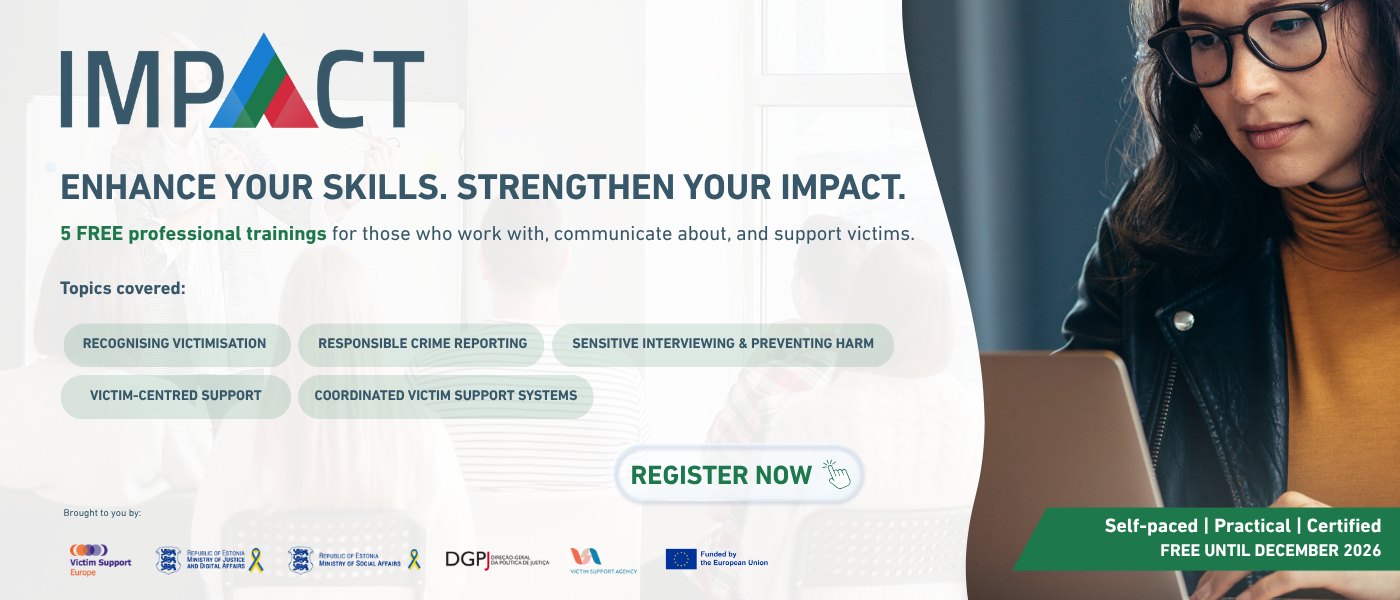
This experiential and practice-oriented training is designed to help you recognise possible indicators of victimisation, respond in a victim-centred way, and refer victims to the right support services.
Throughout the modules, you will move step by step through realistic situations:
- You will explore how trauma can affect memory, communication, and reactions, such as when someone cannot recount events chronologically or suddenly becomes silent during questioning.
- You will practise identifying patterns across physical, psychological, and social indicators, like recurrent unexplained injuries, excessive apologising, hypervigilance, or isolation.
- You will examine how the same signs may appear differently in a hospital, a police station, or a school setting, and what that means for your professional role.
- You will analyse real dialogues and decide whether a professional response supports safety and autonomy, or unintentionally increases pressure, shame, or dependency.
- Finally, you will work through a referral scenario where the challenge is not just recognising harm but knowing exactly how to connect someone to appropriate support, while respecting consent, confidentiality, and choice.
Training 2 — Shaping a victim-centred approach
Language: English
Description
This experiential and practice-oriented training is designed to help you understand how crime and trauma affect victims, respond in a way that prioritises their safety, dignity, and needs, and strengthen your communication and professional practice in real-life situations.
Throughout the modules, you will move progressively from understanding to action:
- You will explore how crime and trauma can affect victims’ behaviour, communication, memory, and trust.
- You will identify how these impacts translate into concrete needs, and how unmet needs can lead to secondary victimisation.
- You will learn how to apply a victim-centred and trauma-informed approach that prioritises safety, privacy, dignity, and empowerment.
- You will practise analysing professional situations and deciding how to respond in ways that reduce harm and support recovery.
- You will strengthen your communication skills, including empathy, active listening, and awareness of non-verbal signals.
Training 3 — Secondary Victimisation, Revictimisation, and Advanced Interview Techniques
Language: English
Description
This self-guided course on secondary victimisation, re-victimisation, and victim-sensitive interviewing techniques is designed to help frontline professionals strengthen their practice and confidence when working with victims of crime.
By the end of this course:
- You will recognise how trauma influences victim behaviour and communication.
- You will understand secondary victimisation and re‑victimisation and differences between them, through examples, definitions, and common causes.
- You will be able to prevent secondary victimisation through professional responses.
- You will be able to conduct interviews that are clear, supportive, and effective, as well as protect privacy and confidentiality.
- You will adapt your approach to sensitive cases and vulnerable victims.
- You will work confidently within multi-professional environments, including health, social, and legal services.
Training 4 – Responsible Media Communication and Victim-Centred Crime Reporting Practices
Language: English
Description
This training equips media professionals with practical, trauma-informed, victim-centred tools for collecting information, connecting with survivors, communicating with victims, and telling stories responsibly.
In this course:
- You will explore how journalists can report on crime and trauma responsibly, without causing additional harm to victims or survivors.
- You will learn how to approach sensitive situations with empathy, respect boundaries, communicate thoughtfully, and tell stories in ways that inform the public while protecting dignity and safety.
- You will encounter realistic scenarios, interactive quizzes, and “What would you do?” decision points that mirror the kinds of situations journalists often face.
Across the modules, you will learn how to:
- Collect information responsibly and approach survivors ethically
- Connect with survivors in safe and empathetic ways
- Communicate with victims using respectful and trauma-informed language
- Tell stories about crime and trauma without sensationalizing or causing additional harm
Training 5 – Working Within a National Framework for Comprehensive Victim Support
Language: English
Description
This self-guided course is designed to help first-contact professionals understand their role within a wider victim support system and for policy-makers to understand what elements need to be present to achieve a successful, well-coordinated system. It focuses on how different actors can contribute to a more coordinated, victim-centred response.
By the end of this course:
- You will better understand how victim support can move from isolated responses to coordinated action.
- You will better understand how your professional role can help victims access the right support, at the right time, with dignity and respect.
Contacts
For project-related inquiries, please contact:
Oleksandr Glagola
Senior Project Officer
o.glagola@victimsupporteurope.eu
0032(0)23 46 04 55
For training inquiries, please contact:
Patrycja Kowalczyk
Project Assistant
p.kowalczyk@victimsupporteurope.eu
0032(0)23 46 04 55
 © 2025. All rights reserved. Privacy Policy.