

A Conversation on Northern Ireland’s New Victims’ and Witnesses Strategy and Whether the System is a C.S. Lewis Wardrobe — or Something Less Magical
What does it take to make a justice system truly work for victims? According to Geraldine Hanna, sometimes it takes persistence, a healthy dose of impatience, and the willingness to be the “cynical voice” asking, “Show me the results.”
After more than two decades on the frontline of victim support, Geraldine is now Northern Ireland’s Victim of Crime Commissioner Designate. In this conversation, she reflects on her journey from the somewhat imposing corridors of a London court to the heart of policy and justice reform in Northern Ireland.
With characteristic honesty—and a few memorable metaphors along the way—Geraldine talks about breaking down institutional silos, putting victims’ voices at the centre, and turning ambition into meaningful change. She also reflects on Northern Ireland’s evolving Victims and Witnesses Strategy 2026–2032, and what it will take to translate its commitments into tangible improvements for victims and witnesses.
As part of Victim Support Europe’s Next Generation Victim Support campaign, this conversation looks at the people, ideas and innovations shaping what victim support can—and should—look like next.
Professional Journey & Motivation
Marina Kazakova, VSE: Geraldine, where are you sitting today as we speak? And if we could travel back to the very beginning, to when you first started working in victim support, what would your workspace have looked like then?
Geraldine Hanna: When I first started working in the victim support sector, one of my first jobs was in London with Victim Support England and Wales. I was the Witness Service Coordinator in this huge, intimidating old court building. I actually vividly remember thinking, “I can’t work in a place like this!” I’m from a small town in Ireland; there are more people in London than there are in the whole island of Ireland. It was so big and so scary. But I remember thinking – if I feel like this, when I’m only going to work, how does a victim or a witness feel going in here?
That grounded me and it really helped me. I used to say to our volunteers all the time – if you’re nervous, think what a victim must feel like walking into such a building.
I still sometimes get that feeling of “I can’t do that!” if I’m preparing to address a committee at Stormont, or when I’m doing media to raise an issue. But I go back to that feeling of, if I’m nervous, how much scarier must this be for the victims who have come forward and told me their stories? And that gives me all the courage I need to do the job.
I used to be “at the coalface” and I’m not anymore. When I worked for Victim Support NI, I was five minutes away from the courts. Now I work five minutes away from the Minister of Justice’s office. It’s a different type of work, but I still feel that heavy responsibility that I have to get this right for victims.
About The Commissioner’s Path
Marina Kazakova, VSE: You spent more than two decades at Victim Support, first with Victim Support England and Wales from 2001 to 2006, and then with Victim Support Northern Ireland from 2006 to 2022, working right at the heart of frontline victim services. And now, in your role as Victim of Crime Commissioner Designate, how did that journey actually happen? Do people wake up one morning and decide they want to become a Commissioner — or is it more a case of being gently, or perhaps not so gently, persuaded along the way?
Geraldine Hanna: I had been campaigning for a Commissioner for a long time. As Chief Executive of Victim Support NI, I obviously was a strong supporter of the office being created. The more I got involved with that campaign, the more I thought I’d love to do that job. I do have a bit of a tendency to just roll my sleeves up and get my hands dirty, so maybe it was inevitable that I would put myself forward. It’s really a question of being careful what you wish for.
I will say this, though – the creation of this office did not just happen. That took a lot of brilliant people in our victim support sector and, in particular, a very determined family who were bereaved by homicide, working really hard for a long time to convince our political leaders that the office was worthwhile. And I hope that the politicians here are seeing some real benefit from the creation of this office.
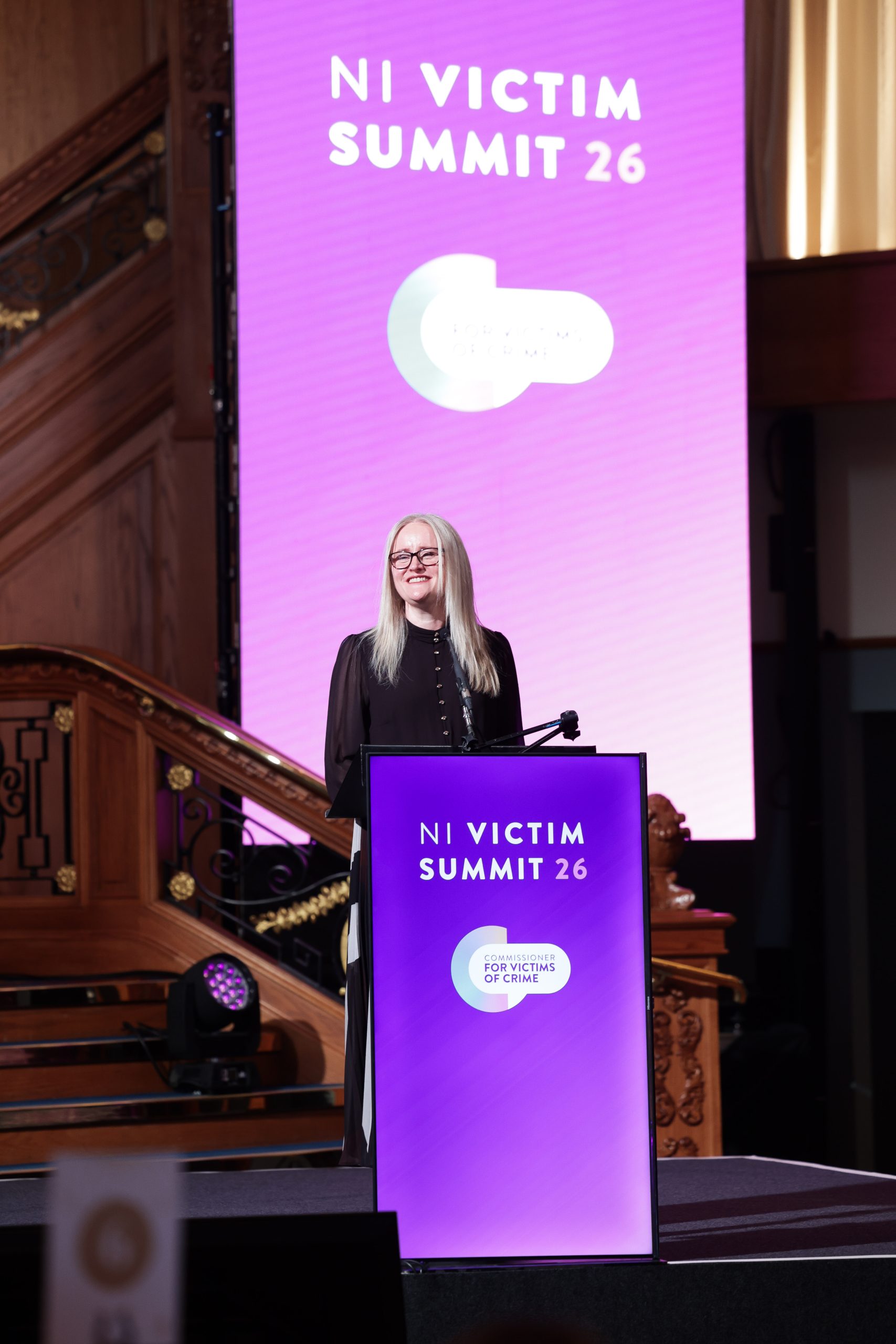
Photo Courtesy of: Geraldine Hanna
About The Previous and Present-Day Strategies
Marina Kazakova, VSE: Geraldine, strategies often promise change, but people want to know what actually improves. What concrete difference did the 2021–2024 strategy make for victims and witnesses, and what new elements will the 2026–2032 strategy introduce—and if you had to explain it to someone outside the justice system over a cup of coffee, what would you say has genuinely changed, rather than just been renamed?
Geraldine Hanna: I always say, words are great, actions are better. I totally agree that a strategy is only as good as the concrete differences it can make in people’s lives.
If I wanted to explain it over a cup of coffee, I’d say it’s a plan to make things better for victims and witnesses of crime here in Northern Ireland. And you’d probably say that seems pretty obvious! I think it’s important, though, that when things are complex, we cut through some of that complexity and remind ourselves of our why. Every action we take has to link back to that seemingly simple goal. I do think there is growing recognition of the lack of consideration that the system has actually built in for victims of crime and their needs in the process.
This strategy is trying to correct that wrong. It is all about increasing participation and rights, and making the justice system trauma-informed. It’s a positive document, and I’m hopeful that it will make changes. I particularly welcome the recognition of children and young people in the document.
I will say this, though. My job now is to be the cynical one. To be the nagging parent over the shoulder saying, “Have you finished your homework yet?” It’s my job to say, vision and plans are all well and good but show me the real changes. Show me the results in 2032.
Victim Support Service Infrastructure
Marina Kazakova, VSE: How comprehensive is the victim support ecosystem in Northern Ireland, and where are the current gaps? If you had to describe the system as a piece of furniture, would it be a sturdy C.S. Lewis wardrobe—solid, reliable, and opening cleanly into something well-structured… or more like an IKEA flat-pack on a busy Saturday in Belfast, where the instructions are there, but the Allen key seems to have gone missing?
Geraldine Hanna: Maybe it’s neither? Maybe it’s a chest of drawers, where the police are in one drawer, the prosecuting body is in another, and the Department of Justice is in another, and none of them are working together properly to support victims. Being from Northern Ireland, I should really try and work out a metaphor about how the justice system is like Narnia, where time stands still and victims get lost, but I’m not sure it really works.
Organisations here are connected but don’t have clear sight of the victim journey – they’re all technically part of one system, but they also operate independently, and victims are trying to navigate between those closed doors.
Our voluntary and community sector does amazing work in supporting victims, but I am really worried about the security of their funding. Those community and voluntary organisations can’t be gutted in the name of efficiencies because the long-term cost will just be so much greater.
Strategic Ambition & Timeframe
Marina Kazakova, VSE: Geraldine, how does the NI Victims and Witnesses Strategy (2026–2030) define success by 2030, and how ambitious is it compared to EU and neighbouring models? Is the strategy primarily reforming existing systems or redesigning the victim support architecture?
Geraldine Hanna: The real aim of this strategy is to try and make things better for victims and witnesses in Northern Ireland – does that seem too obvious? Maybe, but sometimes stating the obvious is important because, when things are complex, it’s important to cut through that complexity with clarity and ask ourselves – is what we’re doing right now going to make things better for victims and witnesses here in Northern Ireland?
The recognition of children and young people is really welcome and important, as is the stated aim of increasing participation and rights.
I would love us to be really ambitious about reform; however, there is, of course, the pragmatist in me that recognises the need for resourcing and political buy-in to reform, which isn’t necessarily a given. It’s important to note that the incremental changes have introduced significant improvements, such as SOLAs, RECs, etc., so progress is being made. However, I am naturally impatient – which is a good trait in this role!
I think the vision of the strategy is really positive, and I’m excited that it’ll make changes. The role of my office now, however, is to be the cynical voice and say, “OK, show me the results in 2032.” Because no matter how ambitious it is, I’m always going to want it to do more. That’s my job!
About a Statutory Commissioner for Victims and Witnesses
Marina Kazakova, VSE: The strategy foresees the establishment of a statutory Commissioner for Victims and Witnesses: what added value do you expect this role to bring in practice, and how will it strengthen accountability across the system?
Geraldine Hanna: This is an interesting time. The office is moving to a statutory footing, so we’ve looked at a range of powers the office should have, including compelling organisations to share data and respond to recommendations, etc.
I do think some of the best work we’ve done so far isn’t because we have powers to compel people to do stuff; it’s because we’ve brought the voices of victims into public debates, and those are the most compelling arguments for change. Having this role send a statement to victims, it adds a weight to their voice. There is something about having a Commissioner championing victims’ rights which sends a powerful message, particularly if that Commissioner has the power, for example, to compel agencies to respond to recommendations.
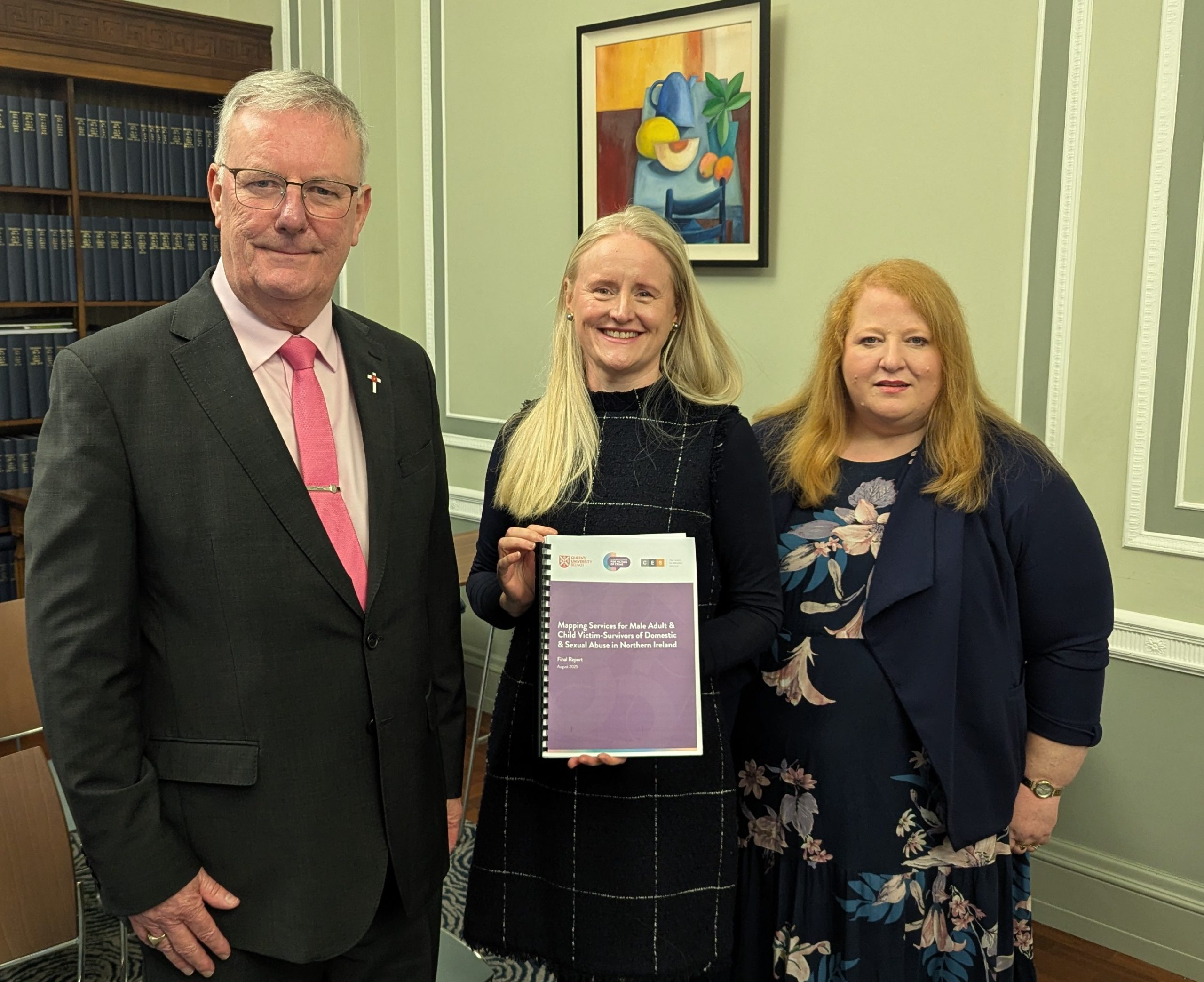
Gerladine meeting the Irish Ministry of Health and Justice
Photo Courtesy of: Geraldine Hanna
Lead Coordination & Governance Model
Marina Kazakova, VSE: Geraldine, which institution is formally accountable for delivery, and how strong is its coordinating authority across justice, health, and social services? Is there a single lead body (like a Ministry of Justice model elsewhere), or a shared governance structure? If this system were a household, who is the one actually making sure everyone takes the bins out — and do they ever admit it?
Geraldine Hanna: When it comes to victims’ issues in Northern Ireland, everyone automatically assumes it’s just for the Department of Justice to worry about. My office was created by the Minister of Justice, and much of the work I do is with the Justice Department or with Criminal Justice Organisations. But anyone who has worked in victims’ rights issues for more than ten minutes will tell you, this work is genuinely cross-cutting.
At the moment, I’m working on improving the experience of victims of domestic abuse in our private law family courts. That needs input from Justice, Health, Finance, the legal professions, support organisations, and loads of others. It’s one of the big challenges of the role: not having a single organisation responsible for coordinating and making that happen. My office will often try to take the lead on facilitating conversations and driving collaboration for positive change.
Multi-agency Coordination Structure
Marina Kazakova, VSE: To what extent is Northern Ireland moving toward a fully institutionalised multi-agency victim support model—and is it becoming the kind of system where police, CPS, courts, health, and NGOs are genuinely “all in the same room” rather than just politely emailing each other? Are they bound into formal coordination protocols, or is it still more of a well-intentioned handshake arrangement? And crucially, is this coordination now statutory and hardwired into the system, or still largely voluntary/operational — depending, in practice, on who has the best meeting invite list?
Geraldine Hanna: We still have a long way to go to get out of siloed working. Progress has been made, and the appointment of Victim Champions within CJ organisations and the creation of a multi-agency Victim and Witness Steering Group to oversee the strategy are certainly steps forward.
One of the big challenges is that our justice system is independent but interdependent. In times of austerity and capacity pressures, agencies often look into and prioritise the internal work rather than the multi-agency work. But on the outside of this, victims don’t see lots of different organisations; they see one system, and if one part of that fails, it all fails.
Implementation, Protection and Support for Victims
Marina Kazakova, VSE: How will implementation be tracked in practice beyond publication of the strategy? Are there measurable indicators, dashboards, or reporting cycles? Will there be independent evaluation or only internal monitoring?
Geraldine Hanna: All of this will be monitored by the Victim and Witness Steering Group who report to the Criminal Justice Board.
Marina Kazakova, VSE: What specific safeguards does the Strategy set out to prevent secondary victimisation during investigations and court processes?
Are trauma-informed practices mandatory or recommended?
Geraldine Hanna: There is a lot of talk in Northern Ireland about a victim-centred justice system that is trauma informed and agencies have undertaken some training on this issue. Sadly, I think we still have a long way to go before the reality matches the rhetoric.
Marina Kazakova, VSE: Geraldine, how does the strategy differentiate support for children, domestic abuse survivors, disabled victims, and other vulnerable groups? You are exploring the introduction of a Barnahus model: what lessons are you drawing from other countries, and how will you ensure it is adapted to the local context? The introduction of pre-recorded cross-examination is a significant step: how do you see this changing the experience of victims, particularly children?
Improved protections for victims’ personal data in sexual offence cases are foreseen: what concrete changes can victims expect, and how will trust in the system be strengthened?
Geraldine Hanna: The introduction of improved protections for victims’ personal data in sexual offences cases has been a key priority of my office since I took up post. The legislation that will provide these protections has just been introduced to our legislature here in Northern Ireland, and I am hopeful that it will make a real difference for victims in the future, once it passes into law.
Marina Kazakova, VSE: Geraldine, as we come to the end of our conversation, I want to look beyond Northern Ireland for a moment. Looking at international models – from Croatia and Portugal to the Netherlands and Germany – which country do you think Northern Ireland most closely resembles in its approach, and where does it go further or fall short?
And, as a final question: if you were allowed to “borrow one feature” from any of them with no budget approval needed… what would you steal first without telling Treasury?
Geraldine Hanna: I’ll take two because I don’t just want one! I would have the CAVAC system—the network of Crime Victims Assistance Centres in Quebec, which provides individual needs assessment, support and advocacy for victims—and the Canadian compensation scheme as well.
Obviously, Northern Ireland is a common law country, which has implications for how changes can be adapted. What I think other common law countries should have are SOLAs (sexual offence legal advisors) and remote evidence centres.
And of course, I think they should all have commissioners for victims of crime! ☺️
