

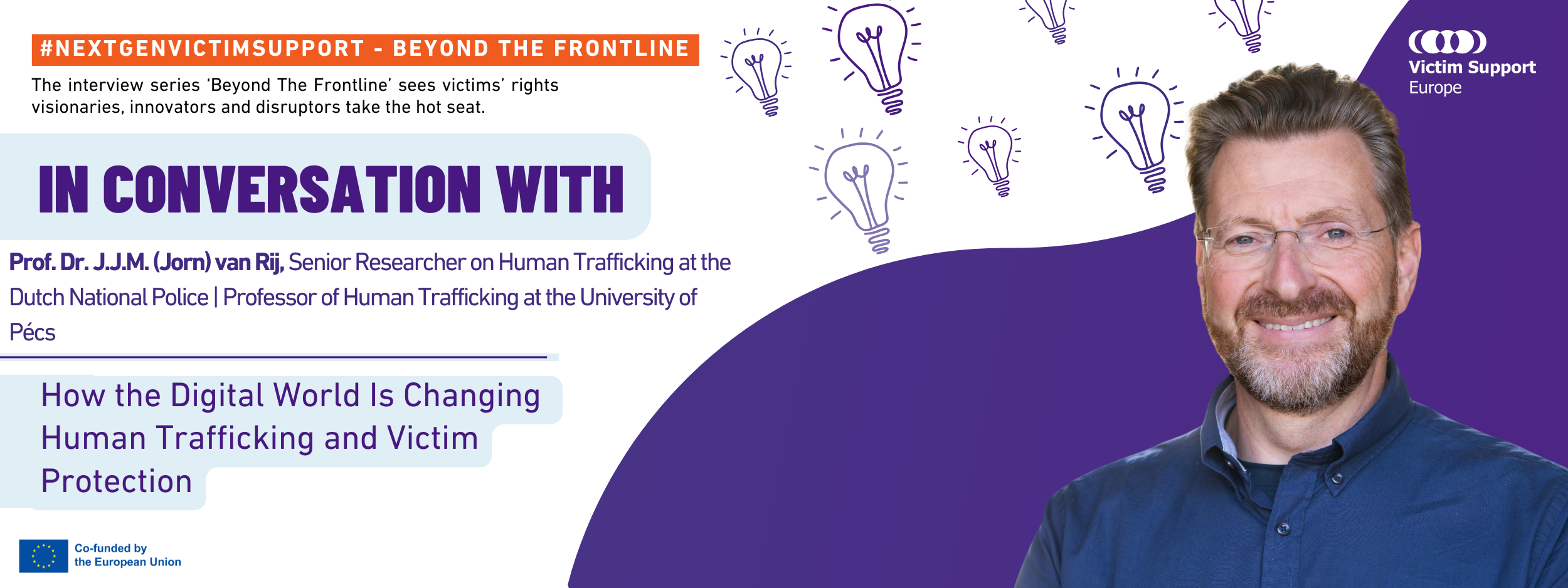
As part of the Beyond the Frontline interview series, we are pleased to speak with Prof. Dr. J.J.M. (Jorn) van Rij, Senior Researcher on Human Trafficking at the Dutch National Police and Professor of Human Trafficking at the University of Pécs. The series explores how communication, cooperation, and coordination across Europe help address complex societal challenges, highlighting the value of cross-sector collaboration in strengthening public understanding, trust, and policy impact. In this conversation for Victim Support Europe, we discuss the role of research, law enforcement, and European cooperation in combating human trafficking and supporting victims more effectively.
Professional journey & motivation
Marina Kazakova, VSE: Jorn, your career has taken a rather unique path. How has your professional journey evolved from policing into research, academia, and advocacy in the field of human trafficking and cyber-enabled victimization, and what motivated those transitions?
Jorn van Rij: It actually is the other way around. I started out working in academia and switched to the Netherlands National Police to have a more direct impact on the fight against human trafficking. As an academic, I found that access to relevant and current information was limited due to stakeholder restrictions, ethical considerations, and the nature of much-needed ethnographic research.
In a way, the academic society in the field of human trafficking research operates in a bubble of ignorance due to the circumstances described above. At the same time, when working for the Netherlands National Police, I also identified and recognized how academia can contribute in a more useful way, and that is why we initiated closer cooperation with universities and other learning institutions, which drew me back into the life of academia. The difference is that I am now able to benefit from the best of both worlds.
The digital youth landscape
Marina Kazakova, VSE: You mentioned that combining academic research with practical law enforcement has given you a much clearer picture of emerging trends and realities. One of those realities is the growing influence of digital environments on young people. You often refer to the “TikTok culture generation.” How would you describe this generation, and what fundamentally distinguishes it from those who grew up with earlier forms of social media?
Jorn van Rij: For the new generations, social media and the internet in general are an undeniable part of their lives, and as such, they use them to identify themselves through these online connections, relations, and realities. What they perceive as real friendships or intimate connections is seen by earlier generations as something that can only be established in the physical realm.
In “The Community”, they speak of so-called Nexions, which describe the transcendence of worlds, and this is something that is quite visible in the perceptions of and the role played by social media and the internet amongst different generations.
Marina Kazakova, VSE: You describe a generation for whom the distinction between online and offline relationships is increasingly blurred, with digital interactions becoming an essential part of identity and belonging. From your perspective, what changes in young people’s online behaviour are most significant when it comes to vulnerability, victimization, and personal safety?
Jorn van Rij: It starts with access to large amounts of data and the algorithms channelling thoughts and behaviour. Younger generations tend to be more gullible, or maybe simply less critical of the information they come across, while at the same time they are also unwilling or unable to verify that information. This leads to certain vulnerabilities, as a wrong choice can lead you down a path into the rabbit hole of reaffirmation and continuous verification, without any option for dissenting opinions and valued, substantive, and critical debate. At the same time, the consequences of behaviour — from sharing personal data and compromising information to simply sharing opinions on open platforms — seem less visible in the short term. This creates an illusion of security and scrutiny.
Online environments and vulnerability
Marina Kazakova, VSE: Jorn, you highlighted how algorithms, constant streams of information, and the reduced visibility of consequences online can create new forms of vulnerability for young people. Beyond open platforms, many interactions now take place in more private or closed digital environments. What makes platforms like gaming spaces, chat groups, and closed online communities particularly difficult to monitor or intervene in?
Jorn van Rij: I would like to challenge this presumption as it is difficult for Law Enforcement to monitor and investigate but this is not the case for the tech companies or providers behind these platforms or apps when it comes to active moderation. They have the know-how, the technology and the personnel to do so. The real problem is that they have no intrinsic motivation to do so as this will lead to extra work which means extra costs and less profit. So, in the future, closer cooperation (as part of the partnership element out of the four P paradigm approach – Prevention, Protection, Prosecution, and Partnership) is needed either because these companies choose moral responsibilities over profit of through governmental interference it being voluntarily or via the principle of nolens volens.
Marina Kazakova, VSE: Jorn, you highlighted that addressing online risks requires stronger cooperation between technology companies, governments, and other stakeholders, particularly when it comes to responsibility and active moderation. Beyond the role of platforms themselves, the online environment also shapes how people communicate, interact, and establish trust. How do online social norms and values differ from offline life in ways that increase vulnerability to exploitation?
Jorn van Rij: In the offline reality, actions have immediate consequences. If you nag a person to the limit, you can expect a consequence, which could have a negative effect. E.g., a punch in the nose or social correction by others, which is felt immediately through changes in behaviour and the intonation of words. In the online realm, these consequences are not felt in the same way, and people will go much further than they would in real life. Meaning that people with bad intentions will have less interference from others, and immediate corrections of behaviour are absent, giving them more options and time to identify, determine strategy, and abuse vulnerabilities. This is also visible in situations where people can watch the most horrific pictures and clips online, but in real life, their tolerance level is much lower, and frequently, when oneself is at the centre of mockery, even absent.
Marina Kazakova, VSE: You highlighted how the online environment can remove some of the immediate social consequences that exist in offline interactions, giving people with harmful intentions more time and opportunity to identify and exploit vulnerabilities. This raises an important question about where the line is drawn between normal online interaction and harmful behaviour. At what point does ordinary online interaction begin to show indicators of potential grooming or coercion?
Jorn van Rij: This again is difficult to answer, as each platform has its own possibilities and limitations for traffickers to recruit their victims. At the same time, traffickers also make use of their own tested and proven methods. Interestingly enough, this strengthens the efforts of traffickers, but it also makes them vulnerable, as this routine activity behaviour makes it possible for them to be detected more easily. Using a proactive approach to identify online recruitment processes, one can use technology such as language pattern recognition software, as adults use different words and build their sentences in different ways than children do. It can also identify certain words that are associated with grooming, which in turn can be used to determine the moment the conversation moves from being perceived as normal to something else.
Trust, influence, and perception of reality
Marina Kazakova, VSE: Jorn, how is trust in offline institutions, such as schools, police, and social services, changing among younger generations as a result of online culture?
Jorn van Rij: This can be influenced by online culture, as recordings are manipulated to make the police and others look violent or discriminatory. However, this is not the only influence, as offline cultural influences also play an important role. Online culture’s way of operating and the information bias funnel can contribute by creating a reality in which any positive actions by offline institutions are ignored or eliminated.
Marina Kazakova, VSE: What role do influencers play in shaping identity, self-worth, and behavioral norms among young people?
Jorn van Rij: Influencers are role models, and they create a level of expectation and a reality that is false. It seems as if their lives are perfect, with lots of luxury and exciting lifestyles. In many cases, however, this is a created reality, which leads to unrealistic expectations amongst followers about what normal life should look like. This can lead to stress, anxiety, and a desperate need for confirmation, creating new vulnerabilities as followers seek to achieve the same (non-realistic) results as those their role models portray.
Marina Kazakova, VSE: Jorn, you pointed out how influencers can shape expectations and perceptions of success. Where do you draw the line between influence, persuasion, and manipulation in influencer-driven ecosystems?
Jorn van Rij: For me personally this line is clear, each influencer which manipulates reality for profit to such an extent that this leads to the victimization of others, it being direct or indirect, should be criminally held accountable. One can also think about the manosphere and the larger effects this has onto society as it discusses of actively disputes equality and calls for male supremacy. Steps have been taken as causal relations of offline results of online content are being tested in court and recently, in several countries, the use of minors on social media has been marked as child labor or even child exploitation.
Emerging forms of victimization
Marina Kazakova, VSE: Jorn, what new or evolving forms of online exploitation or cyber-enabled forced criminality are you currently observing?
Jorn van Rij: Unfortunately, there is so much going on right now. We have the general ‘The Community’ and the 764-Nexion, including cutting scenes, blood walls, and worship of mutilations, suicide live streams, crime/violence as a service, sextortion pages, sadistic, satanic, and nihilistic violence, accelerative groups, and many more. This is the part of the online environment that we recognize as being criminal in nature. On regular channels, we see rising numbers of grooming, sexting, extortion, and recruitment processes. We see new communities, including youth gang culture, exposing people and calling for repercussions through group violence, and we see discussion platforms focusing on the sexual exploration of (young) girls and members of the LGBTQIA+ community.
Marina Kazakova, VSE: You described a wide range of harmful behaviours emerging across both openly criminal online spaces and more mainstream platforms. Given this diversity, are there recognizable behavioural patterns or signals that professionals, platforms, and other stakeholders should be more aware of when identifying potential risks?
Jorn van Rij: Personally, I feel this is a mixture of online and offline behaviour. Spending too much time online, changes in behaviour such as the way people dress, talk, or behave, and isolating themselves can be good indicators. In the online environment, social media checks can disclose interests, vulnerabilities, and risks for manipulation. But the question is how far you are willing to go to protect someone without being too intrusive in their personal life.
Outreach and intervention
Marina Kazakova, VSE: Why do traditional victim outreach methods often fail in online environments, and what needs to change?
Jorn van Rij: Traditional methods no longer have the same effect, as the way young people accept and process information is different. The span of attention has become shorter; content needs to be more direct, relevant, and appealing. Otherwise, it will not be accepted as real and applicable to one’s own situation. This requires new methods, excluding flyers, long written texts, or longer videos, but rather using short, catchy, quick, and easily understandable reels. The people bringing the message across should also fit within the identifiable group of peers.
Marina Kazakova, VSE: Jorn, you explained that traditional outreach methods need to adapt to how younger generations consume and engage with information online. This also raises the question of how communication itself needs to evolve. How important are tone, language, and platform-native communication in gaining trust from at-risk youth online?
Jorn van Rij: One should understand the online dynamics and speak the online language, which also consists of using emoticons, Bitmojis, and avatars, which can differ per platform, group, and time. It is also important to understand that, for young people, the online environment has the same impact and relevance as offline social contacts. When judging this from one’s own subjective narrative, bridging differences and creating connections with the target group is not going to be possible. Only when these conditions are met can you gain insight into what is going on online and have successful outreach.
Marina Kazakova, VSE: Can you share an example where digital outreach successfully led to real-world support or intervention?
Jorn van Rij: Usually, it is a real-world offline circumstance that leads to a digital trace, which in turn leads to an arrest. There is this case involving a Dutch victim, a 14-year-old girl, who jumped off a viaduct, which led to an investigation that, in turn, led to the identification of her as a victim of the 764-cutting scene. The perpetrator was a 15-year-old boy from Romania who wanted to make a name for himself in the world of 764 and who was abusing and exploiting the girl. Because of access to the girl’s social media, the police were able to identify the boy and his brother, as well as three more victims across different European countries. The boys were arrested, and this week (July 9, 2026), the 15-year-old boy was found guilty. More trials will await him in other countries. In general, digital outreach, such as anonymous live chat sessions or anonymous crime reporting options, offers possibilities to obtain information on the nature and extent of recruitment and exploitation online, but it usually lacks the option of continuation and measurable effects beyond providing advice.
Prevention, platforms, and responsibility
Marina Kazakova, VSE: Jorn, you explained that digital outreach can provide valuable insights and help identify patterns of exploitation, but that lasting impact requires stronger cooperation and follow-up between different actors. To conclude our conversation, how can we balance protecting vulnerable users with preserving free expression — and what role should platforms, educators, and law enforcement each play?
Jorn van Rij: Platforms need to step up and accept the responsibilities they have. They should more actively monitor, identify patterns of risk, and act accordingly to limit these risks. Educators can inform users on how to use technology and make use of the internet and AI in a safe way, safeguarding their own position and, by doing so, limiting their risks and becoming less vulnerable. Law enforcement should closely cooperate with both platforms and educators to inform them about relevant indicators and actual modus operandi. We should find common ground in the fight against exploitation and accept the fact that we cannot do it by ourselves. We therefore need to work together to maximise efforts in preventing vulnerable users from becoming victims, identifying those with bad intentions at an early stage, and rescuing and protecting those we identify as victims of online exploitation.
