

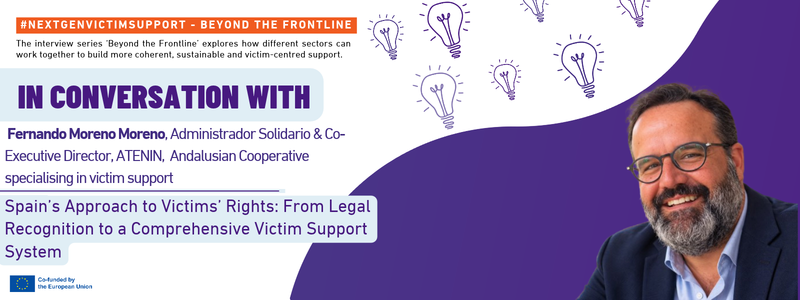
Fernando Moreno Moreno is a Spanish victim-support professional and co-director of ATENIN, a social-interest cooperative providing victim assistance and mediation services in Andalusia. Since 2005, he has coordinated the Victim Assistance Service in Andalusia (SAVA) in Huelva, having been involved in its development from its early days as a university project. With more than two decades of experience, he has witnessed the evolution of Spain’s victim-support system, from a time when cooperation with courts had to be negotiated to one in which victims’ procedural rights are increasingly recognised in law and practice.
In this conversation, Moreno reflects on the development of victims’ rights in Spain, the impact of the 2015 Statute of the Victim of Crime, and the role of support services in translating legal protections into meaningful assistance. He discusses institutional cooperation, access to justice, secondary victimisation, support for vulnerable groups, compensation, restorative justice and the use of technology. He also considers Spain’s position within the European landscape and the challenges ahead, highlighting the need for stable resources, specialised services and victim-centred spaces in every courthouse. At the heart of the discussion is a fundamental question: how can justice systems ensure that victims are treated not merely as witnesses, but as people whose needs, dignity and voices matter?
Setting the scene
Fernando Moreno Moreno: Marina, I am speaking to you from Huelva, from SAVA, the Victim Assistance Service in Andalusia (Servicio de Asistencia a Víctimas en Andalucía), whose team I have coordinated since January 2005. But my story with this service begins a little earlier.
In 2002, I was doing my PhD at the University of Huelva, attached to the Department of Criminal Law and the Andalusian Inter-University Institute of Criminology. That university team was responsible for designing the SAVA office in Huelva, selecting its staff, preparing their training and supervising its launch. I was not part of the first frontline team, but was involved in its coordination from the university.
In 2004, the savings banks that funded the project withdrew, and the Andalusian Regional Government (Junta de Andalucía) decided to put the service out to public tender. One of the professionals, who was a civil servant, returned to his post. The other three colleagues — a lawyer, a psychologist and a social worker, all criminologists like me — and I set up a worker-owned cooperative of social interest: ATENIN. Since then, I have coordinated SAVA and co-directed the cooperative. Today, we are fifteen professionals: eight at SAVA and seven in our mediation services.
What was that world like? At first, judges were very reluctant to have us in the courthouse. We were intruders: victims, they said, were already being looked after by them. It took us a year, a lot of constant work and a couple of meetings with muffins and my famous square potato omelettes to achieve full cooperation.
Before the Victims’ Statute, we had to ask for everything as a favour: a screen, permission to enter the courtroom to accompany the victim… Today, these are rights. A judge can still refuse, but the logic has been reversed: now it is the judge who has to justify why not. And the Public Prosecutor’s Office has become used to asking us for reports on the conditions under which a victim’s statement should be taken, or on how the victim should take part in the proceedings. Not always, and not in every court, but today it is the norm. It is probably the development that has surprised me most.
Our space has also changed, though less than I would like. The four of us started in a single shared room with two screens; today, we have two offices for those of us working in the provincial capital and a room for interventions. It’s something. I keep fighting for more suitable spaces, but the courthouse in Huelva is very old, and there are too many interests at stake, and they are not always those of victims.
And what doesn’t change? We still need someone to be the voice of victims within the justice system. The system has still not fully understood that victims are more than qualified witnesses, and that to participate fully, they need complete information. Victims are capable of understanding even the problems of the justice system: delays, why a case is closed without a conviction, or why it is sometimes better to settle it through a plea agreement (conformidad). If these things were explained to them, the vast majority would understand, and their sense of justice would not be frustrated. But some judges and prosecutors — not all — still prefer to keep their distance from the humanity involved in speaking directly to them.
A journey into victims’ rights
Fernando Moreno Moreno: Marina, I am speaking to you from Huelva, from SAVA, the Victim Assistance Service in Andalusia (Servicio de Asistencia a Víctimas en Andalucía), whose team I have coordinated since January 2005. But my story with this service begins a little earlier.
In 2002, I was doing my PhD at the University of Huelva, attached to the Department of Criminal Law and the Andalusian Inter-University Institute of Criminology. That university team was responsible for designing the SAVA office in Huelva, selecting its staff, preparing their training and supervising its launch. I was not part of the first frontline team, but was involved in its coordination from the university.
In 2004, the savings banks that funded the project withdrew, and the Andalusian Regional Government (Junta de Andalucía) decided to put the service out to public tender. One of the professionals, who was a civil servant, returned to his post. The other three colleagues — a lawyer, a psychologist and a social worker, all criminologists like me — and I set up a worker-owned cooperative of social interest: ATENIN. Since then, I have coordinated SAVA and co-directed the cooperative. Today, we are fifteen professionals: eight at SAVA and seven in our mediation services.
What was that world like? At first, judges were very reluctant to have us in the courthouse. We were intruders: victims, they said, were already being looked after by them. It took us a year, a lot of constant work and a couple of meetings with muffins and my famous square potato omelettes to achieve full cooperation.
Before the Victims’ Statute, we had to ask for everything as a favour: a screen, permission to enter the courtroom to accompany the victim… Today, these are rights. A judge can still refuse, but the logic has been reversed: now it is the judge who has to justify why not. And the Public Prosecutor’s Office has become used to asking us for reports on the conditions under which a victim’s statement should be taken, or on how the victim should take part in the proceedings. Not always, and not in every court, but today it is the norm. It is probably the development that has surprised me most.
Our space has also changed, though less than I would like. The four of us started in a single shared room with two screens; today, we have two offices for those of us working in the provincial capital and a room for interventions. It’s something. I keep fighting for more suitable spaces, but the courthouse in Huelva is very old, and there are too many interests at stake, and they are not always those of victims.
And what doesn’t change? We still need someone to be the voice of victims within the justice system. The system has still not fully understood that victims are more than qualified witnesses, and that to participate fully, they need complete information. Victims are capable of understanding even the problems of the justice system: delays, why a case is closed without a conviction, or why it is sometimes better to settle it through a plea agreement (conformidad). If these things were explained to them, the vast majority would understand, and their sense of justice would not be frustrated. But some judges and prosecutors — not all — still prefer to keep their distance from the humanity involved in speaking directly to them.
Understanding Spain’s approach to victims’ rights
Marina Kazakova, VSE: Spain has developed a comprehensive victims’ rights framework rather than a single national victims’ rights strategy. If you had to explain Spain’s approach to someone unfamiliar with the system, how would you describe it?
Fernando Moreno Moreno: I would say that Spain does not have a single national strategy, but rather a common legal framework that has developed very differently from one territory to another.
The cornerstone is the 2015 Statute of the Victim of Crime, through which Spain transposed the 2012 EU Victims’ Rights Directive. The Statute places the Victim Assistance Offices (Oficinas de Asistencia a las Víctimas) at the centre of victim support — almost exclusively so. The problem is that each autonomous community with powers over justice then organises those offices and their resources, either with the administration’s own staff or by contracting organisations like ATENIN, which run a service that remains public.
In practice, we could also speak of three categories of victims, each with its own law: victims of terrorism (Law 29/2011); victims of gender-based violence (Organic Law 1/2004) and now also of sexual violence (Organic Law 10/2022); and all other victims, to whom the Statute applies in general. Cutting across all of them, there is reinforced protection for particularly vulnerable victims, above all children and adolescents, who have their own specific law (Organic Law 8/2021 on the comprehensive protection of children and adolescents against violence).
Specialised organisations follow the same map: they are concentrated in gender-based violence and, earlier on, in terrorism, as well as in trafficking. That is why Article 28 of the Statute is so important: it gives the offices the role of coordinating all other support services. In practice, it makes us the meeting point for all of them.
Because powers over justice are shared with the autonomous communities, there is not always a single counterpart, and each region has its own plans and priorities. In Andalusia, for example, the Justice Strategic Plan 2030 took victims’ needs into account, though perhaps not as much as I would have liked. And all of this is happening while the system adapts to the 2025 reform of the organisation of the courts, which is transforming it profoundly.
Marina Kazakova, VSE: The Statute of the Victim of Crime (Estatuto de la Víctima del Delito) was an important milestone in recognising victims as rights-holders. What practical difference has this legislation made for victims in Spain?
Fernando Moreno Moreno: For me, the right that has most changed victims’ real experience is the right to be accompanied, in any police or court procedure, by a person they trust: it can be us or whoever they choose. That gives them a sense of security. Has their position in criminal proceedings changed? Yes, a great deal: as I said at the beginning, we used to have to ask for everything as a favour, and today these are rights, so it is the judge who has to justify not applying them.
What remains words on paper is the idea that the victim is at the centre of the system. Less and less so, or so I like to think. But once the system starts rolling, it becomes dehumanised, and legal professionals are not always sensitive to victims’ needs — starting with their time. One example: after a complaint of gender-based violence, despite all the awareness around the issue, every victim is summoned to court first thing the following morning. They arrive at 9 a.m., and many do not leave until 3 p.m. or later. It is not always necessary for them to be there from 9 a.m.; it is simply more convenient for the court and its organisation.
Marina Kazakova, VSE: A victim may have many legal rights, but the real test is whether those rights are experienced in practice. How does Spain ensure that victims understand and can exercise their rights?
Fernando Moreno Moreno: On paper, the Statute requires victims to be informed of their rights from their first contact with the authorities, and in a way they can understand. In practice, whether that information arrives in time and is understood depends above all on there being someone to explain it. And there isn’t always. The forms setting out victims’ rights keep getting longer, but in many cases the police simply hand them over: they neither explain them nor allow time to read them — although it is hardly the best moment to do so — and the victim just signs to say they have been informed. That is the day-to-day reality.
In cases of gender-based violence, information arrives early because we do not wait for victims to come to us: we are at the court right after the complaint is filed, and sometimes from the day before. For other crimes, it depends on someone opening the door: the police referring the person to us before they report, the prosecutor or the court calling us in, social or health services, or a talk where they heard about us. When nobody does, everything stays on that signed piece of paper.
Are procedures understandable for people without legal knowledge? On their own, no. Explaining them is a large part of our work.
The barriers that remain lie not so much with victims as with the system itself: schedules designed around the court’s organisation rather than around the person, postponements that nobody warns them about in time, and decisions taken without involving them.
For me, this variety of entry points is what makes rights real: information and support are only useful if someone is there, in the place and at the moment the person needs them, not when it suits the system.
Coordination between institutions
Marina Kazakova, VSE: Victims often interact with police, courts, prosecutors, healthcare providers, social services, and support organisations. How effective is coordination between these different actors in Spain?
Fernando Moreno Moreno: In gender-based violence, coordination works well. We have a very good relationship with judges, prosecutors, lawyers and court representatives, with the National Police, local police forces and the Guardia Civil, with social services and with specialised gender-based violence services. There are occasional mismatches, and everything can be improved, but there, coordination is not our problem.
That is because gender-based violence has its own protocols, referral pathways and resources. For other forms of victimisation, there are no specific protocols or pathways, except — recently and tentatively — for hate crimes and trafficking. Victims of terrorism have always been dealt with separately, with their own law and their own state structures. So, to the question of whether we work as one system, the answer is that we work as several parallel systems depending on the type of victim, and for other victims, everything depends much more on the professionalism of each individual.
Personally, I prefer good practice to protocols, but what we lack is time, and sometimes everything rests on goodwill.
The 2025 reform of the organisation of the courts is another matter. It is still too early to assess it, but so far, all it has brought is organisational chaos. We’ll see.
Marina Kazakova, VSE: Spain has Victim Support Offices (Oficinas de Asistencia a las Víctimas del Delito). How effective are these structures in ensuring that victims receive comprehensive support?
Fernando Moreno Moreno: Different models coexist in Spain. The great strength of the Andalusian model, from the outset, has been the specialisation of its teams and the fact that their profiles include criminology: the victimological perspective is essential. In the Ministry’s offices, by contrast, the profile has traditionally been more administrative than specialised: for a long time, in quite a few of them, the post was held by a court clerk who received, informed and referred victims, but did not support them in the sense that we do in Andalusia.
I believe Andalusia has one of the best victim assistance systems in terms of its professional model — though not the only one.
Are they accessible across all territories? Coverage is very uneven. Except in the Valencian Community, which has a network of offices spread across its whole territory, elsewhere the service operates in the provincial capitals and only tentatively beyond them. In Andalusia, territorial expansion began in 2019, but it does not reach the whole territory equally or all the time: there are no permanent offices in every judicial district. In that sense, Huelva is a privileged province: we have few judicial districts, and we cover them all.
The price of our model is dependence. If we were civil servants, we would be independent of pressure. If we were funded through non-earmarked grants or from several sources, we would be free to set our own objectives and alliances. But we depend on public tenders, and that makes us hostages to short-term political decisions: each set of tender specifications decides what we do, how we do it and for how long. It also fragments us: each province has its own contract, its own timetable and sometimes its own provider, which makes it very difficult to build a common voice, both in Spain and within Andalusia itself. That is why what would most strengthen the impact of the offices is stability: permanent offices in every judicial district, specialised teams in all of them, and funding that does not depend on each tender.
Preventing secondary victimisation
Marina Kazakova, VSE: Many victims experience additional harm when navigating justice and support systems. How does Spain address the risk of secondary victimisation?
Fernando Moreno Moreno: The law provides tools. The Statute provides for an individual assessment of each victim’s protection needs and for specific measures during proceedings: avoiding visual contact with the accused, giving evidence by videoconference or, for children, pre-recorded evidence. In Huelva, that assessment often goes through us: the prosecutor’s office asks us for a report on the conditions under which the victim should give evidence.
As for training, our team is well prepared: the psychologists through their specialisation; the rest of us thanks to criminology and our personal and professional commitment to training in these areas. Judges, prosecutors and police officers, on the other hand, have practically none: it is neither required nor demanded of them.
But secondary victimisation does not only happen in the courtroom. It still makes me angry that victims are not consulted when a plea agreement is being negotiated, neither by their own lawyers nor by the prosecutor. Or that hearings which were predictably going to be postponed are postponed, and nobody remembers to tell the victim until the last minute. These are small things for the system and enormous ones for someone who has spent weeks preparing for that day.
On the other side of the scale is Auva, our courthouse facility dog programme. It is incredible how children change before, during and after giving evidence when they are playing with the dogs. Many do not want to leave the courthouse once they have finished, because they are having a good time. And that is what they will remember of their time in court — not the questions asked during the pre-recorded evidence session in the Gesell room (a child-friendly interview room with a one-way mirror).
And not only them. Their parents, who have to wait outside while the child gives evidence, notice it too: with the dogs they are more relaxed, chatting calmly with us, less anxious. There is no comparison. You can tell.
Vulnerable victims and specialised support
Marina Kazakova, VSE: Different victims require different forms of protection and assistance. How does Spain adapt support for children, victims of gender-based violence, victims of sexual violence, elderly victims, persons with disabilities, migrants and other vulnerable groups?
Fernando Moreno Moreno: We do not do it equally well for every group. With children, the key is preparing their testimony carefully, pre-recorded evidence and, in our case, Auva. In gender-based and sexual violence cases, we are present proactively every day in the specialised courts. With migrants, the barrier is less the language, which is addressed with interpreters, than culture. In Huelva, with women seasonal farmworkers, especially in the Andévalo area, we coordinate with organisations that run intercultural mediation programmes. In fact, we met the colleague who has just joined SAVA precisely while he was working on one of those programmes — and now he is on our team.
With older people, the problem is usually bureaucratic: processing long-term care (dependency) benefits. With persons with disabilities, we have improved a great deal thanks to the procedural facilitator, an expert who adapts communication so that the person can understand and be understood during the proceedings.
Are there enough specialised services? For gender-based violence, many more than for everyone else. And there is one group that always remains out of focus: victims of hate crime. They are still undervalued: it is very hard for them to recognise themselves as victims, and even harder to be recognised as such. Equal access, at present, simply does not exist.
Gender-based violence and victim protection
Marina Kazakova, VSE: Spain is often recognised internationally for its work on gender-based violence. What lessons can Spain’s experience provide in terms of protecting victims and building specialised support systems?
Fernando Moreno Moreno: What has worked is specialisation and networked work around each case. There are specialised courts for violence against women; in Huelva, they have their own waiting room. Protection orders are sent to a coordination point — in Huelva, that is us — which activates support. And VioGén, the Ministry of the Interior’s system, allows police, courts, prosecutors and assistance services to share the risk assessment and follow-up of each case; as SAVA coordinator, I have access to it. Today, we work in the same way with victims of sexual violence, in line with the approach of the Istanbul Convention.
In practice, this means we are at the court right after the complaint is filed, coordinating with the judge, the prosecutor, the forensic doctor and the victim’s lawyer. Sometimes even from the day before, because the police or the Guardia Civil warn us about a particularly complex case; on occasion, we have gone straight to the Guardia Civil station.
Challenges remain: inertia, such as the hours-long waits at court I mentioned earlier, and a social regression that worries me and that I will come back to at the end.
What can other forms of victimisation learn? Precisely that model: specialisation, dedicated resources and coordination around each case. Because today, let us be clear, other victims are second-class victims: they have fewer specialised resources and less financial support, or smaller amounts. The only law that establishes general public financial aid for all victims, Law 35/1995, is completely outdated. Gender-based violence is light years ahead of the rest.
Accessibility and reaching all victims
Marina Kazakova, VSE: A victim support system can only work if people can access it. How accessible are victim support services in Spain?
Fernando Moreno Moreno: It depends a lot on where you live. In Huelva, since 2019, we have reached every judicial district in the province with multidisciplinary teams, but the province has very different realities.
In rural areas such as the Sierra, the population is extremely dispersed. Aracena is a small judicial district with only two courts. There, we focus more on coordinating with local services than on providing direct support through our own professionals. We travel there regularly, and whenever a case requires it for a specific court proceeding. But it is better not to make victims travel to the court in Aracena, because sometimes even that is difficult from their villages. Coordination and more coordination, including with the local Guardia Civil.
We overcome language barriers with the court’s official interpreting service. Since last year, we can also call the interpreter directly for support sessions that are not court appearances; before, we had to ask the court to book her for us. There is an Arabic interpreter every day, and for less common languages, there is a telephone interpreting service. It is less convenient, but it is something.
Digital exclusion is not our main problem today, because our support does not depend on digital channels: it is face to face or, at most, by phone.
Victims who do not report are supported just the same: the Statute does not make assistance conditional on reporting. My first case, in fact, was a woman who never reported.
And for people who do not know where to seek help, what matters is having many entry points: some go to the court for information and end up in our office; others are referred by the police or social services; others heard us at a talk.
Victim participation in justice processes
Marina Kazakova, VSE: Modern victims’ rights frameworks recognise victims as active participants, not only witnesses. How does Spain ensure that victims’ voices are heard throughout criminal proceedings?
Fernando Moreno Moreno: Whether victims are informed about how their case is progressing depends, once again, on someone explaining it to them. They are capable of understanding even the problems of the justice system; if they are not told, what remains is the feeling that the system decides without them.
Do they have real opportunities to participate? More than before. The right to be accompanied by a person they trust has changed things a lot, and the prosecutor’s office increasingly asks us for reports on how the victim’s statement and participation should be arranged. But what still fails most is what happens when the victim is not in the room: plea agreements are still negotiated without speaking to them.
What would I improve? Three things: talking to the victim before closing a plea agreement, informing them in time when a hearing is postponed, and genuinely developing restorative justice. ATENIN also runs the adult criminal mediation service, which is separate from victim assistance, and I see many cases — interpersonal conflicts between family members or, even more so, between acquaintances — in which a punitive criminal response does not help, and what does help is understanding why what happened happened. That dialogue is, in itself, reparative and healing. And it does not take place in ordinary criminal proceedings.
Compensation and access to remedies
Marina Kazakova, VSE: Victims may face financial consequences after experiencing crime. How easy is it for victims in Spain to access compensation and other remedies?
Fernando Moreno Moreno: On paper, victims are entitled to compensation from the convicted person. In practice, if that person is insolvent, the victim receives nothing. And there is nothing else, apart from the public aid provided under Law 35/1995 on aid and assistance to victims of violent crimes and crimes against sexual freedom, whose scope is very limited. Curiously, it is the same law that, in Article 16, formally — though not in practice — created the victim assistance offices.
The aid only covers intentional violent crimes — crimes of negligence are excluded — that cause death or serious injury, as well as sexual violence. And the law defines serious injury as a permanent disability of at least 33% or a temporary incapacity lasting more than six months. That 33% must be caused by the crime itself; in other words, it is added to any disability the person already had. It is a very high bar: most cases are left out.
On top of that, there is the deadline to apply: one year, which is suspended while the criminal proceedings last and resumes when the final decision is notified. Only for sexual and gender-based violence, following a recent reform, is the deadline five years. Again, many cases are left out.
So, is it easy? No. At SAVA, we inform victims about this aid and help them apply, but the barriers lie in the law itself: the offender’s insolvency, very restrictive requirements and short deadlines. It is a completely outdated law that needs thorough reform and a wider scope.
Technology and innovation in victim support
Marina Kazakova, VSE: Technology is increasingly changing how victims access information, support, and justice. How is Spain using digital tools to improve victim support?
Fernando Moreno Moreno: If I think of technology that has really changed something, I would give three examples. VioGén, which allows police, courts, prosecutors and assistance services to share the risk assessment in gender-based violence cases. Giving evidence by videoconference, which spares the victim from encountering the accused. And telephone interpreting, which allows us to support people in less common languages.
In our day-to-day work with victims, however, technology is very basic: the telephone, at most. Since the pandemic, we have used video calls a little more, but only marginally. Support is still face to face, and I believe it should stay that way.
On privacy and dignity, VioGén is a good example: it is useful precisely because access is restricted to specific roles — in our case, to the coordinator.
Artificial intelligence, for now, is more a problem than a solution. For our work, I do not yet see the point. What we have noticed over the past year is a clear increase in first-contact emails obviously written with AI: veritable lists of demands in which nothing is left unrequested, but which give almost no information about the real problem behind them. And that is exactly what we need: to understand what has happened to that person.
Spain in the European context
Marina Kazakova, VSE: Looking at developments across Europe, from Portugal’s National Framework for Victims’ Rights to the Netherlands’ Multi-Year Agenda for Victim Policy, how does Spain compare?
Fernando Moreno Moreno: Portugal and the Netherlands have something we do not have in Spain: a national framework or agenda with its own objectives for victims. Here, we have a common law, the Statute, and very different realities depending on the territory. And, from what I have seen over the years, Spain is quite isolated from the rest of Europe in this field — and so is ATENIN, in our corner of south-western Europe.
What is particularly strong in the Spanish model? Specialisation in gender-based violence and, in SAVA’s case, our position within the justice system. We are inside the courthouses, we are part of the daily life of courts and prosecutors’ offices, and the Victims’ Statute, in Article 28 — my favourite — gives us two key functions: coordination with judges, courts and prosecutors, and coordination of all other support services. That puts us in a very good position to work with victims.
What could we learn from abroad? ATENIN has been a member of Victim Support Europe for more than ten years, and in European exchanges I have seen the dynamism of many larger organisations, which can rotate the staff working in direct support and take better care of their professionals. Our structure does not allow that. Exchanges are always enriching: in fact, we copied Auva from the European FYDO project (Facility Dogs in Europe), whose conclusions we heard at the VSE conference in Berlin some years ago.
And what could inspire others? Above all, being inside the system: being a real part of it, rather than standing opposite it or being made to feel that way. I know that our opinions are valued as those of a colleague, not as those of an organisation external to the justice system. That is why SAVA’s role works: being able to tell a court, on our own initiative and through a needs report, how a victim’s appearance should be arranged — and the court having, at the very least, to listen.
Future challenges
Marina Kazakova, VSE: Looking ahead, what are the biggest challenges for victims’ rights in Spain?
Fernando Moreno Moreno: I don’t want to be alarmist, but I don’t want to be naïve either. I did not expect the social regression we are experiencing: the decline of feminism among young people, the return of a senseless punitive approach, the loss of class consciousness and rampant xenophobia in a land of emigrants like Spain. We keep making progress in legislation, and I would say, tentatively, in resources, but we are going through a dark period. So, if I have to choose, the challenge lies not so much in legislation as in resources and their real-world implementation.
And this shows in very concrete things. To give a local example: in Huelva, with the judicial reform, there are plans to move the duty court to the ground floor of the courthouse; until now, duty has been handled at the premises of whichever court is on duty. But, as far as we know, there will be no separate waiting room for victims and accused persons — perhaps no waiting room at all, just the main hall. Victims of gender-based violence, who are seen on that same floor, do have a specialised court and a waiting room: small, but they have one. We also have our own office there to support them, although SAVA is on the fifth floor; there are plans to take it away from us too, though this has not yet been confirmed. I fear that the gap between gender-based violence and other victims may end up closing from the bottom rather than the top. Perhaps all victims will end up being second-class. I still hold on to a little hope that this will not happen; by the time this interview is published, we will know.
That is why, if I had to choose one single priority for the next decade, it would be spaces: designing and providing suitable spaces for victims — safe and confidential — in every courthouse. There are good examples. This summer, the Andalusian Regional Government opened a waiting room in Seville for victims of gender-based violence, designed to reduce stress and anxiety, with a children’s area and a breastfeeding area. But it is a drop in the ocean. What we need is for that to be the norm in every courthouse, and for all victims.
Marina Kazakova, VSE: If we return in five years and ask victims themselves whether Spain’s system has improved, what is the one change you would hope they describe?
Not institutions.
Not professionals.
Victims.
What would you want them to say?
Fernando Moreno Moreno: The best thing I could hear in five years’ time would be a victim who never needed us, because the court had already treated them as it should. I have always thought that SAVA should not need to exist: if everything worked the way the law says it should, we would not be needed.
Until that day comes, I would settle for more people being able to say: “They helped me understand what was happening to me, and I had someone I could count on for as long as I needed.”
