
EU Day for Victims of Crime 2026: VSE Pushes Next Phase of 116 006 Implementation
Since our establishment in 1990, Victim Support Europe has worked to ensure that victims’ rights are not only recognised in law, but realised in practice. In 2026, that mission takes on renewed urgency. As the European Commission finalises the revision of the Victims’ Rights Directive and the European Parliament moves toward approval, we stand at a fundamental moment for victims across the European Union.
What better occasion, then, than the International Day for Victims of Crime to focus on one of the Directive’s most important commitments: the establishment of clear guidelines for the 116 006 helpline — a single European number to support all victims of crime.
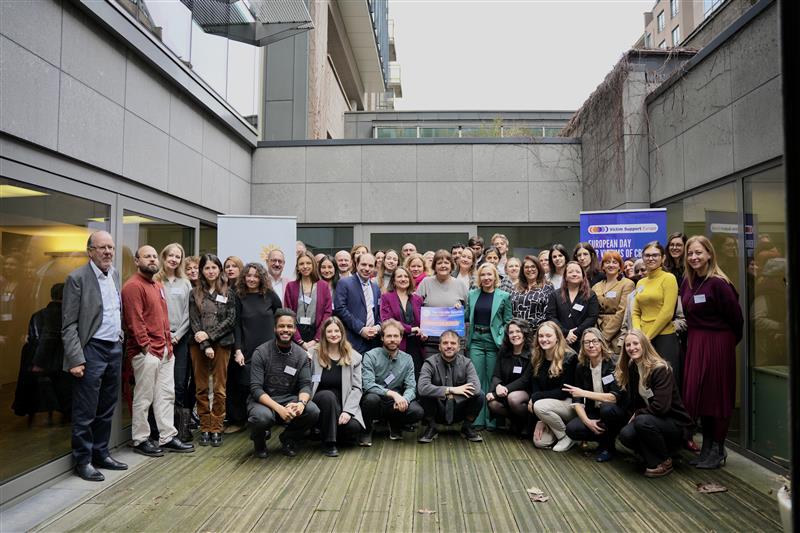
On 20th February, Victim Support Europe, with the support of the Cyprus presidency of the Council of the European Union, hosted a high-level symposium at the Press Club Brussels Europe. Bringing together policymakers, practitioners, victim support organisations and survivors, the event centred on one powerful idea: one number, accessible to all victims, regardless of background, sex, age or nationality.
Opening the symposium, Polina Efthyvoulou, Attorney of the Republic of Cyprus and Head of the Public Prosecutor, delivered a strong message of support. She reaffirmed the Cypriot Presidency’s commitment to advancing victims’ rights and underlined the importance of 116 006 as a crucial first point of contact for victims — a concrete way to translate legal provisions into real-life protection.
”For many victims, a helpline is the first point of contact. It is often the moment when someone finally feels able to speak, to ask for help, or simply to be heard.
Polina EfthyvoulouAttorney of the Republic of Cyprus and Head of the Public Prosecutor
This was followed by remarks from Katarzyna Janicka-Pawlowska, Coordinator for Victims’ Rights at the European Commission, who emphasised the significance of the revised Victims’ Rights Directive and the Directive’s commitment to ensuring robust standards for a universally recognised, harmonised 116 006 helpline across the EU.
”Member States are obliged to establish the necessary measures to establish easy to use, accessible, user friendly, secure, free of charge and confidential victim help lines.
Katarzyna Janicka-PawlowskaCoordinator for Victims’ Rights at the European Commission
VSE President Rosa Jansen concluded the opening segment by drawing on her experience as a judge. She reflected on the tangible difference that accessible helplines can make, citing the example of the Dutch children’s helpline as a powerful illustration of how a single number can serve as a lifeline — offering safety, clarity and immediate support at a moment of crisis.
”It's very important that we make sure that this victim's helpline reaches every corner of Europe and no victim must be left behind.
Rosa JansenVSE President
The symposium then shifted from policy to personal experience.
In a moving video contribution, Ruth Maxwell shared how access to the 116 006 helpline made a profound difference in her recovery following a random knife attack. Her testimony reminded the audience that behind every legislative article and policy discussion lies a human story.
This was followed by a powerful intervention from Ayleen Charlotte — known publicly for her testimony in the “Tinder Swindler” documentary — who described how sharing her story became instrumental in securing recognition of her rights as a victim. She highlighted the importance of sustained funding for helplines and warned against budget cuts on this essential service.
”I know we live in a world where we have budgets, but please don't have budgets on victims.
Ayleen CharlotteVictim Advocate
The second section of the symposium broadened the discussion, exploring the realities behind running helplines.
Lea Meindre-Chautrand of Missing Children Europe underscored the importance of accessibility and anonymity, noting that many victims still hesitate to come forward. She emphasised the need for multiple points of access — including chat functions and digital tools — particularly for younger generations. Individual testimonies, she argued, move policymakers emotionally; data, meanwhile, reveals patterns and strengthens policy recommendations.
Irina Ionita, representing La Strada International, addressed the specific challenges of operating helplines in the context of human trafficking. She stressed the importance of documenting and publishing cases and data, ensuring that victims’ stories reach policymakers and inform systemic change.
Annick Deblauwe of the Flemish Reporting Point for Transgressive Behaviour, demonstrated how data collection allows organisations to adapt services, cross-reference cases and provide more targeted support. She highlighted a simple but crucial principle: even when victims call the wrong number, they should be redirected seamlessly, without additional burden or confusion.
Aleksandra Ivankovic, Deputy Director of Victim Support Europe, reminded participants that 116 006 currently exists in only 14 Member States. She stressed the importance of establishing minimum quality standards and explained how a harmonised number across Europe can strengthen trust — ensuring that victims know where to turn, wherever they are.
The third session turned to national experiences.
Siiri Urbas, from the Estonian Social Insurance Board, provided a compelling account of the cultural barriers to help-seeking in Estonia, where reaching out for support has historically been stigmatised. Through full government funding, however, Estonia’s helpline is able to provide comprehensive services — including chat and video counselling, multilingual support, and sustained accompaniment throughout the call — ensuring victims are not left alone at their most vulnerable moment.
Maja Štahan of Victim and Witness Support Service Croatia described how persistence and long-term advocacy allowed Croatia’s helpline to gain visibility and become a well-established and trusted service within the national context.
Carmen Rasquete of Victim Support Portugal (APAV) highlighted the importance of formal government recognition and sustained institutional support, echoing a message repeated throughout the day: effective helplines require stable, long-term funding.
The symposium concluded with remarks from Jérôme Moreau, Vice President of Victim Support Europe and spokesperson of France Victimes. He noted that the French 116 006 helpline receives more than 72,000 calls per year — a success made possible through strong communication campaigns and an interdisciplinary approach combining psychologists, victim support specialists and social workers.
His message was clear: it is no longer acceptable that only 14 countries operate the 116 006 number.
The purpose of the day was not simply to reflect — but to send a strong message.
A harmonised 116 006 helpline is not an administrative detail. It is a promise: that no victim, anywhere in Europe, will be left without a door to knock on.
We owe it to victims to ensure that when they reach out, someone answers.
