

Gerttu Aavik
28 August 2026
Estonia’s 2026 Violence Prevention Awards recognised Dr Helen Riimus from Estonian Forensic Science Institute and a healthcare initiative developed with Dermtest for strengthening the recognition, documentation and support of victims of violence.
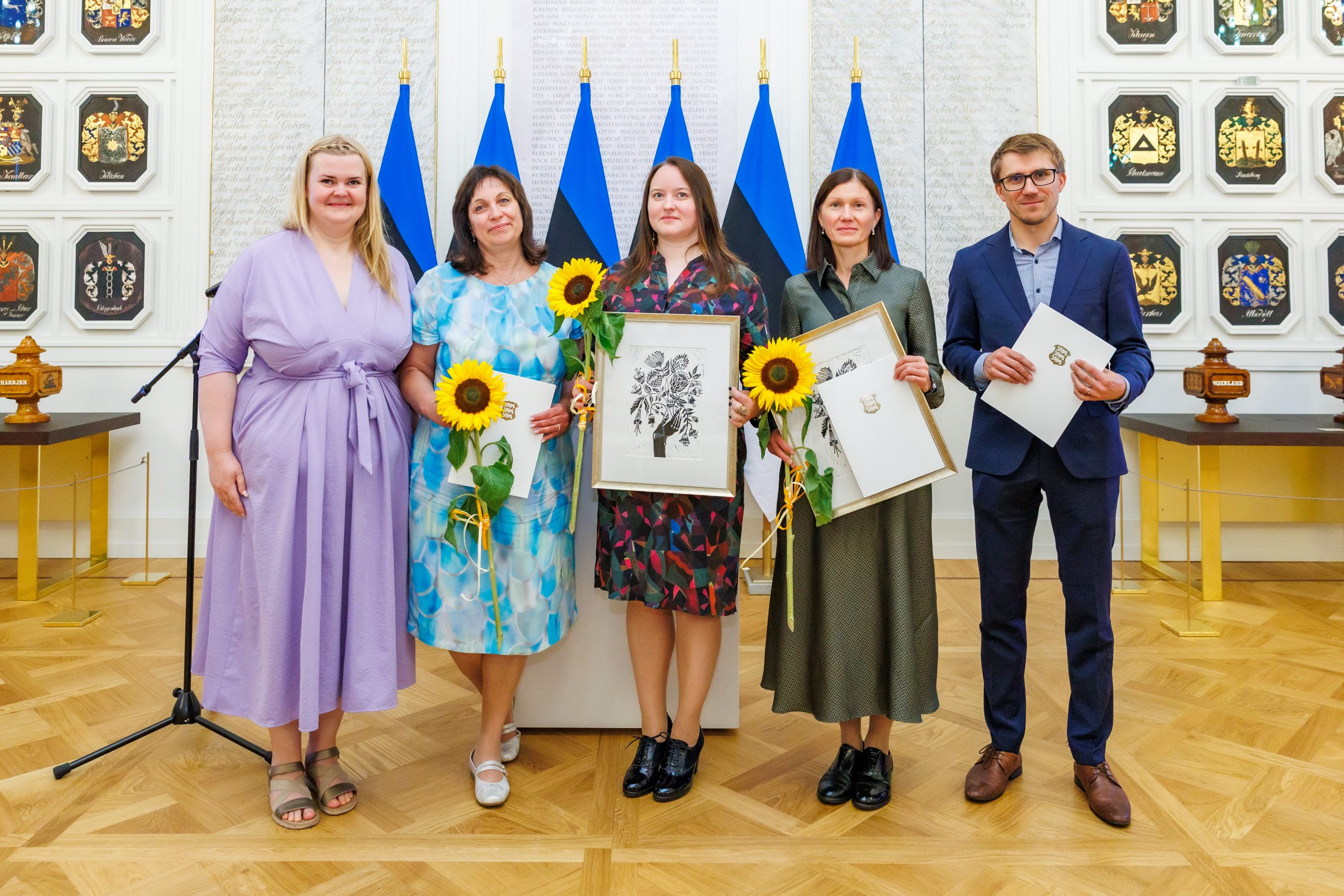
Award ceremony group photograph (Photo credit: Arno Mikkor / Office of the President of the Republic of Estonia)
On 27 August 2026, President of Estonia Alar Karis and Minister of Justice and Digital Affairs Liisa Pakosta presented Estonia’s annual Violence Prevention Awards, recognising 22 individuals and initiatives for their contribution to preventing violence and supporting victims. Among this year’s recipients were Dr Helen Riimus from Estonian Forensic Science Institute and dr. Marit Märk, Kai Kuuspalu and Priit Kruus an initiative strengthening trauma-informed practice and the visual documentation of injuries in the emergency department of the North Estonia Medical Centre in cooperation with Dermtest.
“Without courage, there is no freedom.”
— President Alar Karis, at the award ceremony (translated from Estonian)
Dr Helen Riimus: strengthening professional practice
Dr Helen Riimus was recognised for her contribution to the IMPACT project, where she has trained healthcare professionals at the emergency departments of the North Estonia Medical Centre and Tallinn Children’s Hospital. Her training has focused on how to recognise, describe, document and photograph injuries, and on the information that is essential when injuries may be related to violence. Crucially, the sessions place documentation in the wider context of a victim’s journey: high-quality records are not simply a medical or technical task. They can influence how injuries are understood later and can support a victim’s subsequent protection, access to assistance and ability to exercise their rights.
Dermtest pilot: making visual documentation part of trauma-informed care
The awards also recognised dr. Marit Märk, Kai Kuuspalu and Priit Kruus for the initiative “Developing a trauma-informed approach and visual injury documentation in the emergency department of the North Estonia Medical Centre in cooperation with Dermtest”. The initiative forms part of the practical work carried out in Estonia under IMPACT to strengthen the healthcare sector’s response to victims of violence.
North Estonia Medical Hospital emergency department has been piloting functionality within Dermtest Pildivaatur that enables bodily injuries to be documented quickly, securely and visually with the patient’s consent. The approach supports more systematic documentation alongside victim-centred and trauma-informed care, and the resulting records may also be important if evidence is needed at a later stage.
The value of the pilot lies not only in the technology itself, but in how it is integrated into clinical practice: recognising possible violence, treating the patient safely and with dignity, documenting injuries consistently and explaining options for further support. The North Estonia Medical Centre’s willingness to develop a more systematic approach demonstrates that violence prevention and victim support can be understood as part of healthcare quality and patient-centred care.
Why this matters for victims
In Estonia, one of IMPACT’s central priorities is to strengthen cooperation with the healthcare sector. The project supports the development and piloting of practical tools, professional training and better pathways for identifying and supporting victims, with the broader aim of improving access to assistance and reducing secondary victimisation.
The recognition of both Dr Helen Riimus and the visual documentation initiative highlights two complementary parts of this work: professional knowledge and practical systems. Training helps healthcare professionals understand what to look for and why documentation matters; secure digital tools help make good practice easier to apply consistently in real clinical settings.
“Violence is never inevitable or a private matter.”
— Minister of Justice and Digital Affairs Liisa Pakosta (translated from Estonian)
This message is particularly relevant to healthcare. For many victims, a healthcare professional may be among the first people in a position to notice signs of violence. Ensuring that professionals have the confidence, knowledge and tools to respond can therefore make a tangible difference to what happens next.
Congratulations to Dr Helen Riimus, Dr. Marit Märk, Kai Kuuspalu and Priit Kruus and thank you to all the healthcare professionals and partners contributing to this work.
About IMPACT
The IMPACT project (2024–2026) develops victim-support systems in Estonia, Malta and Portugal. In Estonia, it is implemented in cooperation between the Ministry of Justice and Digital Affairs, the Ministry of Social Affairs and Victim Support Europe. The project is funded through the EU Technical Support Instrument.
Sources and photo
- Ministry of Justice and Digital Affairs: 2026 Violence Prevention Awards
- Ministry of Justice and Digital Affairs: IMPACT / Protection of Crime Victims in Estonia
- Office of the President of the Republic of Estonia: award ceremony press release
- Official award ceremony photo album
Editorial note: The two quotations have been translated from the original Estonian for this English-language publication draft.
